


How can I reduce cyanobacteria in an aquarium?
How to reduce cyanobacteria in an aquarium? Cyanobacteria represent a nightmare for aquarium hobbyists. This is because their development and proliferation within an environment release highly harmful cyanotoxins that eventually suffocate an aquarium.
Cyanotoxins are potentially dangerous to aquarium fauna. They become lethal when they form deposits on top of aquatic plants because they prevent all chlorophyll activity in the latter.
The presence of cyanobacteria generally causes significant damage within an aquarium. Whether in freshwater or saltwater, cyanobacteria severely affect the morale of aquarists because they are difficult to reduce due to their resistance and mode of reproduction. Usual cleaning techniques are generally ineffective for reducing them. A small fragment is enough for cyanobacteria to reform a thick biofilm.
Appearance of cyanobacteria
Also known as blue-green algae or slime algae, cyanobacteria behave as both bacteria and algae. They can have a reddish-brown or blue-green appearance. They most often appear very slowly in the form of small tufts or patches. Afterwards, they spread and expand very quickly to the point of covering the entirety of an aquarium. If you notice the presence of cyanobacteria in your aquarium, you must quickly define action plans to reduce them immediately, but also to prevent them from growing in the future.
Origin and description of cyanobacteria
Cyanobacteria are very ancient living beings that have existed since the Precambrian in very simple forms. In short, their existence began 3.8 billion years ago in less complex forms than today.
The presence of cyanobacteria is even supposed to have favored the existence of certain life forms on Earth in the Precambrian—life forms for which we have no fossils. There are more than 7,500 species of cyanobacteria, divided into more than 150 genera.
Cyanobacteria have the ability to live in almost any environment, whether on land, in freshwater, or in saltwater. Generally considered algae, cyanobacteria are in truth bacteria. They do not have a cell nucleus and are particularly capable of fixing nitrogen from the atmosphere.
This ability to fix nitrogen is, however, not possible for a plant or an alga. For cyanobacteria, this nitrogen fixation capacity facilitates adaptation in any environment. Cyanobacteria reproduce solely by binary fission, splitting into two identical parts that will lead lives independent of each other.
Causes of the presence of cyanobacteria
Cyanobacteria generally have varied and diverse origins. They are most often caused by:
• An aquarium that is insufficiently or ineffectively maintained (for example, water that is not regularly changed)
• The decomposition of any organic waste from plants (dead leaves, stems, branches, etc.) within the aquarium water
• Aquarium water excessively rich in nitrogenous compounds resulting from the dissolution of organic matter, which feeds the cyanobacteria
• Remains of often unsuitable food that pollutes the aquarium water (food given to animals in excessive quantities)
• The decomposition of dead fish within the aquarium water
• High temperatures and the alkalinity of the water, which accelerate their development
• Copper infiltration into the aquarium water due to the use of medications and antibacterial treatments
• Lack of oxygen supply • Insufficient surface water movement
• Poor water circulation due to the existence of dead zones within an aquarium
• An imbalance in the NO3/PO4 ratio. It should be noted, however, that cyanobacteria are living beings that are always naturally present in an aquarium.
Cyanobacteria are therefore never absent. They are just waiting for the aquarium water to become imbalanced to proliferate. Also, cyanobacteria use nitrogen as food. They therefore tend to appear when aquarium water becomes enriched with nitrogenous matter.
Anticipating the appearance of cyanobacteria is very complex. This is because even in clean aquarium water (without nitrate and phosphate), cyanobacteria are capable of developing by feeding beforehand on organic phosphate.
Consequences of the presence of cyanobacteria in an aquarium
The effects of cyanobacteria on the water and the population of an aquarium are always devastating if appropriate measures are not taken to combat them. As mentioned earlier, when cyanobacteria spread in an environment, they release cyanotoxins.
These cyanotoxins are potentially dangerous, or even lethal, to the fauna and flora of an aquarium. The proliferation of cyanobacteria can suffocate the entire ecosystem of an aquarium.
Treatments against cyanobacteria
To reduce cyanobacteria, it is best to first remove the majority manually as much as possible. To do this, you must siphon them daily. In short, you must siphon up every last little bit, and you must carefully clean the substrate and decor that are contaminated.
Also, to combat cyanobacteria, you must diligently perform certain operations, which are:
• Perform frequent partial water changes as soon as the aquarium water becomes too rich in nutrients conducive to the development of cyanobacteria
• Clear the aquarium water of organic debris (dead leaves, stems, animal food scraps, etc.)
• Remove excess cyanobacteria clinging to the aquarium reservoir, notably by scraping it with scrapers or other tools available in pet stores
• Frequently perform careful cleaning of filters
• Use a protein skimmer in your aquarium (one of the major factors for cyanobacteria is the presence of organic debris such as dead leaves, food scraps, fish waste, etc., in the water column). Protein skimmers can be more effective than ordinary filters when it comes to eliminating this organic debris from aquarium water.
• Limit the amount of food given to fish by avoiding excesses (because food scraps contribute significantly to the rise in phosphate levels in aquarium water)
• Add aquatic plants to your aquarium that will not only feed on the same nutrients as the cyanobacteria but will also compete for sunlight with them.
• Limit your aquarium's exposure to light, because while light is essential for aquatic plants, it can also create an environment that promotes the growth of cyanobacteria
• Check the quality and intensity of the lighting
• Check the quality of your tap water
• Test the pH of your tap water
• Improve water movement within your aquarium
• Improve maintenance. Still with the goal of reducing cyanobacteria, one of the methods commonly used is a general blackout.
The blackout consists of depriving the aquarium and all its occupants of light by plunging the aquarium into total darkness for a minimum of 4 days. This method of combating cyanobacteria has proven effective for some people. You can also try a blackout if the plants in your aquarium are not fragile. Otherwise, while the absence of light will certainly decrease the development of cyanobacteria, it will inevitably cause a disaster among your plants. Sometimes, to counter the spread of cyanobacteria, a simple rebalancing of good bacteria can be more than enough.
To add live bacteria to your aquarium, you can obtain bacterial preparations that are generally available in stores or pet shops. Water quality can also be the basis for the development of cyanobacteria. For example, a low nitrate level promotes the multiplication of cyanobacteria. For this reason, you must check the concentration levels of your aquarium water. Specifically, you must ensure the maintenance of nitrate levels at reasonable levels of 5 to 10 mg/L.
To increase the nitrate levels of your aquarium water, you can choose solutions available in pet shops or stores. The development of cyanobacteria can also result from an NO3/PO4 imbalance (Redfield Ratio). In the event that the nitrate level of your aquarium water is below 5 mg/L, you have the option to add KNO3 (potassium nitrate) and PO4.
The Redfield Ratio advocates for the respect of the ideal ratio between nitrate and phosphate, which is 10 mg of nitrate per liter to 1 mg of phosphate per liter. An imbalance in this ratio can promote the development of cyanobacteria.
The use of chemicals to limit cyanobacteria is strongly discouraged: they can harm the aquarium's fauna and flora. If the problem persists despite these measures, seek advice from an aquarium professional or a veterinarian.
It should be noted that if you have several aquariums and one is contaminated with cyanobacteria, you must ensure you do not use the same cleaning equipment for your aquariums.
In short, a miracle solution to reduce cyanobacteria unfortunately does not exist. It is instead recommended that the aquarist seek out the precise causes of the cyanobacteria. They will then be able to eliminate the problem at its root.
Produits et rayons conseillés


Les produits conseillés par nos experts
Voir toute la sélection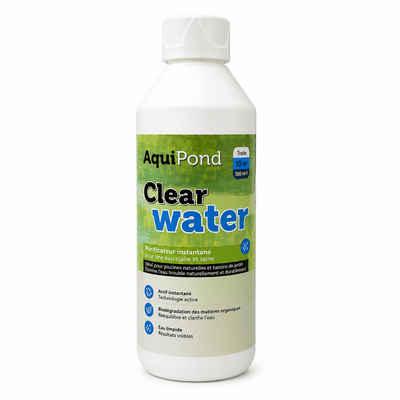 Aquipond ClearWater 10M³ - Works effectively on green water - Instant clarifier
€32,95
Voir le produit
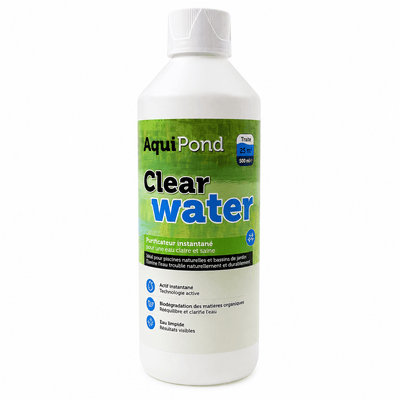 Aquipond ClearWater 25M³ - Works effectively on green water - Instant clarifier
€43,95
Voir le produit
 Aquipond Starter Pack (Nitriboost & Bacto Maintenance)
€98,95
 Aquipond BactoClay - Montmorillonite clay 2 kg for koi ponds
€43,95
Voir le produit


Leave a comment