

How to remove algae in an aquarium?
Algae are a real scourge in the world of fishkeeping. It is one of the most common problems you will face if you own an aquarium.
For many people, this means giving up on having an aquarium if they cannot find a way to get rid of it.
However, it is important to understand that the appearance of algae is absolutely not a matter of chance.
Furthermore, their growth is caused by an imbalance in the aquarium parameters. Therefore, they can be completely avoided by following our recommendations.
The different types of algae
To get rid of algae in your aquarium, you need to know their origins and types:
- Green algae are mainly found on plants, as well as on the substrate, decorations, and glass. They are easily identifiable by their fuzzy appearance, and their growth is often encouraged by excessively high light intensity.
- Filamentous algae are also green, but they can also have brown or grey hues. They love to attach themselves to plants, decorations, or glass. However, unlike other types of algae, they are easy to remove by hand. When present in small quantities, they do not pose a major risk to the balance of the biotope. But if they get out of control, they can completely overrun your aquarium, smothering your plants. They are a symptom of an aquarium with excessively high levels of iron, phosphate, or nitrate. Furthermore, your lighting may not be properly suited to your aquarium. If you still have old T5 or T8 tubes, it is time to replace them.
- Brown diatoms are mainly found on plants and decorations, identifiable by their brownish colour. However, unlike the other two types of algae we have previously introduced, these algae only grow when the lighting is unsuitable or insufficient. A high concentration of silicate can also explain their appearance.
- Blue algae or cyanobacteria are also composed of bacteria. Found on decorations and glass, they form a slimy film that is immediately identifiable by the presence of small air bubbles. To get rid of them, you can very easily vacuum them up using a simple hose.
Be aware that there are also other types of algae that you may find in abundance in your aquarium, such as beard algae, encrusting algae, and staghorn algae.
Use the right method to get rid of algae
Even before adjusting certain settings in your aquarium, it is important to adopt certain habits to stop algae from proliferating. First, we recommend focusing on cleaning by ensuring that your water is regularly changed. Approximately every 15 days, change 25% of the total water, remembering to properly vacuum the bottom of your aquarium and clean all your decorations. However, it is not necessary to change all the water, as this would cause a thermal shock to your ecosystem.
The second check concerns the lighting. Indeed, the quality of the lighting is an absolutely essential parameter for your aquarium. If the light is too intense or too weak, algae will inevitably proliferate. In addition, you should set the lighting to run for a maximum of 8 to 12 hours to achieve the best possible balance of light in your tank.
However, if you use a direct light source, it should supplement your artificial light and heating system. The damage to the flora and fauna of your aquarium can then be irreversible.
The third essential element is controlling the population in your tank. Remember to regularly count the living creatures, as having too many can lead to algae proliferation. You are well aware that fish naturally produce phosphates and nitrates.
However, these elements promote the growth of algae. If too much is produced, you will have ingredients that unfortunately favour their growth, which can lead to an imbalance in the biotope.
Finally, routine checks are always necessary to monitor the water hardness. Once a week, we recommend using a drop test to check for any imbalance. If this is the case, you will be able to take all the necessary measures to rectify the situation before the algae proliferation gets out of control.
Cleaning your aquarium
Normally, if you have followed our recommendations, you should be able to identify the causes of the algae growth.
Whether it is changing the lighting or reducing the number of species, it is always important to ensure that your aquarium is properly cleaned. With regular monitoring and good foresight, your tank will always be clean and the proliferation will be manageable.
By cleaning the substrate, you will be able to remove contaminated leaves and restore the health of the plants. Cleaning the glass is also essential, as is brushing the decorations. Do not forget to carefully vacuum the bottom of your aquarium to remove as many harmful elements as possible.
Algae treatments
If you have already followed our previous advice but find that it has had limited impact, you should then reduce the use of liquid fertiliser. Also try reducing the amount of food and consider adding algae-eating creatures. We recommend snails, shrimp, otocinclus, or plecos.
Be aware that there are also chemical products designed to treat algae. Although these products remain effective, we recommend using them only as a last resort. Indeed, they do not directly address the underlying problem.
Produits et rayons conseillés


Les produits conseillés par nos experts
Voir toute la sélection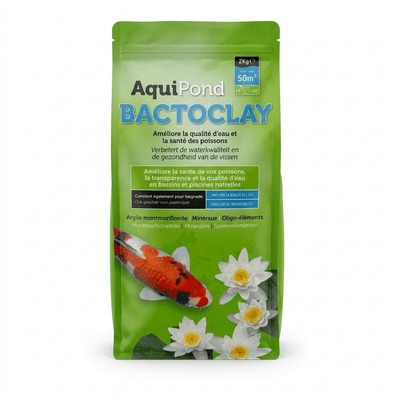 Aquipond BactoClay - Montmorillonite clay 2 kg for koi ponds
€41,95
Voir le produit
 Minerall in One Aquipond - Increases GH & KH simultaneously - 2.5KG to treat 30M³
€51,45
Voir le produit
 Sera Aqua-Test Set - The essential analysis kit for ponds and aquariums
€36,34
 Aquipond KH+ 1kg - Increases Carbonate Hardness (KH)
€20,95


Leave a comment