


How to clean a pond?
Dredging a pond means removing the material that has built up in the water. A pond is generally dredged after an excess of organic matter. Sludge is usually the main problem found in most ponds.
It is a delicate but essential operation to preserve the natural balance of your pond. The fundamental aim of the project is to clear it of accumulated material. If a pond is left to silt up, it risks becoming eutrophic and turning into a marsh. It is important to dredge properly. Some ponds with a fragile biotope are sensitive to mechanical sludge dredging. There are several solutions for dredging ponds naturally over the long term.
In other words, dredging a pond means limiting build-up by removing the sediment that has accumulated in the water. Several techniques can indeed achieve this.
The complete guide: How to remove sludge from a pond or natural pond?. It explains how to measure the thickness of the sludge, choose between dredging, suction and bacteria, and then prevent it from coming back.
In this article, we review the best-known techniques and also mention a few methods that may be less familiar at first sight but have certainly proved their worth. Each technique has its advantages and limits, and it should not be forgotten that dredging a pond may also call for an investment, and therefore a substantial budget, closely tied to the dredging technique chosen. It is certainly by taking these different aspects into account (cost, effectiveness, respect for the environment, etc.) that a choice will be made.
In short: dredging a pond means removing the sludge and organic matter that have built up on the bottom. There are five approaches: mechanical dredging (fast, but heavy on the banks), dry dredging (pond drained), hydraulic suction (banks preserved), bioaugmentation with bacteria (no machinery, over time) and gentle dredging, which is rare. The right choice depends on the amount of sludge, whether the pond can be drained, how fragile the environment is and the budget.
5methods compared in this guide
3questions to choose: drain? how much sludge? fragile environment?
1free water analysis to decide
Updated on 1 November 2026 — The Foudebassin experts
So-called mechanical dredging
This pond dredging method relies on mechanical machinery. Buckets are deployed which, from the bank, from the surface or even from the bottom of the pond, manage to extract the bulky material. Several types of machine are used during this operation. These include the hydraulic excavator (easy to handle, suited to ponds about 15 metres wide); the spider excavator (usable from the bank but also in the water, although it cannot be used in marshy areas); the bucket excavator on a pontoon (usable for ponds up to 20 m wide); the amphibious dredger, or amphidredge (its movable legs are perfectly designed to float on water; it is one of the machines best suited to marshy areas); and the dragline (a machine whose manoeuvring requires stable ground and a clear bank).
Mechanical dredging has the advantage of being faster thanks to machinery suited to the task. That is why, « in France, it has been used in more than 60% of cases for extracting gravelly, uncontaminated sediment since the 1990s, all waterways combined ». However, using this technique can prove costly. It also causes serious damage to the bank. This is due to the movements of the machines used, which are generally heavy. That is why, although quick in terms of the time needed, mechanical dredging may be used less and less in the years ahead.
Dry pond dredging
The technique simply consists of emptying the pond. Once dry, the pond is easier to reach with all kinds of machinery to clear it of its intruders, that is, the useless material. The machines mentioned above are no longer necessarily needed. Other machines, even ones unsuited to pond dredging, can be used, since draining the pond makes it possible to drive on the bottom and collect the material with a marsh bulldozer and a loader, or with a tractor and tipping trailer.
Hydraulic dredging, or suction dredging
One of the greatest advantages of this technique is that it avoids damaging the bank. Hydraulic dredging consists of sucking up the mixture of water and sludge and pumping it through a pipe to another pond prepared for the purpose. As mentioned above, this method requires no machinery to move along the bank. Certain specific equipment is needed for the job. These include: the dredger with horizontal cutter (it cuts the material and uses a drain to draw it out); the dredger with rotary horizontal cutter (designed to remove heavy material as well as vegetation; its special feature is its ability to lift and drain the material stored in the pond before it is sucked up); the water-pressure or rotary cutter dredger (it makes it possible to extract material by rotation or with a jet of pressurised water); and the submersible pump (a pump able to go deep down into a pond to clear material lying on the bottom; it is designed to reach a depth of 20 metres in the water).
Bioaugmentation
This is described as biological dredging. It is called that because the bioaugmentation technique is not dredging in the strict sense. Rather, it relies on a process that uses natural beneficial bacteria. These spread through the aquatic environment and lower the level of sludge on the bottom of the pond. This process is increasingly favoured because of its effectiveness. However, its adoption is not only due to its effectiveness. It is, even more, a technique that does not require specialised machinery. The advantage therefore lies in the fact that it is a less expensive technique. In addition, the bioaugmentation method makes it possible to preserve the pond's ecosystem by avoiding dredging in the strict sense of the term. It is worth stressing the need to combine bioaugmentation with a pond aerator, in order to oxygenate the aquatic environment and thus allow the bacteria to work more effectively.
Gentle dredging
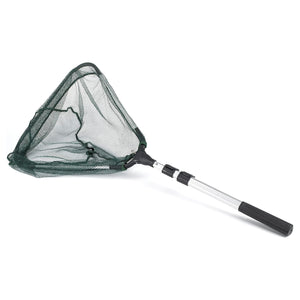
Rarely used, gentle dredging is a technique that uses a hand net in the form of a scoop to recover the material that has settled on the bottom of the pond. Technically speaking, it is a difficult operation. Not only will the method require a long time to carry out, it will also prove exhausting when you consider how much sludge there may be at the bottom of the pond.
The 5 dredging methods in one table
This table brings together the methods described above so that you can compare them at a glance. It deliberately gives no price: the cost depends on the volume of sludge, access and the removal of the sludge, and is worked out by quotation.
| Method | Principle | Advantage | Limitation | Pond drained? |
|---|---|---|---|---|
| Mechanical | Bucket machinery from the bank, the surface or the bottom | Fast | Costly; banks damaged by heavy machinery | No |
| Dry | The pond is drained, then the material is collected from the bottom | Easy access for all types of machinery | The pond has to be drained | Yes |
| Hydraulic (suction dredging) | Suction of the water and sludge mixture, pumped through a pipe to a prepared pond | Banks preserved, no machinery on the bank | Specific equipment and a receiving pond to plan for | No |
| Bioaugmentation | Beneficial bacteria that lower the sludge level, combined with an aerator | Less expensive, no machinery, preserves the ecosystem | It is not dredging in the strict sense: it works over time | No |
| Gentle dredging | Recovering deposits with a hand net | No machinery | Slow and exhausting with a thick layer of sludge | No |
Dredge or treat biologically: how to choose
Three questions are enough to find your direction: can the pond be drained, does the sludge cover almost the whole bottom, and is the environment fragile? If there is a lot of sludge and the pond can be drained, dry dredging remains the most direct option. If the environment is fragile or if you want to avoid machinery, suction followed by biological treatment is gentler on the banks and wildlife.
Always combine bioaugmentation with oxygen: bacteria work better in aerated water. To measure what your pond needs, start with the free water analysis.
To understand how sludge forms and how to stop it coming back, read our guide How to prevent sludge and get rid of it, as well as the natural pond guide.
Before you start: regulations and preparation
In France, bodies of water larger than 0.1 ha fall under heading 3.2.3.0 of the French « water law » nomenclature: declaration between 0.1 and 3 ha, authorisation from 3 ha. Since 2020, draining has been part of this heading, and the order of 9 June 2021 sets the general requirements. We did not find a heading specific to dredging: the procedure depends on your pond. An example of a prefectoral order from the Gers (2018) authorises dredging a drained pond, with the material taken away beyond the footprint of the water body and protection of the species present.
In Belgium, contact your municipality and the regional authority before any dredging or draining.
- Contact the departmental directorate for territories (France) or your municipality (Belgium) before draining or dredging.
- Plan where the sludge will be taken: settling pond, authorised plot, suitable disposal route.
- Protect the wildlife: fish to be moved to safety, amphibians and invertebrates on the bottom to be spared.
- Ask for several detailed quotes, with the estimated volume of sludge, the removal of the sludge and site access.
This page is not a substitute for legal advice: check the current version of the texts and the local rules.
Frequently asked questions
What is the difference between dredging and hydro-dredging?
Dredging covers all the techniques that remove sludge. Hydro-dredging, or suction dredging, is one of them: it sucks up the mixture of water and sludge and pumps it through a pipe to a prepared pond, without any machinery moving along the bank.
Can you dredge a pond without draining it?
Yes, with hydraulic suction, with bucket machinery used from the bank or the surface, with gentle dredging using a hand net, or by limiting sludge through bioaugmentation. Dry dredging is the only method that requires draining the pond.
Does biological dredging replace mechanical dredging?
It works over time, without machinery, and preserves the ecosystem. If the layer of sludge is very thick or the pond has silted up, dredging may still be necessary: have the situation assessed on site.
How much does it cost to dredge a pond?
The price depends on the method, the volume of sludge to be extracted, site access and the removal of the sludge. We do not give a price range, as it would be misleading: ask for detailed quotes and compare them point by point. Bioaugmentation is generally less expensive, according to the description of the method.
Is authorisation needed to dredge or drain a pond?
In France, a body of water larger than 0.1 ha falls under heading 3.2.3.0 (declaration between 0.1 and 3 ha, authorisation from 3 ha), draining included. Check with the departmental directorate for territories. In Belgium, contact your municipality and your region.
Where should the extracted sludge go?
It must be removed according to local rules: settling pond, authorised plot or suitable disposal route. In the example of a prefectoral order from the Gers, the material is taken outside the footprint of the water body and must not return to the water.
Is your situation different?
Sludge, odours, a pond that is silting up: describe your situation to us and we will help you choose between dredging, suction and bacteria.
Free water analysis · Solutions against sludge · Write to us
Experts since 1998 · Free delivery from €149 (excluding bulky items)
Also read: How to prevent sludge and get rid of it? · How to oxygenate the water in a pond? · The natural pond guide
Also read: Renovating an old garden pond: diagnosis, restoration or rebuilding
Sources
- Landot & associés law firm, « Maintenance and draining of bodies of water », 20 October 2023 — heading 3.2.3.0, order of 9 June 2021 (NOR TREL2018473A), Council of State of 19 October 2023
- Gers Prefecture, prefectoral order no. 32-2018-08-02-003 of 2 August 2018 — example of requirements for draining and dredging an existing body of water
Produits et rayons conseillés


Les produits conseillés par nos experts
Voir toute la sélection Aquipond BactoClay - Montmorillonite clay 2 kg for koi ponds
€41,95
Voir le produit
 Minerall in One Aquipond - Increases GH & KH simultaneously - 2.5KG to treat 30M³
€51,45
Voir le produit
 Sera Aqua-Test Set - The essential analysis kit for ponds and aquariums
€36,34
 Aquipond KH+ 1kg - Increases Carbonate Hardness (KH)
€20,95
À lire aussi
Tous les conseils Garden fountain: how to choose the right one (freestanding, in the pond, solar-powered, or statue) and where to find it
6 min de lecture
 Arrosoir & Persil: recycled metal garden decor, choosing and installing
12 min de lecture
 38 or 50 mm hose for a pond pump? Choose the diameter based on the flow rate and length
9 min de lecture
Comments
Leave a comment