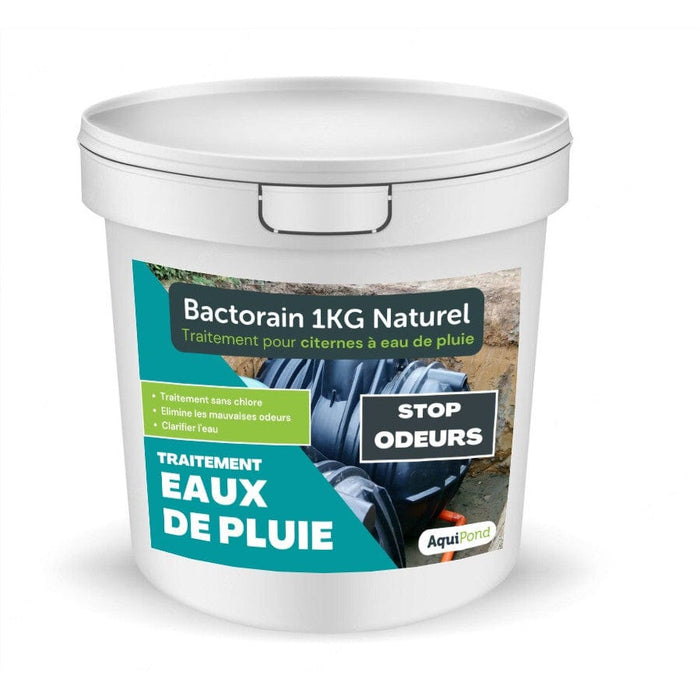
Description du produit :
Aquipond BactoRain 1 KG: The complete solution for your rainwater tank and microstation. This innovative treatment effectively neutralizes bad odors, prevents fermentation, and limits sediment buildup, ensuring better quality rainwater.
With its insoluble formulation, BactoRain works directly at the bottom of the tank. Once applied, it releases specific microorganisms that feed on organic matter and transform sludge into CO₂ and H₂O, providing proven and natural effectiveness.
Why choose Aquipond BactoRain?
-
Effective odor neutralization: fights odors at the source for odor-free water.
-
Prevention of sediment buildup: keeps your tank clean by limiting sludge deposits.
-
Progressive and lasting action: microorganisms multiply quickly for continuous and optimal biodegradation of organic matter.
Recommended use: 200 g/m², four times in the first year, then twice a year for effective maintenance. Choose Aquipond BactoRain and transform your rainwater management with an ecological, efficient, and unique solution.
Plan for 200 g/m² four times a year in the first year and twice a year in subsequent years (indicative, as treatment should be adjusted based on odors).
- Prevents fermentation
- Neutralizes bad odors
- Limits sediment buildup in the rainwater tank
Due to its insoluble formulation, once spread, the product will settle and deposit at the bottom of the rainwater tank. The various microorganisms will then do their work by feeding on the organic matter present in the sludge, breaking it down into CO2 and water. To feed, aerobic bacteria produce "exo-enzymes," substances that break long carbon chains into smaller and smaller chains.
This first step produces degraded components small enough to be ingested by the bacteria. Then, inside the bacteria, other types of enzymes called "endo-enzymes" break down the assimilated components and use them for their metabolism. Through this process, only CO2 and H2O remain from the original organic matter. Under these aerobic conditions, microorganisms multiply very quickly: they reproduce every twenty minutes.
Bacterial multiplication consumes matter. Indeed, to exist, a new bacterium uses carbon, hydrogen, oxygen, and nitrogen (CHON). Thanks to this bacterial proliferation, protozoa (microorganisms higher than bacteria in the food chain) will gradually develop, feeding on bacteria. They will in turn be eaten by more developed organisms... Through this degradation, we ultimately achieve a significant reduction in the initial sludge height, this reduction varying according to the organic content of the sludge at the time of treatment.