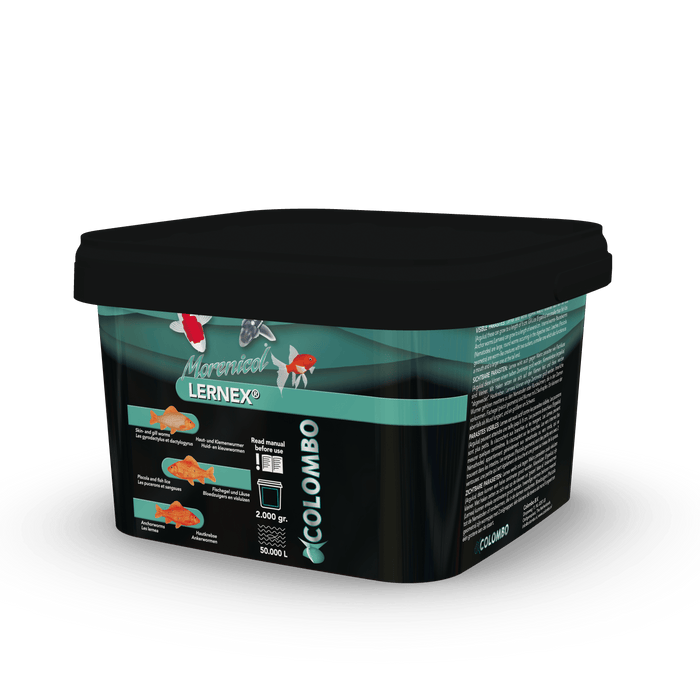
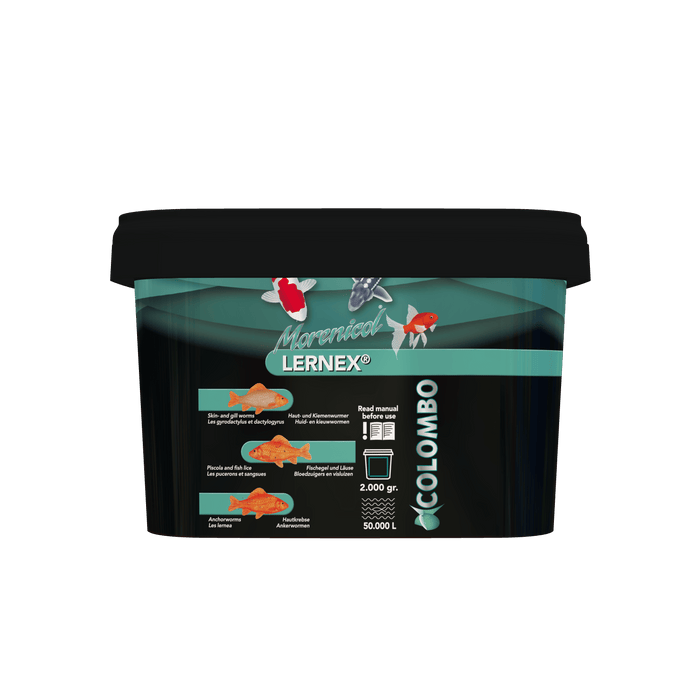
Description du produit :
Lernex is active against skin and gill worms, internal worms, leeches, fish lice, and hook worms.
Lernex® acts effectively against skin worms, gill worms, and internal worms. The presence of these parasites can only be determined with a microscope. Lernex® will also be effective against leeches, fish lice, and anchor worms, which are parasites visible to the naked eye.
Effective against:
- The gyrodactylus and dactylogyrus
- Aphids and leeches
- The lernea
Morenicol Lernex – Lernex fights skin worms (Gyrodactylus), gill worms (Dactylogyrus), and intestinal worms (Nematodes). The presence of these parasites can only be detected under a microscope. Lernex is also effective against leeches (Piscicola), fish lice (Argulus), and anchor worms (Lernaea).
The presence of these parasites is visible to the naked eye.
Evaluation of your pond volume: Calculate the pond water volume by
as precisely as possible: length x width x average depth in decimeters. You will get the volume in liters. Morenicol Lernex is available in: 250
ml for 5,000 ltr, 500 ml for 10,000 ltr, 1 ltr - 20,000 ltr and 2.5 ltr - 50,000 ltr.
Water quality: Remember that water quality is essential both for the effectiveness
optimal medication only for the rapid recovery of sick fish. That is why it is important to always test your water before and after treatment and to
correct the values if necessary.
Dosage: Dosage: 20 g (=1 scoop) per 500 liters of pond water. The scoop
is included in the packaging. If necessary, the treatment can be repeated
after 14 days. Parasites of cold-blooded fish. This means that at lower temperatures, their metabolism decreases. Below 10°C Lernex is not
sufficiently absorbed by the parasite.
Mix the product with water from a bucket or watering can. Then distribute the mixture
throughout the pond water. Do not filter with charcoal or zeolite; UV lamps and
the equipment must be unplugged up to 1 week after administration
8 of the treatment. Thoroughly clean the mechanical and recirculation filters if present before the treatment and leave them connected during the treatment, to
so that the larvae are also removed in the filter.
Catabolism: Remedies administered in the ponds will disappear by themselves thanks to natural processes such as oxidation and decomposition
by bacteria.
Warning: After adding the product Lernex, the activity of the parasites
will initially intensify. This product indeed irritates the fish that
will thrash in the water and even jump out of the pond. So watch your fish carefully during and after treatment!
Lernex can be harmful to invertebrates such as snails and crustaceans. Concerns pond fish only. Keep out of reach of children. Store the product in its box, dry, between 4 and 32°C and away from light. Do not inhale.
Avoid any contact with eyes and skin. Close the lid. Wash your
hands after use
Concerns pond fish only. Keep out of reach of children. Store the product in its box between 4 and 32°C. Do not inhale. Avoid
any contact with skin and eyes. In case of ingestion, consult a doctor
immediately, with the packaging or label.
Pets and birds also drink the pond water containing these products: It can be assumed that if the fish swim in it, it cannot be harmful to the animals that drink it. However, it would be safer during treatment to give water in a bowl to pets (dogs, cats) used to drinking pond water.
Combinations: Between the use of Morenicol Lernex and Morenicol Alparex one must
last at least 2 weeks. The effect of a combination
with other products is not known. Administration of more than 2 preparations
(in a combination) is at your own risk.
Information: Gill lice (Argulus) can reach a size of up to ½ cm.
They are flat and round, and have many legs on the side of the belly. Using
with 2 suckers, they attach to the fish and pierce its skin using the part
venomous from their mouth. They feed on the moisture of their skin
host; it loses weight and rubs against the bottom of the pond and plants. The argulus
drops its eggs into the water.
These eggs then turn into larvae, which must find a fish within one day to survive. Below 14°C, there is no reproduction, which means the problems mainly occur in summer. Gill lice (Ergasilus) are smaller. They attach to the 9 gills and eat them. The gill tissue can then become infected. In any case, the gills start to swell. The fish suffocate and can even die.
This most often occurs in July and August. Lernea can measure a few centimeters. They are not worms; they belong to the family of parasitic crustaceans. They mate on the gills. After that, only the females become harmful. They attach to the fish and pierce it with their anchor-shaped head. The first symptom is bleeding in the fish's skin, visible as a small red spot on the skin.
When the parasite is adult, their body, containing 2 egg sacs (like a V), protrudes from the fish and is visible and dragged in the water. When these sacs fall off, they leave behind a disgusting pustule. From these eggs hatch small larvae that contaminate the gills again.
Gyrodactylus and Dactylogyrus. These are flat sucking worms 0.3–0.5 mm long, which were once very rare in our ponds. Today they are regularly detected. Gyrodactylus is a viviparous skin worm that reproduces quickly and in large numbers.
Its passage on the skin causes swelling and leaves a viscous gray layer. The gill worm is called Dactylogyrus. It damages and irritates the gills, causing swelling and poor gill function. Fish rub their gills against plants and stones. When it worsens, they swim with open gills.
to avoid asphyxiation and can even die from it.
Internal worms (Nematodes) generally belong to the nematodes or roundworms, which are found in the intestines. The larvae from the eggs are also transferred by live food. There are larvae that travel throughout the fish's body and can be stored in muscle and organ tissues. From these dormant larvae, adult worms form under certain conditions. Fish severely affected by nematodes lose weight and have slimy stools.
Leeches (Piscicola geometra) are small worms with 2 suckers: one
small one that also serves as a mouth and a large one at the tail. They
have a transverse line and are on average 2-4 cm in size. Thanks to the
tail sucker they attach to stones or plants and wait for a
fish passes to jump on it in a fraction of a second and they attach
to it thanks to their oral sucker.
Like any other parasite, they can cause infections. They cause agitation and rubbing in fish. If they are very numerous, the fish are literally drained and die. All of these parasites cause wounds in the fish's skin, which can become infected by bacteria and molds. It is advisable to treat with Morenicol Cytofex or Morenicol FMC-50.