


Cyanobacteria: how to swim safely in a lake, pond, or natural swimming area
It's 31 °C, the children are impatient, and the lake is just a short walk from the parking lot. Yet as they approach, they notice a greenish tint along the shore and a few bluish streaks trapped among the reeds. Should they go in anyway? Swimming safely in the presence of cyanobacteria is mainly about learning to read the water before entering it and knowing when to turn back when the signs are there. Here are the tips we give swimmers and owners of natural swimming areas who stop by the store.
— The short answer
Always follow posted prohibitions. If no information is available, do not swim if the water is bright green or blue-green, if foam resembling paint is floating on the surface, or if you can no longer see your feet when the water reaches your knees. Keep children and dogs away from foamy areas, do not swallow the water, and shower after swimming. In a private natural swimming area, safety is built upstream by depriving cyanobacteria of phosphorus.

Before entering: read the body of water in two minutes
Start with the obvious: a prohibition or warning sign at an official swimming area must be respected, even if the water looks fine where you are. Blooms move with the wind, and the beach may be affected in the afternoon even though it was clear in the morning.
Without a sign, observe. Start with the color: an opaque apple green, a blue-green tint, or turquoise reflections are not normal. Next, the surface: suspended particles like green semolina, films that look like spilled paint, or foam accumulating along the downwind shore. Finally, the smell: an odor of mold, damp earth, or decomposing grass. None of these signs is proof, but their combination should be enough to make you decide against swimming.
A practical guideline adopted by many health authorities: enter the water up to your knees. If you can no longer see your feet even though the water is neither muddy nor choppy, the density of algae or cyanobacteria is probably too high for worry-free swimming.
Two simple tests to resolve any doubt
The stick test involves dipping a stick into the suspect area and pulling it out. If it is covered with a paint-like substance rather than long filaments that wrap around it, cyanobacteria are likely present. Filamentous algae, on the other hand, form “hair” that clings.
The jar test requires a little more patience. Fill a transparent jar with surface water and leave it in a cool place for a few hours without disturbing it. If a green layer forms on the surface, it is often cyanobacteria, which can float thanks to small gas vesicles. If the particles sink to the bottom, they are more likely to be green algae. These tests provide guidance; they do not replace an analysis.
| What you observe | Reasonable decision |
|---|---|
| Clear water, feet visible, no foam | Swimming possible, while staying alert to changes |
| Greenish, cloudy water, without foam | Caution: no putting your head underwater, no young children |
| Foam, blue-green streaks, positive stick test | No swimming, dogs must be kept on a leash |
| Official ban or warning | No swimming, regardless of how the water looks |
Children and dogs first
Children swallow more water than adults, play along the shore where foam accumulates, and weigh less: with equal exposure, the dose they receive is greater. Do not let them wade in calm areas sheltered from the wind; these are precisely the places where cyanobacteria concentrate.
For dogs, the rule is simple: never allow access to water that has foam or colored streaks. They drink while swimming, then lick their fur as it dries and ingest significant amounts. A dog that has swum in questionable water should be rinsed with clean water immediately, and a veterinarian should be contacted at the first sign of symptoms: vomiting, drooling, tremors, weakness.
During and after swimming
Most of the risk comes from swallowing water: avoid putting your head underwater, swimming crawl laps in questionable water, or splashing around. When you get out, take a shower, rinse your swimsuits and wetsuits, and wash your hands before having a snack. Itching, redness, eye irritation, or digestive problems in the hours that follow warrant medical advice; be sure to specify where you swam. The Belgian Poison Centre can be reached at 070 245 245.
Another common trap is believing that clear water is safe again. When a bloom collapses, dead cells release their toxins, which can persist in the water for several days. Wait for the official lifting of the ban, or for several days without any signs, before going back in.
Aquipond BactoSwim 2,5 kg
Bacteria for natural swimming ponds measuring 10 to 25 m² that help break down the organic matter that algae and sludge feed on. Live pricing and add to cart:
Your natural swimming pond: safety starts with preparation
In a private natural swimming pond, you are both the swimmer and the manager. The FLL recommendations, the German reference for designing natural swimming ponds, emphasize one point: keep phosphorus levels as low as possible. In practical terms, this means a well-planted, appropriately sized regeneration zone, no garden soil or fertilizer entering the pond, removing leaves before they sink, not feeding fish, and topping up with water of known quality.
Add a monitoring routine. A thermometer in the water will tell you when conditions become favorable to cyanobacteria, while a test kit will allow you to track nutrient levels. In the swimming ponds we monitor, the first warnings almost always come after a series of hot, still days, with water temperatures above 24 to 25 °C. This is the time to step up your observations.
JBL Test Combi Set Pond
Drop test kit for monitoring the main water parameters in your swimming pond or garden pond. Live pricing and add to cart:
Floating pond thermometer
The simplest indicator of when the water enters the summer risk zone. Live pricing and add to cart:

You may also like
Dreaming of your own swimming pond: The benefits of an ecological pool and natural swimming.
READ THE ARTICLEDo you have a natural swimming pond or a project underway? The Aquiflor / Foudebassin team can help you size the regeneration zone, choose the plants, and establish a suitable monitoring routine. Visit us in Nodebais or send us your photos.
Frequently asked questions
— Can you swim if the water is simply green?
Slightly green water without foam is not necessarily dangerous, but caution is required: keep your head above water, do not allow young children in, and stay out if the color darkens.
— How long should you wait after a bloom?
Wait for the official lifting of the prohibition. Without official monitoring, wait several days with no signs at all, as toxins can persist after the foam disappears.
— Can toxins pass through the skin?
Skin contact mainly causes irritation. The risk of poisoning primarily comes from swallowing water, which is why it is important to keep your head above water.
— Can a natural swimming pond have cyanobacteria?
Yes, if phosphorus accumulates and the water warms up. A well-designed regeneration zone and regular maintenance make this scenario rare.
In summary
- Posted prohibition, foam, blue-green water, or feet invisible at knee height: do not swim.
- The stick test and the jar test provide guidance but do not replace an analysis.
- Children and dogs are the most exposed; shower and rinse after every swim.
- In a natural swimming pond, safety depends on low phosphorus levels and summer monitoring.
Sources and references
- FLL Bonn, recommendations for the design, construction and maintenance of natural swimming ponds
- Wetzel R. G., Limnology, 3rd edition, Academic Press, 2001
- Manufacturers' technical data sheets: Aquipond (BactoSwim), JBL (Test Combi Set Pond)
- Aquiflor / Foudebassin consulting experience, Nodebais (Belgium)
Last updated: September 29, 2026.
Les produits conseillés par nos experts
Voir toute la sélection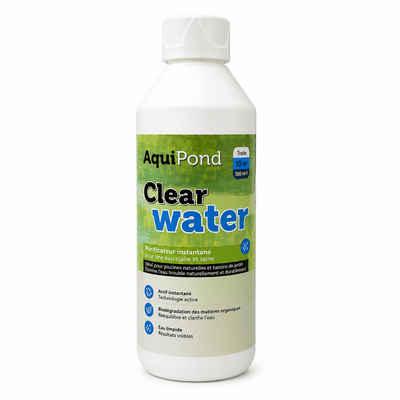 Aquipond ClearWater 10M³ - Works effectively on green water - Instant clarifier
€32,95
Voir le produit
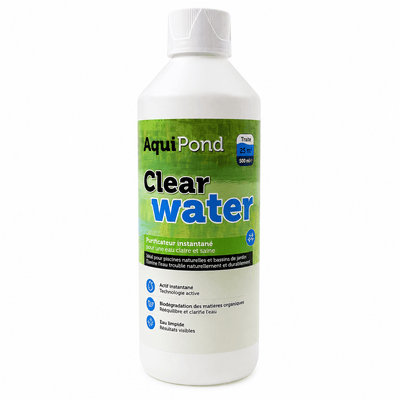 Aquipond ClearWater 25M³ - Works effectively on green water - Instant clarifier
€43,95
Voir le produit
 Aquipond Starter Pack (Nitriboost & Bacto Maintenance)
€98,95
 Aquipond BactoClay - Montmorillonite clay 2 kg for koi ponds
€43,95
Voir le produit


Leave a comment