


Pond approximately 30 m by 10 m overrun with filamentous algae: what should I do in practice?
The message reached us exactly as a comment: « I have my small pond, 30 m by 10 m, and I have lots of filamentous algae—what should I do? » Small, not really: 300 m² of surface area is already a proper body of water, and that is precisely what changes the answer. On such a surface, you do not “treat” the entire pond like a garden pond: you remove the mass of algae mechanically, target the areas where they regrow, and address what feeds them. Here is the approach we recommend to owners of large ponds who come to see us in Nodebais.
— The short answer
Start by removing as much algae as possible with a rake or net, in several passes, and take it well away from the bank. Do not try to destroy everything at once with a product: a large mass of algae that dies in the water consumes oxygen and releases its nutrients. Then treat the shallow, sunny areas where they regrow in a targeted way, reduce inputs (fertilizer, leaves, feeding, silt), and install plants along the bank. Allow one to two seasons for a stable result.

Why a large pond becomes covered in filaments
Filamentous algae are not a sign of dirty water in the way the term is often understood. On the contrary, they grow very well in clear, well-lit water, with a bottom or shallow banks that warm up quickly in spring. They attach themselves to stones, stems, and the bottom, then detach and rise to the surface, forming those familiar green-yellow mats, lifted by the oxygen bubbles they produce themselves in the sun.
What makes them explode is the combination of light and nutrients, especially phosphorus. In a 300 m² pond, these nutrients rarely come from a single source:
- runoff from farmland, a fertilized lawn, or a sloping vegetable garden;
- leaves from nearby trees that fall every autumn and accumulate as silt;
- ducks, geese, or fish fed by visitors;
- old silt that slowly releases the stored phosphorus, especially when the bottom lacks oxygen.
Limnology studies of shallow bodies of water, particularly those by Marten Scheffer, show that a pond tends to shift between two states: dominated by aquatic plants or dominated by algae. A pond overrun with filaments is often wavering between the two, and that is good news: there is still room to tip the balance in the right direction.
Step 1: remove the mass intelligently
On a surface like this, mechanical removal is not a makeshift solution; it is the foundation. Every kilogram of algae removed means that much phosphorus and nitrogen permanently leaves the pond instead of returning to the silt as it decomposes.
- Work by zone, starting with floating mats, then the banks. A hay rake pulled on the end of a rope and thrown from the bank works wonders on large bodies of water.
- Let the algae drain on the bank for a few hours: frogs, newts, dragonfly larvae, and small fish have time to return to the water.
- Then remove them to the compost heap or the base of hedges, never in a pile on a sloping bank where rain could wash them back into the pond.
- Repeat every eight to fifteen days during the season, without seeking perfection every time.
140 cm fine-mesh landing net for aquatic plants – Oase
A long handle and fine mesh for removing filaments from the bank. Direct price and add to cart:
Step 2: target rather than blanket-treat
For a pond measuring 30 m by 10 m, the volume is often between 200 and 450 m³ depending on the average depth, roughly speaking. Dosing a treatment for the entire volume is expensive and is almost never necessary. The filaments regrow from specific areas: shallow edges, stones heated by the sun, inlets sheltered from the wind. That is where you need to focus your efforts.
The golden rule: never cause the sudden death of a large mass of algae in the water, especially in hot weather. Their decomposition consumes a great deal of oxygen, precisely at night, and can put fish under stress. That is why you should first remove them mechanically, then treat what remains locally, while strictly following the manufacturer's dosage.
| Action | Appropriate scale | Time to take effect |
|---|---|---|
| Removal with a rake or landing net | The entire pond, by zone | Immediate |
| Treatment for filamentous algae | Targeted regrowth areas | A few days to two weeks |
| Silt-degrading bacteria | Silted bottoms, inlets | Several weeks |
| Marginal plants and shade | Banks exposed to the south | One to two seasons |
| Cut off external inputs | Watershed, surroundings | Durable |
AlgoLon Oase
Filamentous algae treatment to be applied selectively to areas where regrowth occurs, according to the manufacturer's dosage. Live price and add to cart:
Step 3: cut off the fuel
This is the step most often skipped, yet it is what makes the difference the following year. Walk around the pond with fresh eyes. Where does the water come from when it rains? Do a ditch, drain, or sloping lawn carry runoff into it? An unfertilized grass strip a few meters wide between the lawn and the bank is often enough to filter out a large part of these inputs.
Next, the bottom. A pond of this size that has never been dredged accumulates decades of leaves and debris. This sediment is a reserve of phosphorus. Specialized bacteria, applied to silted areas, accelerate the mineralization of organic matter; for substantial accumulations, partial dredging may still be necessary, and we can point you in the right direction.
Finally, the animals. Ducks fed bread or an excessively large fish population that is also fed extra food add their share of nutrients every day. Reducing this feeding costs less than any treatment.
Step 4: let the plants take over
A balanced natural pond is one where higher plants consume nutrients before algae do. On 300 m², aim for beds of marginal plants along a good part of the perimeter, water lilies to shade part of the surface, and a few native submerged plants. Absolutely avoid invasive exotic species regulated at European level, such as Nuttall's waterweed or parrot feather: they solve the algae problem by creating a much worse one.
Biobooster+ for 40 m³
Bacteria that accelerate the breakdown of organic matter and sediment, to be applied to the most heavily affected areas. Live price and add to cart:
What to expect, season after season
In the first year, you will mostly be removing them. A lot. The filaments will grow back, more slowly each time if nutrient inputs are reduced. In the second year, if the plants have established themselves and the sediment has decreased, spring is often still the challenging period, then the pond stabilizes in summer. Accepting a few filaments on the stones is part of the process: in a living pond, they provide shelter and food for a whole range of microfauna.

Do you have a large pond and do not know where to start? Send us the dimensions, approximate depth, and a few photos: the Aquiflor / Foudebassin team will help you target the right areas and dose without waste.
Frequently asked questions
— Can an entire 300 m² pond be treated chemically?
It is rarely useful and can be risky: the sudden death of a large mass of algae consumes oxygen. Remove it mechanically first, then treat regrowth areas.
— What should you do with removed filamentous algae?
Let them drain on the bank for a few hours so the small aquatic life can return to the water, then put them in the compost, away from the pond.
— How long does it take to get rid of filamentous algae in a large pond?
As a general estimate, one to two seasons, while nutrient inputs decrease and plants become established.
— Can herbivorous fish be enough?
They consume some of the algae but also add excrement. Without addressing nutrient levels, they cannot solve the problem on their own.
In summary
- 300 m² is a real body of water: think in terms of zones, not total volume.
- Regular mechanical removal permanently takes nutrients out of the pond.
- Never destroy large quantities of algae all at once: risk of oxygen depletion.
- Targeted treatment in regrowth areas, bacteria for silted bottoms.
- Cut off nutrient inputs and plant the banks for lasting results.
Sources and references
- Scheffer M., Ecology of Shallow Lakes, Chapman & Hall, 1998
- Wetzel R. G., Limnology, 3rd ed., Academic Press, 2001
- Boyd C. E. & Tucker C. S., Pond Aquaculture Water Quality Management, Kluwer, 1998
- Regulation (EU) No. 1143/2014 on invasive alien species
- Manufacturer technical data sheets: Oase (AlgoLon, pond nets), Aquatic Science (Biobooster+)
- Aquiflor / Foudebassin consulting experience, Nodebais (Belgium)
Last updated: September 29, 2026.
Les produits conseillés par nos experts
Voir toute la sélection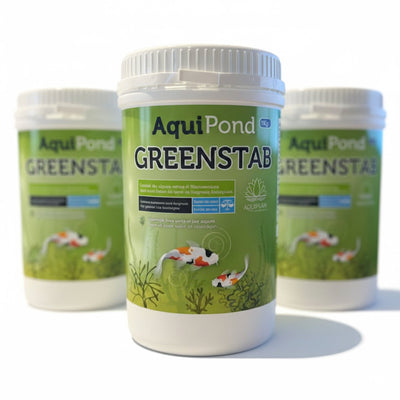 Aquipond Greenstab - Balanced pond water, limits algae
À partir de €38,45
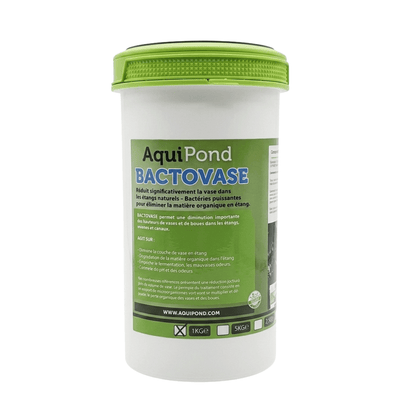 Aquipond Bactovase 1 kg – Bacteria for pond sludge reduction (5 to 10 m²)
€43,95
Voir le produit
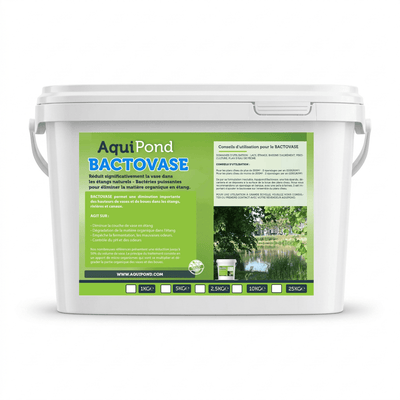 Aquipond Bactovase 2.5 kg – Bacteria to reduce pond sludge (12.5 to 25 m²)
€98,95
Voir le produit
 Aquipond Bactovase 5 kg – Bacteria to reduce pond sludge (25 to 50 m²)
€166,10
Voir le produit
À lire aussi
Tous les conseils The nitrogen cycle in a pond: ammonia, nitrites, and nitrates explained simply
12 min de lecture
 Gorgeous pool in spring, tired by summer: why it deteriorates month after month
7 min de lecture
 Why algae always come back to the same spot in the pool (and what that spot is trying to tell you)
5 min de lecture
Leave a comment