


Baking soda, hydrogen peroxide, copper, vinegar against filamentous algae: what works and what is dangerous
Filamentous algae, those long green strands that cling to stones and wrap around everything, drive pond owners to look for solutions in their cupboards. Baking soda, hydrogen peroxide, vinegar, copper: every forum has its miracle cure. Some do nothing, while others cause more damage to fish and the filter than to the algae. Here is what the biology of each one tells us, and how to achieve a lasting result without putting your pond at risk.
— The short answer
Baking soda does not kill algae: it raises KH and pH. Hydrogen peroxide burns algae but also damages gills and filter bacteria if improperly dosed. Copper sulfate is toxic to fish, snails, and amphibians and accumulates in sediment: it should be avoided. Vinegar and salt are ineffective at doses tolerated by fish. What works: manual removal, phosphate reduction, bacteria, and, if necessary, a treatment formulated for ponds.

Why filamentous algae proliferate
Filamentous algae are attached: they draw their nutrients directly from the water, and UV has no effect on them because they do not pass through the device. They thrive under three conditions: available phosphate and nitrates, plenty of light, and hard water rich in carbonates. They often explode in spring, when the water warms up before aquatic plants wake up and take their share of the nutrients. Any remedy that does not address these causes provides, at best, a respite of a few weeks.
Baking soda: a misunderstanding
Baking soda is sometimes recommended “against algae.” In reality, it raises KH, the water's carbonate reserve, and stabilizes pH. This is useful in a pond with water that is too soft and a yo-yoing pH. But it does not kill any algae. Worse: filamentous algae use carbonates as a carbon source. In water that is already hard, adding more is pointless. Verdict: ineffective against algae, useful only for correcting KH that is too low, with a product dosed for ponds.
Hydrogen peroxide: effective but dangerous
Hydrogen peroxide is a powerful oxidizer. On contact with algae, it burns them, which is why it is discussed on forums. The problem is that it does not distinguish between algae and other living tissue. If improperly dosed, it damages fish gills, destroys some of the filter bacteria, and can cause water quality to deteriorate. Concentrations sold in pharmacies and drugstores vary, and calculating the amount for an approximate pond volume is a frequent source of accidents.
If you want the “active oxygen” effect, choose a product formulated and dosed for stocked ponds, with precise instructions, rather than a drugstore bottle.
AlgoLon - Oase
Treatment formulated for filamentous algae in ponds, to be used according to the instructions. Direct price and immediate add-to-cart:
Copper sulfate: prohibited
Copper is an old and powerful algaecide. It is also toxic to fish, particularly in soft, acidic water, and deadly to snails, freshwater shrimp, insect larvae, and amphibians. It does not break down: it accumulates in sediment and tissue. Copper “ionizers” sold for swimming pools pose the same problem in a fish pond. Verdict: ban it from a living pond.
Vinegar, salt, bleach: no
- Vinegar causes the local pH to drop; at doses that would affect algae, it endangers fish. It remains useful for descaling equipment outside the water.
- Salt has therapeutic uses for fish, but filamentous algae tolerate it better than pond plants do.
- Bleach kills all life in the pond. Never use it in a stocked pond.
Barley straw: a real effect, but slow
Barley straw is the only “natural” remedy supported by scientific research. As it slowly decomposes in well-oxygenated water, it releases compounds that slow the growth of certain algae. But the effect is preventive, takes several weeks to appear, and varies from pond to pond. It helps; it does not cure an infestation that is already established.
| Remedy | Effectiveness against filamentous algae | Risk to the pond |
|---|---|---|
| Baking soda | None | Low |
| Hydrogen peroxide | Real but temporary | High if improperly dosed |
| Copper sulfate | Strong | Very high |
| Vinegar, salt | None at tolerated doses | Medium to high |
| Barley straw | Preventive, slow | Low |
What really works
- Remove the algae mass mechanically: use a rough stick that you rotate, or a fine-mesh net. Every kilogram removed means nutrients leaving the pond.
- Reduce phosphate: it is the most limiting nutrient. A phosphate remover binds it, and properly portioned, high-quality food adds less.
- Strengthen the bacteria that break down organic matter at the bottom and on dead algae.
- Plant heavily: aquatic plants are algae's direct competitors for nutrients.
- Shade part of the pond if it is in full sun.
It is by reducing the nutrient content of the environment that algae pressure can be reduced sustainably.
AquaActiv PhosLess - Oase
Phosphate filter to place in the circuit, to permanently deprive algae of their main nutrient. Live price and immediate add to cart:
Fine-mesh net for aquatic plants 140 cm - Oase
To remove algae and plant debris without dispersing them. Live price and immediate add to cart:

See our pond algae control solutions and our oxygenating plants.
Frequently asked questions
— Is baking soda dangerous for fish?
Not at reasonable doses, but it raises the pH. A sudden increase can make ammonia more toxic. It is only used to correct a KH that is too low.
— Does hydrogen peroxide destroy the filter?
It can kill some of the filter bacteria if it passes through the filter in large quantities. This is one of the major risks of improvised treatments.
— Why do algae return after every treatment?
Because nutrients remain in the water and sludge. Dead algae even release their nutrients as they decompose. Without reducing phosphates, they grow back.
— Does UV work against filamentous algae?
No, UV acts on suspended microalgae that pass through the device. Filamentous algae, which are attached, do not pass through it.
In summary
- Bicarbonate: does not kill algae; vinegar and salt: ineffective.
- Hydrogen peroxide: risky; copper: must be avoided.
- Manual removal + phosphate remover + bacteria + plants.
- If treating, use a product formulated for ponds, according to its instructions.
Sources and references
- Wetzel R.G., Limnology: Lake and River Ecosystems, Academic Press, on phosphorus limitation
- Newman J.R. et Barrett P.R.F., “Control of Microcystis aeruginosa by decomposing barley straw”, Journal of Aquatic Plant Management, 1993
- Noga E.J., Fish Disease: Diagnosis and Treatment, Wiley-Blackwell, on the toxicity of copper and oxidizing agents
- Boyd C.E., Water Quality: An Introduction, Springer
- Aquiflor experience, aquatic garden center in Nodebais (Belgium), over 30 years
Last updated: September 28, 2026.
Les produits conseillés par nos experts
Voir toute la sélection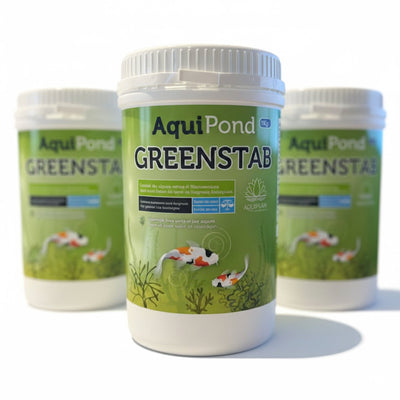 Aquipond Greenstab - Balanced pond water, limits algae
À partir de €38,45
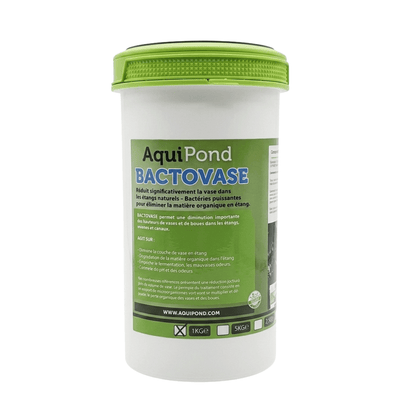 Aquipond Bactovase 1 kg – Bacteria for pond sludge reduction (5 to 10 m²)
€43,95
Voir le produit
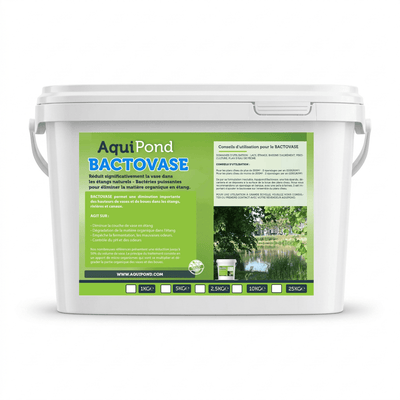 Aquipond Bactovase 2.5 kg – Bacteria to reduce pond sludge (12.5 to 25 m²)
€98,95
Voir le produit
 Aquipond Bactovase 5 kg – Bacteria to reduce pond sludge (25 to 50 m²)
€166,10
Voir le produit


Leave a comment