


How to make a natural pond filter?
A natural pond filter can offer an ecological and effective solution for maintaining water quality, thereby ensuring a healthy environment for your fish and aquatic plants.
Unlike mechanical filtration systems, a natural filter uses biological processes and natural materials to filter the water. In this article, we will explore the different steps to create a natural filter for your pond.
3 stagesmechanical, biological, vegetal
Bacteriahoused in porous stones
Plantsthey consume nitrates and phosphates
Slow flowwater must have time to be purified
Why choose a natural filter?
Natural filters offer several advantages:
- Ecological: Uses natural materials without chemicals.
- Economical: Reduces long-term maintenance costs.
- Aesthetic: Integrates harmoniously into your garden landscape.
- Effective: Helps maintain clear, healthy water by promoting a balanced ecosystem.
Necessary materials for a natural filter
To create a natural filter, you will need the following items:
- Gravel and sand: For initial mechanical filtration.
- Volcanic rocks or porous stones: To house beneficial bacteria.
- Aquatic plants: To absorb nutrients and provide oxygen.
- Water pump: To ensure water circulation through the filter.
- Container or tub: To hold the filtration materials.
For the biological part, lava rock (pozzolana) is a classic choice: highly porous, it offers a large surface area for useful bacteria. Also discover our filter media to complete your setup.
Steps to create a natural filter
-
Choose the location: Select a spot near your pond where the filter will be installed. It must be easily accessible for maintenance.
-
Prepare the container: Use a container or tub large enough to hold all the filtration materials. Drill holes in the bottom to allow for drainage.
-
Add gravel and sand: Start with a layer of gravel at the bottom of the container to ensure good drainage. Then, add a layer of sand for mechanical filtration.
-
Add volcanic rocks or porous stones: These materials provide a large surface area for beneficial bacteria to grow. These bacteria break down organic matter and waste in the water.
-
Plant aquatic plants: Aquatic plants like reeds, irises, or water mint are excellent for absorbing excess nutrients and providing oxygen. Plant them directly in the container among the rocks and stones.
-
Install the water pump: Place a water pump at the bottom of the pond and connect it to the natural filter. The pump will circulate the water through the different filtration layers, ensuring effective cleaning.
-
Maintain the filter: Check the filter regularly to ensure it is functioning correctly. Remove debris and clean the filtration materials as needed. Replace dead or diseased plants to maintain filter efficiency.
The tub must return water to the pond: plan for an overflow outlet or a return pipe, positioned so that the water passes through all layers before flowing out. If you drill the bottom for drainage, do so only when the tub is placed in the pond or above an area that returns water to it. And choose native or non-invasive plants: water hyacinth, for example, is an invasive alien species regulated in the European Union.
Benefits of aquatic plants in a natural filter
Aquatic plants play a crucial role in a natural filter:
- Nutrient absorption: The plants consume nutrients like nitrates and phosphates, thereby reducing algae growth.
- Water oxygenation: They release oxygen into the water, which is essential for fish and beneficial bacteria.
- Habitat for micro-organisms: The roots of the plants provide a habitat for various micro-organisms that participate in biological filtration.
Marsh iris, water mint, rushes, or marsh marigold: our article list of filtering aquatic plants details the most effective species, available in our plants for lagooning and phyto-purification section. If you lack space around the pond, a floating island allows you to grow these plants directly on the water.
The principle of a natural filter, in cross-section
A natural filter reproduces in an accelerated way what happens in a wetland area. Pond water, laden with particles and dissolved waste, passes through three successive "stages," each having a specific role.
- Mechanical stage: gravel and sand retain suspended particles. This is the layer that clogs the fastest.
- Biological stage: in the pores of the lava rock, bacteria transform ammonia, which is toxic to fish, into nitrites and then nitrates.
- Vegetal stage: plant roots consume nitrates and phosphates, depriving algae of some of their nutrients.
To better understand why these steps are essential, also read our article why filter my pond water.
Correctly sizing and choosing materials
There is no single formula: the size of a natural filter depends on the pond volume, its exposure to sunlight, and especially the number of fish. However, some benchmarks help avoid disappointment.
- The larger the planted area, the better. A small planted tub complements filtration, but it alone does not replace a filter sized for a stocked pond.
- A moderate flow rate. Water must pass through the filter slowly to give bacteria and roots time to act. A pump that is too powerful "washes" the filter without purifying it. Choose one from our range of pond pumps for filters and streams based on the discharge height and desired flow rate.
- An easily accessible pre-filter. A strainer or foam at the pump intake prevents large particles from clogging the gravel.
- Fish? Plan for more. With koi carp or a large population, combine the natural filter with conventional filtration and, if necessary, a UV clarifier. Our guide for choosing a pond filter helps you take stock.
| Material | Main role | Maintenance |
|---|---|---|
| Gravel | Retains large particles, distributes water | Rinse when flow drops |
| Sand | Fine filtration | Clogs quickly: thin layer, to be monitored |
| Lava rock | Bacterial support, root anchoring | Rinse with pond water, rarely |
| Plants | Consume nitrates and phosphates | Pruning and removal of dead parts |
Maintenance through the seasons
A natural filter requires little maintenance, but regular maintenance is key. The most important thing is to never "sterilize" the filter by cleaning it too thoroughly.
- In spring, restart the pump, rinse the gravel if necessary, and reactivate bacterial life once the water temperature exceeds 10 °C.
- In summer, check the flow rate every week and trim plants that are taking up too much space.
- In autumn, remove leaves and cut back dead plant parts before they decompose in the filter.
- In winter, leave the filter dormant depending on your setup, without deep cleaning, to preserve the bacteria.
Always rinse biological materials with water taken from the pond, never with tap water: chlorine destroys a portion of the useful bacteria. After a major cleaning or at the beginning of the season, adding nitrifying bacteria helps the filter restart.
If the water remains green despite a well-planted natural filter, a UV clarifier adapted to your pond can complement the system.
Conclusion
Creating a natural filter for your pond is an ecological and effective way to maintain clean and healthy water. By using natural materials and promoting biological processes, you can not only improve water quality but also add an aesthetic touch to your garden. At Foudebassin, we are ready to provide you with all the advice and materials needed to realize your natural filter project. For more information and assistance, do not hesitate to visit our blog or contact us directly.
Frequently asked questions
Is a natural filter enough for a pond with fish?
For a few goldfish in a well-planted pond, often yes. For koi carp or a large population, it is better to combine it with conventional filtration, as the waste load exceeds what plants and bacteria can handle alone.
What plants should be put in a natural filter?
Marginal and marsh plants with developed root systems: marsh iris, water mint, rushes, marsh marigold, purple loosestrife. Avoid invasive alien species like water hyacinth, which is regulated in the European Union.
Is a pump required for a natural filter?
Yes, unless the filter is integrated into the pond itself as a lagoon zone. The pump circulates the water through the layers; a moderate flow rate is preferable to allow time for purification.
How long does it take for a natural filter to be effective?
It takes several weeks for bacteria to colonize the stones and for plants to take root. Effectiveness then improves throughout the season.
How to clean a natural filter without upsetting it?
Rinse the gravel when the flow drops using pond water, and never clean all layers at the same time. Regularly remove leaves and dead parts of plants.
Les produits conseillés par nos experts
Voir toute la sélection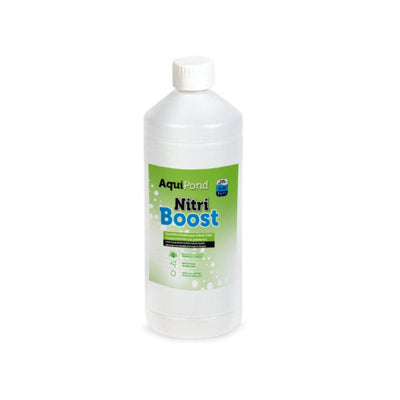 Aquipond NitriBoost - Liquid Nitrifying Bacteria for 10M³ - 1L
€41,95
Voir le produit
 Floating island for aquatic plants round 41CM
€77,82
Voir le produit
 16-32mm pozzolan lava stone - Ideal for plants and lagoons
À partir de €26,20
Voir le produit
 Aquamax Eco Premium 6000 12V - Low voltage pond pump - Oase
€671,95
Voir le produit


Comments
Leave a comment