A pond can be biologically stable while still having a visible presence of algae. In an aquatic ecosystem, this is nothing unusual: algae contribute to the life of the environment and often appear as soon as there is light, nutrients, and calm water.
The real issue is therefore not to want to make them disappear at all costs, but to understand from what point they become too invasive, visually disturbing, or revealing of an ongoing imbalance.
When they take up too much space, they obscure the pond’s appearance, compete with plants, and often indicate an excess of organic matter or nutrients.
Natural solutions are based on a simple logic: act at the source rather than only on the symptom. This involves barley straw, beneficial bacteria, aquatic plants, and regular maintenance actions, as well as better water observation through appropriate tests.

To better understand the real state of your pond, consult our test kits and strips and our selection of natural solutions against algae.
Algae in a pond: useful, normal, or problematic?
— Natural presences in a balanced ecosystem
Algae are part of a pond’s life. Their presence is not necessarily a bad sign: in a balanced aquatic ecosystem, they naturally appear at certain times and even contribute to the overall functioning of the environment.
However, it is important to distinguish between discreet, almost invisible algae and more pronounced blooms that take the water hostage. Slightly green-tinted water, a few filaments on stones or edges, do not automatically mean the pond is in poor condition.
— A signal of an imbalance to be corrected
However, when algae invade the surface, cloud the water, or cling everywhere, they become a symptom of a broader imbalance. In a pond, they are often favored by an excess of nutrients, insufficient filtration, a lack of aquatic plants, overpopulation of fish, or an accumulation of organic matter at the bottom.
Light and heat further accelerate their growth, especially when the water remains too still. In other words, algae are not the enemy to be eliminated at all costs: they rather serve as indicators.
They often indicate that a resource is not circulating well, that an excess is settling in, or that the biological balance needs to be readjusted. In this logic, the real issue is not just to make them disappear, but to understand why they develop.
This is also why a sustainable approach relies on several levers: sufficient plants, appropriate filtration, measured fish feeding, well-monitored water, and, if necessary, UV treatment for suspended algae.
The goal is not to sterilize the pond but to make it more stable, clearer, and more resilient over time.
Why limit them anyway?
Algae are not always a problem in themselves, but their excessive growth often harms the pond’s visual and biological balance. Limiting them helps both maintain more pleasant water to look at and preserve better conditions for other aquatic organisms.
— Clearer and more aesthetic water
In a garden pond, water clarity plays an important role in the overall perception of the water feature. When algae multiply, they can cloud the water, turn it green, or hide decorative elements and plants, giving the impression of a less controlled pond.
Conversely, clearer and more stable water better highlights the relief, fish, and plantings.
— Preventing imbalances
An algae bloom often signals an excess of nutrients, light, or organic matter available in the pond. Limiting them is therefore also a preventive action before the water shifts toward a more marked imbalance.
This is an important point for the reader: algae are not just an “aesthetic problem,” they can sometimes be a useful indicator of the aquatic environment’s condition.
— Reducing competition with plants
Both algae and aquatic plants draw from the pond’s resources, especially dissolved nutrients. When algae take over, they can hinder the establishment or vigor of plants, which actually contribute to the pond’s long-term balance.
Limiting algae also means giving more space to useful plants and enhancing the natural reading of the ecosystem.
— Better pond observation
A pond overrun by algae becomes harder to observe and understand. It becomes more difficult to distinguish water quality, fish activity, plant condition, or debris accumulation at the bottom.
Conversely, limiting algae helps better monitor the pond, which also makes it easier to detect any imbalance and use controls like water tests wisely.

Barley straw: a natural benchmark solution
Barley straw is often presented as a natural supplementary solution to limit algae appearance in a pond. Its benefit lies in a slow and gradual action, which takes effect after immersion and partial decomposition in the water.
It does not replace good filtration, regular maintenance, or a stable biological balance. In practice, it is mainly considered a supplement, to be used before the algae growth period, with a dose adapted to the water surface area rather than its volume.
A few key points:
- Gradual action, no immediate effect.
- Relevant use as prevention, before algae peaks.
- Dose to be adjusted according to the pond surface area.
- To be combined with effective filtration and aquatic plants for better results.
However, keep in mind that its effectiveness varies depending on pond conditions and the type of algae targeted. Available data show encouraging results on some blooms but also variable effects depending on the species studied, so it should be used with caution and discernment.
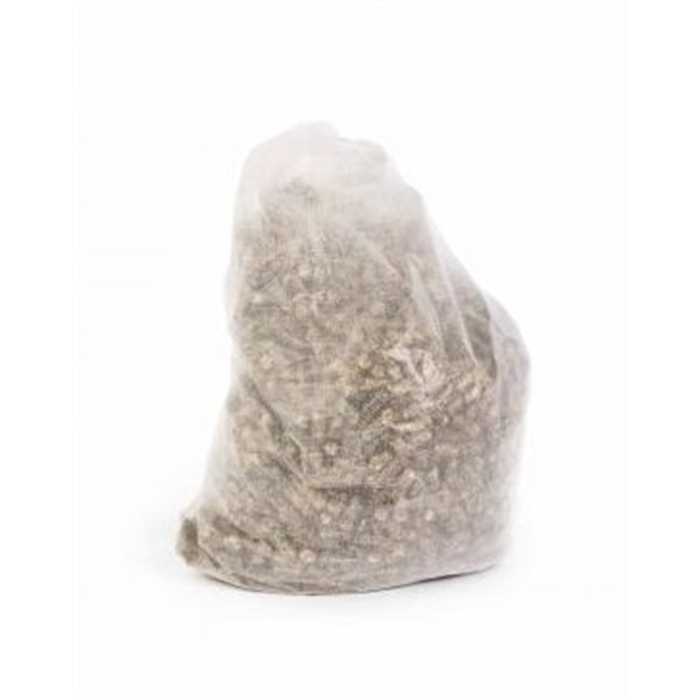
Pack of 5 Aquipond Eco AlgControl
100% natural barley to treat algae - 5kg (max 25M³)
See product
Beneficial bacteria: addressing the cause
When aiming to sustainably limit algae, it’s not enough to act only on what is visible on the surface. It’s equally important to work “from the inside” by reducing the organic matter that indirectly feeds the algae.
Beneficial bacteria play a central role here. Naturally present in the water, filter, and biological supports, they help decompose organic waste from fish, leaves, pollen, or leftover food.
In short, they help the pond transform an invisible pollutant load into elements less problematic for the overall balance.
— Why they are useful
A pond is never a completely closed environment: it continuously receives organic inputs, even if modest. As these accumulate, the waste breaks down and feeds the nutrient cycle, especially nitrogen, which can promote algae growth if nothing regulates this process.
Beneficial bacteria work precisely at this level, accelerating the biological decomposition of organic matter.
They do not "kill" algae directly, but they reduce their available food. It’s a more subtle approach, but often smarter than a one-time treatment, as it targets the cause rather than just the symptom.
— When to use them
Spring is often the most relevant time to get the pond back on track.
After winter, biological activity restarts, temperatures rise, and the system must regain its natural purification capacity. Adding beneficial bacteria at this time can help restart the filter and secure the pond’s increase in activity.
In routine maintenance, they can also accompany periods of higher load, for example after rain, cleaning, restarting filtration, or a marked increase in fish population.
The goal is not to make them a magic solution but a regular support for the stability of the environment.
— What to keep in mind
Bacteria do not replace good filtration, proper water circulation, or regular maintenance. They are effective in a coherent pond where organic matter is limited and the living conditions for microorganisms remain favorable. If the pond is overfed, overcrowded, or poorly filtered, their action will be necessary but insufficient.
This is also what makes them valuable: they follow a biological, gradual, and ecosystem-respecting logic. The goal is not to mask the problem but to restore a healthier and more stable functioning.

Aquatic plants: naturally competing with algae
Aquatic plants are often the most sustainable solution to naturally limit algae because they act both on the pond’s balance and its aesthetics. By occupying space and consuming some of the available nutrients, they reduce the resources algae need to develop.
In a pond, not all plants play the same role. Oxygenating plants directly contribute to biological balance, floating plants create shade on the surface and thus slow algae proliferation, while bank plants structure the pond and absorb some of the excess nutrients.
— Why they help
Algae develop more easily when the water receives a lot of light and contains excess nutrients. Aquatic plants then compete with them, making this a natural lever that is interesting in a prevention logic rather than correction.
This approach also has a broader value: it fits into an ecological understanding of the pond, where each plant contributes to a more stable micro-ecosystem. This is what makes a planted pond more lively, more readable, and often more resilient over time.
— The main useful types
Oxygenating plants help support the balance of the environment and contribute to the consumption of dissolved nutrients.
Floating plants limit direct sunlight, which can slow down certain algae blooms.
Shoreline plants enhance shallow areas and complement the action of other vegetation by absorbing some of the excess nutrients.
— A sustainable strategy
The benefits of aquatic plants are not limited to fighting algae. They also contribute to pond diversity, provide shelter for wildlife, and make the whole environment look more natural. In a sustainable approach, they work better when chosen according to depth, exposure, and available space, rather than planted randomly.

Good habits to limit algae
Algae never appear without reason. In most cases, their growth indicates excess organic matter, a biological imbalance, or insufficient pond maintenance. Before trying to eliminate them, it is therefore useful to address the causes that promote their appearance.
A more stable pond is often built with simple, regular, and consistent actions. These habits don’t always produce immediate results, but they sustainably improve water quality, fish comfort, and the pond’s clarity over time.
— Actions to prioritize
▪ Avoid organic overload, as accumulated waste directly feeds algae.
▪ Avoid overfeeding fish, since uneaten excess food decomposes quickly.
▪ Regularly remove leaves, plant debris, and other decomposing materials.
▪ Maintain filtration and check water circulation to limit dead zones.
▪ Adjust sun exposure if possible, as prolonged strong light often promotes algae growth.
— Why these habits matter
These good practices act upstream. They limit the supply of nutrients available to algae and help maintain a healthier balance between fish, plants, bacteria, and filtration. In a pond, prevention is always more effective than repeated correction.
— A more logical maintenance
A clear pond is not just the result of a product or a one-time solution. It mainly relies on an overall approach: less waste, better water circulation, and an environment suited to aquatic life. It is often this coherence that makes the difference over time.
What to avoid
In algae management, the most common mistake is trying to act too quickly without taking the time to observe the pond. A one-time treatment may seem reassuring, but it solves nothing if the real cause remains: excess nutrients, insufficient filtration, organic overload, or lack of plants.
It is also important not to confuse a simple natural coloration of the water with a true imbalance. A living pond does not always have perfectly clear water, and some hues are linked to the presence of natural materials or the normal evolution of the environment. Conversely, persistent green water or massive algae growth should alert to a disturbed functioning.
Another reflex to avoid: multiplying products without a global logic. This approach often gives a temporary result but strains the system in the long term and can weaken the pond’s biological balance. It is better to favor a coherent strategy based on maintenance, prevention, and solutions adapted to the real situation.
Finally, it should not be forgotten that a pond is not a fixed decoration but an ecosystem. Regular observation, patience, and understanding of natural cycles remain the best allies to sustainably limit algae.
Conclusion
Limiting algae in a pond does not rely on a single solution but on an overall logic. Effectiveness comes from a combination of prevention, regular maintenance, and choosing tools adapted to the actual functioning of the pond.
In practice, this means addressing the causes before trying to correct the effects, because more stable water is also clearer, more sustainable, and easier to maintain.
Natural solutions like barley straw, beneficial bacteria, or aquatic plants make sense when integrated into a coherent strategy. They are not meant to replace pond observation but to support it by helping limit excess organic matter and preserve biological balance.
It is often this gradual approach, more than stacking treatments, that yields the best long-term results.
To go further, the most relevant approach is to choose solutions based on the size of the pond, its exposure, its fish population, and the nature of the observed imbalance.
Ask for advice to determine the most suitable combination for your pond.
Related articles:


Leave a comment