


The Foudebassin.com team
Published
5 min read
Water hyacinth and water lettuce banned in Europe: 8 approved floating plants to replace them
For years, water hyacinth was the star of summer ponds: bright green rosettes, spectacular purple flowers, and feathery roots that pump nutrients at an astonishing rate. Water lettuce, with its velvety rosettes, played the same role. Yet both have disappeared from garden centres. This is no fad: their sale, cultivation, and exchange are banned throughout the European Union. Here is why, and above all, what to replace them with.
Why these two plants are banned
Water hyacinth (Eichhornia crassipes, now Pontederia crassipes) has been on the EU list of invasive alien species of concern since 2016. Water lettuce (Pistia stratiotes) joined it in 2022. This list stems from European Regulation 1143/2014: the species listed can no longer be imported, sold, cultivated, transported, or released into the wild, even in a private pond.
The reason lies in their vigour. In warm regions, a single rosette of water hyacinth can cover dozens of square metres in one season. Floating mats deprive the water of light and oxygen, smother local flora, and block canals and water intakes. In our climate, they freeze in winter, but increasingly warm summers and releases into waterways have been enough to justify the ban across the European Union.
I already have some in my pond: what should I do?
- Never throw them into a ditch, river, or public pond. This is precisely what the regulation is intended to prevent.
- Do not give them away or resell them, even to a neighbour.
- Remove them and leave them to dry in the sun on a hard surface, then put them in green waste or compost, away from any water.
Take the opportunity to check the other plants in your pond: Brazilian water grass, water primrose, and false pickerelweed are subject to the same ban. Our guide on invasive aquatic plants helps you identify them.
What you expected from them
Before choosing a replacement, you need to know what service you were looking for. A floating plant provides three benefits to a pond:
- It provides shade. Covering 40 to 60% of the surface in summer limits the light available to the microscopic algae responsible for green water.
- It consumes nutrients directly from the water, as its roots hang freely in it.
- It provides shelter for wildlife: fry, insect larvae, snails.
8 permitted floating plants
| Plant | Type | Hardiness | Main benefit |
|---|---|---|---|
| Water crowfoot (Hydrocharis morsus-ranae) | Native floating | Hardy | Small water lily leaves, white flowers |
| Water aloe (Stratiotes aloides) | Native floating | Hardy | Spiny rosettes, highly purifying |
| Water chestnut (Trapa natans) | Rooted with floating leaves | Annual, self-sowing | Decorative rosettes, shade |
| False water lily (Nymphoides peltata) | Rooted with floating leaves | Hardy | Yellow flowers all summer |
| Dwarf water lily | Rooted with floating leaves | Hardy | Long-lasting shade, flowers |
| Hornwort (Ceratophyllum demersum) | Free-floating submerged | Hardy | Oxygenation, no rooting |
| Utricularia | Free-floating submerged | Hardy | Yellow flowers, eats larvae |
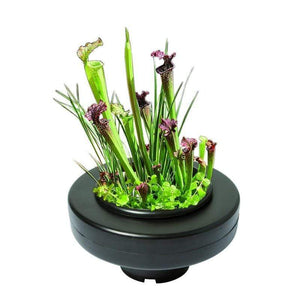
| Plant-filled floating basket | Island of marginal plants | Depending on the plants | Roots in the water like water hyacinth |
Water crowfoot, the closest visually
It forms small rosettes of round, shiny leaves, like a miniature water lily, with white three-petalled flowers in summer. Its roots hang in the water and absorb nutrients. In autumn, it produces winter buds that sink and rise again in spring: nothing to do.
Water aloe, the discreet purifier
Its rigid rosettes float in summer and sink in winter. It consumes a lot of nutrients and provides shelter for abundant wildlife. Handle it with gloves: the edges of the leaves are serrated.
The floating basket, the real replacement for water hyacinth
What we loved about water hyacinth was its curtain of roots that filters the water. A basket or floating island filled with irises, pontederia, or bulrush reproduces exactly this effect: the roots of the marginal plants pass through the support and hang freely in the water, without the risk of invasion.
Water lilies and false water lilies, for shade
To cover the surface permanently, nothing replaces a water lily. False water lily flowers yellow all summer but spreads quickly: reserve it for large ponds or grow it in a basket.
Hornwort and Utricularia, below the surface
They do not provide shade, but float freely between the two waters and compete with algae for nutrients. Hornwort is one of the few plants we ship everywhere.
How much to plant?
Aim for about half the surface covered in midsummer, including all floating-leaved plants. Below 30%, the effect on algae is weak; above 70%, the water lacks light and gas exchange, which can bother fish in warm weather. Remove the excess with a net: every handful removed takes nutrients out of the pond.
Receiving live plants
We deliver live aquatic plants within a 150 km radius of our Nodebais garden centre. Plant kits, bare-root plants, and hornwort are shipped everywhere. Any questions: support@foudebassin.com or +32 10 86 03 54.
Frequently asked questions
Can you still buy water hyacinth online?
Some websites outside the European Union still offer it, but importation, cultivation, and transport are banned in the Union. Do not take the risk.
Water hyacinth does not survive the winter here: why ban it?
Because the regulation applies to the entire Union, including Mediterranean regions where it proliferates, and because warm summers now allow it to multiply in the north before the first frosts.
What floating plant for a small pond?
Water crowfoot and a dwarf water lily are enough in a pond of less than 2 m². Avoid false water lily, which is too vigorous.
Are duckweed a good alternative?
They are permitted and highly purifying, but quickly cover the entire surface. See our article on duckweed.
Also read: What floating plants for ponds and garden ponds? and List of filtering aquatic plants.
Produits et rayons conseillés


Products recommended by our experts
See the full selection Aquipond BactoClay - Montmorillonite clay 2 kg for koi ponds
€39,95
View product
 Minerall in One Aquipond - Increases GH & KH simultaneously - 2.5KG to treat 30M³
€49,00
View product
 Sera Aqua-Test Set - The essential analysis kit for ponds and aquariums
€34,61
 Aquipond KH+ 1kg - Increases Carbonate Hardness (KH)
€19,95
Read also
All our tips Pond bulrushes: soft rush, striped bulrush and drooping bulrush, the guide
Updated November 26, 20263 min read
 Utricularia: the carnivorous aquatic plant that hunts mosquito larvae
Updated November 26, 20263 min read
 Thalia dealbata: the large exotic bank plant that survives the winter outdoors
Updated November 26, 20263 min read
Leave a comment