


Filamentous algae in an aquarium: identify the type and eliminate them in 3 weeks
One morning, a few green threads cling to the tips of the plants. A week later, they form sheets that trap the leaves, wrap around the thermometer, and clog the filter intake. Filamentous algae are among the most discouraging problems in aquariums because they grow quickly and return if you simply pull them out. To eliminate them, you need to do three things in order: identify the type of filament, remove the mass by hand, then correct the imbalance between light, CO2, and nutrients that caused them to explode. Here’s how to proceed, with a three-week plan that works in the vast majority of tanks.
— The short answer
Remove as many filaments as possible by hand (a toothbrush twisted around itself winds them up like spaghetti), reduce the lighting period to 6 to 7 hours, perform a 30 to 50% water change each week, add fast-growing plants and a few Amano shrimp. Stabilize the CO2 if your tank receives it, and check the phosphate and nitrate levels. Within two to three weeks, most infestations will noticeably recede. Rigid cladophora-like tufts require more patience.

What filamentous algae really are
“Filamentous algae” is a convenient name that covers several very different green algae that all form threads. In aquariums, you mainly encounter three profiles. Recognizing them helps you avoid wasting time with an unsuitable treatment.
| What you see | Likely | Behavior | Difficulty |
|---|---|---|---|
| Very fine, slimy threads that slip between the fingers, forming sheets | Spirogyra | Grows very quickly under strong light, can cover the tank in a few days | Medium: disappears if you reduce light and excess nutrients |
| Dark green, coarse, branched tufts, sometimes in balls | Cladophora | Slow growth, clings to décor and mosses, regrows from the smallest fragment | High: patient manual removal |
| Tuft or short green hairs on leaves and décor | “Hair” algae (often Oedogonium or Rhizoclonium) | Common in new tanks or with unstable CO2 | Low to moderate: recede when the plants start growing again |
| Hard, gray-black clumps on the edges of leaves | “Beard” or brush algae (red algae) | This Is Not Green Filamentous Algae | Treat Differently |
The touch test is the most reliable: take a little algae between two fingers. If it is slimy and comes apart, think spirogyra. If it is stiff and catches like very fine steel wool, think cladophora. If you see dark, hard clumps instead, it is beard algae, covered in our article on beard algae.
Why they explode in your tank
Algae do not “fall” from the sky: their spores and fragments arrive with plants, decor, or water, and they wait for favorable conditions. A proliferation almost always indicates that the plants are no longer consuming all the available resources. The most common causes:
- Too much light for the amount of plant growth: powerful lighting or lighting left on for 10 to 12 hours a day, few plants, or slow-growing plants (anubias, ferns) alone.
- Unstable CO2: in tanks with injection, an emptying bottle, fluctuating flow rate, or clogged diffuser often triggers hair algae.
- Unbalanced nutrients: excess food, too many fish, phosphate-rich tap water, or conversely a deficiency in an element that limits plant growth while algae are satisfied with very little.
- A new tank: during the first few weeks, the filter and plants are not yet established, and algae take advantage of the available space.
- Irregular maintenance: fewer water changes, waste accumulating in the substrate and filter.
Remember this: pulling out the strands without correcting the cause is like mowing a lawn. It grows back.
JBL ProScape Tool P 30 straight
30 cm straight tweezers for grasping clumps of algae and cleaning between plants without uprooting everything. Live price and add to cart:
Step 1: remove the mass cleanly
Manual removal is essential: it removes a large amount of nutrients stored in the algae all at once and allows light to reach the plants again. The most effective technique for long filaments is surprisingly simple: a clean toothbrush reserved for aquarium use, which you dip into the growth and rotate around its own axis. The strands wind around the bristles like spaghetti around a fork. Take it out, rinse it in a bucket, and repeat.

A few precautions:
- Turn off the filter pump during the operation to prevent fragments from being sucked up and redistributed.
- For rigid tufts attached to the decor, remove the stone or root and brush it outside the tank, under aquarium water taken from a bucket, never under hot water or with soap.
- Prune heavily colonized leaves rather than persevering: a healthy plant will grow new ones.
- Finish by siphoning the substrate and changing 30 to 50% of the water to remove debris.
For delicate plants covered in fuzz, our article on algae on aquarium plants details the appropriate steps for each type of leaf.
Step 2: rebalance light, CO2 and nutrients
The light
Reduce the lighting period to 6 to 7 hours per day throughout the treatment phase, using a timer to keep it consistent. If your LED light is adjustable, also reduce the intensity by 20 to 30%. Make sure no direct daylight reaches the tank. Some aquarists use a three-day “blackout,” covering the tank with a blanket: this weakens spirogyra and hair algae, but not really cladophora, and it is only useful as a complement to the other measures.
CO2
In a tank with CO2 injection, the goal is not “more CO2” but stable CO2: the same flow rate every day, starting one to two hours before the lights come on and stopping one hour before they go off. Clean the diffuser, check the pressure and the bubble counter. In a small tank without injection, a biological CO2 system can help medium-growth plants, provided you monitor the fish’s behavior.
The nutrients
Test nitrates and phosphates. If both are high, the cause is often the food and the population: reduce rations (what the fish eat within one to two minutes), increase water changes, and check the tap water. Anti-phosphate filter media can help if a test confirms an excess, but do not overuse it in a heavily planted tank: plants also need phosphorus. If, on the other hand, nitrates and phosphates are nearly zero in a brightly lit tank, the plants may be deficient, and a well-dosed complete fertilizer will give them the upper hand again.
JBL PhosEx Ultra
Filter media that binds phosphates, to be used when a test confirms an excess. Live price and add to cart:
Step 3: give the plants and algae eaters the upper hand
Algae recede when vigorous plant growth consumes nutrients before they can. Temporarily add fast-growing plants: stem plants such as hygrophila or limnophila, or floating plants, which absorb nitrogen and provide some shade at the surface. You can remove them once balance has been restored.
Among algae eaters, the Amano shrimp (Caridina multidentata) is the best ally against fine filaments and hair algae: a group of a few individuals per 60 liters or so does a remarkable job, provided they are not overfed. The Siamese algae eater (Crossocheilus) also consumes certain filamentous algae, but it grows large and becomes less effective with age; it is suitable for tanks of at least around one hundred liters. No animal will overcome a massive infestation on its own: they maintain the tank, they do not clean an overrun tank.

The 3-week plan
| Period | Actions | What you should observe |
|---|---|---|
| Days 1 to 3 | Complete manual removal, trim affected leaves, siphon, and change 40 to 50% of the water. Reduce lighting to 6 hours. | The tank may look “bare”: this is normal. |
| Days 4 to 7 | Remove regrowth every two days. Test nitrates and phosphates. Add fast-growing plants. Reduce rations. | The filaments are growing back more slowly. |
| Week 2 | 30% water change. Introduction of Amano shrimp. Adjust the CO2 if injected. | New green shoots on the plants, fewer mats. |
| Week 3 | 30% water change. Remove the last strands. Gradually increase the lighting in 30-minute steps. | Tank stabilized; only a few isolated clumps remain. |
If the lighting is increased too quickly, the algae return within a week: this is the signal to step back down one level and let the plants build up more biomass.
What about liquid anti-algae treatments?
They do exist, and some act on filamentous algae, particularly products known as “liquid carbon.” They can provide occasional help with localized clumps, but they do not correct any underlying cause. Above all, several of these products are poorly tolerated by shrimp, snails, and certain plants such as Vallisneria when overdosed. Follow the instructions strictly, avoid combining them, and turn off the filter's activated carbon only if the manufacturer requires it. Algae killed in large quantities decompose and consume oxygen: remove them and perform a water change a few days later.
Mistakes that cause filaments to return
- Pulling them out without turning off the pump: the fragments are redistributed throughout the tank.
- Turning the lighting back up to full as soon as the tank is clean.
- Overfeeding the fish to make up for meals that are “too small.”
- Cleaning the filter with tap water, which destroys beneficial bacteria and triggers another imbalance. Rinse the filter media in aquarium water.
- Introducing unchecked plants: rinse and inspect each new plant, and remove any visible strands before planting it.
Keeping a filament-free tank over time
Once balance has been restored, a few habits are enough to prevent a recurrence. Keep up regular water changes, around 20 to 30% per week, even when everything is going well. Trim the plants before they reach the surface and shade the others. Keep a log of the lighting duration, fertilizer doses, and CO2 flow rate: when strands reappear, you will know what has changed. Replace the tubes or check the LED intensity according to the manufacturer's recommendations, without increasing the power “because the plants are growing well.” Finally, stay vigilant: removing a few strands as soon as they appear takes two minutes of work; an established mat takes three weeks of effort.
JBL ProFlora bio80 2
Biological CO2 system for small planted tanks: better-nourished plants leave less room for algae. Live price and add to cart:

You may also like
For other types of algae: I have algae in my aquarium, what should I do?.
READ THE ARTICLEDo your algae look unlike any of the cases described? Send us a photo, the tank volume, the lighting duration, and your nitrate and phosphate levels: the Foudebassin team will help you identify the algae and adjust your plan.
Frequently asked questions
— How can I tell spirogyra from cladophora?
To the touch: spirogyra is fine, slimy, and comes apart between the fingers; cladophora is rough, branched, and clings strongly to the decor.
— Do Amano shrimp eat filamentous algae?
Yes, especially fine filamentous algae and hair algae. They are very effective at maintaining a tank, but they cannot overcome a massive infestation on their own.
— Should I turn off the light completely to kill filamentous algae?
A three-day blackout weakens some algae, but it is not enough on its own. Permanently reducing the lighting duration and strengthening the plants is more effective.
— Why do filamentous algae come back after cleaning?
Because the cause has not been corrected: too much light, unstable CO2, or excess nutrients. Manual removal only buys time.
In summary
- Identify the type: slimy spirogyra, rough cladophora, or hair algae-like fuzz.
- Remove the mass with a toothbrush, with the filter pump switched off, then change the water.
- Reduce lighting to 6 to 7 hours and stabilize the CO2.
- Test nitrates and phosphates, reduce feeding, and add fast-growing plants.
- Amano shrimp maintain the results; they do not create them.
Sources and references
- Scheffer M., Ecology of Shallow Lakes, Chapman & Hall, 1998 (competition between plants and algae)
- Wetzel R. G., Limnology, 3rd ed., Academic Press, 2001 (ecology of filamentous green algae)
- Manufacturer technical data sheets: JBL (PhosEx Ultra, ProFlora, ProScape)
- Foudebassin consulting experience, Nodebais (Belgium)
Last updated: October 3, 2026.
Products recommended by our experts
See the full selection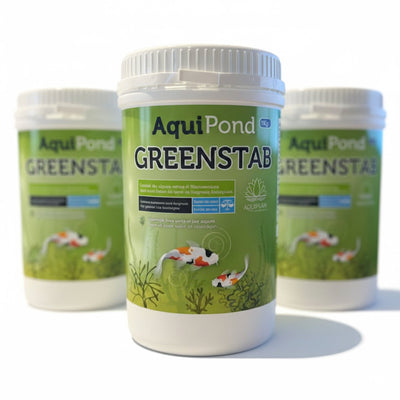 Aquipond Greenstab - Balanced pond water, limits algae
À partir de €34,95
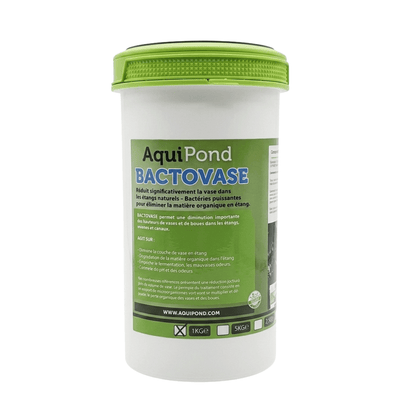 Aquipond Bactovase 1 kg – Bacteria for pond sludge reduction (5 to 10 m²)
€39,95
View product
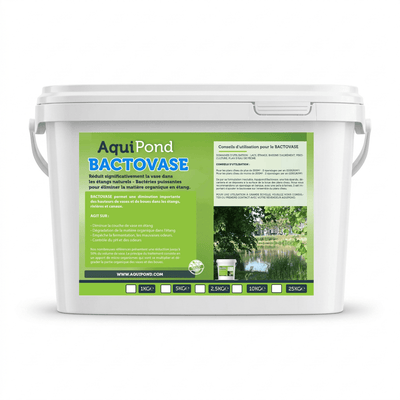 Aquipond Bactovase 2.5 kg – Bacteria to reduce pond sludge (12.5 to 25 m²)
€89,95
View product
 Aquipond Bactovase 5 kg – Bacteria to reduce pond sludge (25 to 50 m²)
€151,00
View product
Read also
All our tips Lowering nitrates in an aquarium: find the source, act quickly, and stabilize it for the long term
10 min read
 Increasing nitrate levels in a planted aquarium: when it’s useful and how to dose safely
14 min read
 Raise an aquarium’s pH: check the KH first, then adjust it without stressing the fish
11 min read
Leave a comment