


Why cyanobacteria bloom after a heatwave: the timeline of a bloom
The scenario is almost always the same. A week of intense heat, water that looks «a little green», then one morning, blue-green streaks, a kind of spilled paint on the surface, sometimes with a musty smell. Owners feel as though cyanobacteria have fallen from the sky. In reality, they were already there in small numbers: the heat wave does not create them; within a few days, it gives them every advantage over the other algae. Understanding the chronology of this shift means knowing when we can still influence how things unfold.
— The short answer
Cyanobacteria explode after a heat wave because the heat brings all their favorable conditions together at once: very warm water, which they tolerate better than green algae; calm, stratified water where they can float at the surface thanks to their gas vesicles; phosphorus released from oxygen-deprived sediment; and a high pH with little carbon dioxide, which they exploit better than their competitors. The bloom becomes visible at the end of the heat wave, and its subsequent collapse can cause a sharp drop in oxygen levels.

Before the heat wave: the groundwork is already laid
It all begins well before the heat wave. For months, or even years, the pond has accumulated phosphorus: fallen leaves, fish food, excrement, soil carried in by rain. Much of this phosphorus is not in the water but stored in the sediment, bound to iron compounds. As long as the bottom remains oxygenated, it stays there. In spring, green algae and diatoms dominate, while cyanobacteria are present but inconspicuous.
Days 1 to 3: the water warms and settles
With very hot days and nights that no longer cool down, the surface layer warms considerably. It becomes lighter than the bottom water and stops mixing with it: this is stratification, described by Wetzel in all somewhat deep bodies of water. Without wind, the surface water is almost motionless.
First advantage for cyanobacteria: many of them tolerate, or even thrive at, temperatures at which green algae slow down. Second, more decisive advantage: some species have gas vesicles that allow them to regulate their buoyancy. In calm water, they rise and settle near the surface, in full light, while green algae, which tend to sink, remain in their shade.
Days 3 to 7: the sediment opens the tap
Isolated from the surface by stratification, the bottom water loses its oxygen, which is consumed by the decomposition of sediment. When the bottom becomes anoxic, the iron compounds that were retaining phosphorus dissolve and release it into the water. This is the mechanism well known to limnologists as “internal loading”: the pond fertilizes itself again, without any external input.
At the same time, intense daytime photosynthesis consumes carbon dioxide and causes the pH to rise. Yet many cyanobacteria are particularly effective at capturing carbon when it becomes scarce. And if nitrogen becomes limited, some species can fix nitrogen from the air, which green algae cannot do. Scheffer clearly shows how these cumulative advantages establish the dominance of cyanobacteria in shallow, nutrient-rich bodies of water.
It is the combination that causes the explosion: heat, stagnant water, phosphorus released by sediment, and high pH. Remove just one of these ingredients, and the bloom becomes much less likely.
Oase AquaActiv PhosLess
Binds dissolved phosphate in the water to deprive algae and cyanobacteria of their main nutrient. Install before summer. Live price and add to cart:
End of heatwave: the bloom becomes visible
After about a week, sometimes less in a small, heavily loaded pond, the population has had time to multiply. It suddenly becomes visible: suspended grains, blue-green streaks pushed by the wind against a bank, a film that looks like paint. This is often when people call us, even though the process began much earlier.
From this point on, exercise caution. Some cyanobacteria produce toxins. Do not swim, prevent dogs from drinking or bathing, and handle the water while wearing gloves.
After the heat wave: the collapse, the most dangerous moment
A storm, a drop in temperature, or overcast skies for several days in a row, and the bloom collapses. This mass of cells dies and decomposes, consuming enormous amounts of oxygen and releasing their contents into the water, including any toxins and compounds with an earthy or musty odor. Fish kills attributed to cyanobacteria very often occur during this phase, due to a lack of oxygen, rather than during the bloom itself.
The timeline in one table
| Phase | What happens | What you can do |
|---|---|---|
| Before summer | Phosphorus stored in the sludge | Reduce sludge, bind phosphate, plant |
| Days 1 to 3 | Warm, still, stratified water | Circulate the water, provide shade, aerate the bottom |
| Days 3 to 7 | Anoxic bottom, released phosphorus, high pH | Maintain aeration, stop feeding |
| End of heat wave | Visible bloom | Make it safe (swimmers, animals), skim off the accumulations |
| After | Collapse, oxygen drop | Maximum aeration; monitor fish at dawn |
Sera Test PO4 (phosphates)
To find out how much fuel your pond reserve has left, in spring and then during summer. Live price and add to cart:
Break the chain before the next heat wave
In the ponds we monitor, blooms decrease significantly when we act on two links in the chain at the same time. The first is phosphorus: less feeding, fewer leaves sinking, progressively reduced sludge, and binding of dissolved phosphate. The second is stagnant water: aeration that circulates the water column prevents stratification, keeps the bottom oxygenated, and limits the release of phosphorus from the sludge. Well-established submerged and floating plants complete the system by directly competing for nutrients and light.
Oase OxyTex Set 500
Bottom aeration with bacterial support for 5 to 10 m³ ponds: keeps the bottom oxygenated and the water moving during hot spells. Live price and add to cart:

Read also
To treat and prevent: Cyanobacteria in a natural pond: a complete guide to restoring healthy water.
READ THE ARTICLEBlue-green streaks on your pond? Send us a photo or visit Aquiflor in Nodebais: we will help you identify what is happening and protect your fish during the collapse phase.
Frequently asked questions
— Are cyanobacteria algae?
No. They are bacteria capable of photosynthesis, long called “blue-green algae.” They live in the same environments as algae and compete with them.
— Why does the bloom often appear at the end of the heatwave?
Because it takes several days of favorable conditions for the initially inconspicuous population to multiply enough to become visible. The process begins as soon as the first hot days arrive.
— Does a storm make cyanobacteria disappear?
It can cause them to collapse by mixing and cooling the water. This is precisely a risky moment: the decomposition of the mass of cells consumes a great deal of oxygen.
— Can fish be left in an affected pond?
Yes, in most cases, provided that strong aeration is maintained day and night and the fish are monitored at daybreak, especially during and after the collapse.
In summary
- Cyanobacteria are already present: the heatwave gives them the advantage.
- Heat, stagnant water, phosphorus released by sediment, and high pH combine over about a week.
- The collapse after the heatwave is the most dangerous moment for fish.
- Acting on phosphorus and water circulation breaks the chain.
Sources and references
- Wetzel R. G., Limnology: Lake and River Ecosystems, 3rd ed., Academic Press, 2001
- Scheffer M., Ecology of Shallow Lakes, Chapman & Hall, 1998
- Boyd C. E. and Tucker C. S., Pond Aquaculture Water Quality Management, Kluwer, 1998
- Manufacturer technical data sheets: Oase, Sera
- Aquiflor / Foudebassin consulting experience, Nodebais (Belgium)
Last updated: September 29, 2026.
Les produits conseillés par nos experts
Voir toute la sélection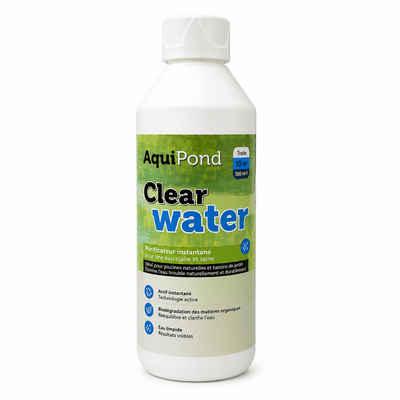 Aquipond ClearWater 10M³ - Works effectively on green water - Instant clarifier
€29,95
Voir le produit
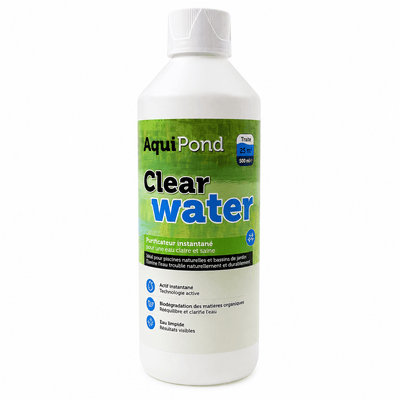 Aquipond ClearWater 25M³ - Works effectively on green water - Instant clarifier
€39,95
Voir le produit
 Aquipond Starter Pack (Nitriboost & Bacto Maintenance)
€89,95
 Aquipond BactoClay - Montmorillonite clay 2 kg for koi ponds
€39,95
Voir le produit


Leave a comment