


What are the algae eating snails for my pond?
Pond owners are often faced with a common but annoying problem: algae growth. Fortunately, nature offers an effective and ecological solution in the form of two species of freshwater snails: ramshorn snails and bladder snails.
In this article, we will explore how these snails help control algae and how you can use them to keep your pond clean and healthy.
Our experts' update: for an outdoor pond in France or Belgium, choose native snails such as ramshorn and bladder snails. Malaysian trumpets and neritina snails are tropical snails that cannot survive the winter outdoors, and apple snails of the genus Pomacea are banned in the European Union. Never release an aquarium snail into a pond or into the wild.
2 native families to choose: ramshorn and bladder snails
3 species mentioned below are tropical: for aquariums only
Hard waterwith sufficient KH and GH protects the shell
1 lever among others: light, nutrients, plants
Ramshorn Snails: Discreet Defenders Against Algae
Ramshorn snails, members of the Planorbidae family, are known for their insatiable appetite for algae. They are extremely valuable in a pond environment, playing a key role in the fight against algae.
Their characteristic spiral shell hides a hard worker. They roam the bottom of your pond, grazing on algae along the way. In addition to helping reduce algae, they also help break down organic matter, contributing to an ideal biological balance in your pond.
Going further against algae
Snails help; light, filtration, and nutrients do the rest.
Bladder Snails: Energetic Fighters Against Algae
Next are bladder snails, or snails of the Viviparidae family. They are also avid algae eaters and share many benefits with ramshorn snails.
These snails differ mainly in their reproduction. Ramshorn snails, which are hermaphroditic, lay eggs, while bladder snails carry their offspring live. This latter characteristic can be advantageous for quickly establishing a snail population in your pond.
Ramshorn or bladder snails: how to identify them
The two families are easily distinguished with the naked eye. The ramshorn snail has a flatly coiled shell, like a small spiral lying on its edge. The bladder snail has a conical and domed shell, closed by an operculum that it closes when it retracts. Both are species from our freshwater, adapted to European winters: they slow down their activity at the bottom of the pond when the water cools.
Bladder snails have an additional asset: in addition to grazing, they filter some of the suspended particles. However, they do not replace filtration or a UV-C lamp, but they contribute to the biological balance of the pond.
Adopting Ramshorn and Bladder Snails for Your Pond
The successful integration of these snails into your pond depends on how you introduce them. Although they are excellent algae eaters, they cannot solve a massive algae problem on their own.
It is essential to have a complete strategy for algae control. This includes managing light, reducing nutrients, and potentially adding other algae eaters.
Several other snail species can be useful for algae control in outdoor ponds and ponds. Here are a few examples:
-
Snails of the Viviparidae family (Viviparus viviparus): These snails are also great algae eaters.
-
Malaysian trumpet snails (Melanoides tuberculata): They are often used in aquariums for their effectiveness in eating algae, but they are tropical snails that cannot survive the winter in an outdoor pond at our latitudes: reserve them for the aquarium.
-
Neritina snails (Neritina natalensis): They are known for being excellent algae eaters in aquatic environments, but they are tropical snails: they need warm water and are not suitable for an outdoor pond at our latitudes.
-
Apple snails (Pomacea bridgesii): They also consume algae and plants, but they are tropical snails, and their introduction into the European Union as well as the circulation of snails of the genus Pomacea have been banned since 2012: they have no place in a pond.
However, it is important to note that the effectiveness of snails as algae eaters depends on the type of algae present in your pond. In addition, they will not be able to solve an algae infestation problem on their own. Algae control requires a comprehensive approach, including light control, reducing available nutrients (food for algae), and possibly introducing other algae-eating organisms, such as certain fish and invertebrates.
It is also crucial to ensure that your pond conditions are suitable for the snail species you plan to introduce. Some snails need warmer or colder water, a certain chemical composition of the water, etc. Also, make sure that the species you introduce is not invasive in your region.
Welcoming snails properly into your pond
A snail introduced in poor conditions often disappears within a few weeks, without anyone understanding why. A few simple precautions make the difference.
- Choose native species. Ramshorn and bladder snails, purchased from an aquatic garden center, rather than aquarium snails.
- Check the water hardness. The shell is built with minerals from the water: very soft or acidic water damages it. Check the KH and GH with a test, as explained in our guide for conducting a water analysis of your pond.
- Acclimate gently. Let the bag float for a while in the pond to balance the temperature, then place the snails in a shallow and planted area.
- Offer shelter. Oxygenating plants and bank plants provide them with food, shelter, and egg-laying supports.
- Read the treatment label. Some products for fish or for water, especially those based on copper, can be harmful to snails and invertebrates.
If your snails' shells become thin, whitish, or eroded, first check the KH and GH of the water. In a pond filled with rainwater, these values often drop over the season: an appropriate mineral input protects both the snails and the stability of the pH.
Minerall in One AquipondMineral mix that raises the GH and KH at the same time, useful in ponds filled with rainwater.See product →Sera Aqua-Test SetDrip test kit for pH, KH, GH, and nitrites of the pond.See product →
Snails in an overall strategy against algae
Snails mainly graze on algae attached to rocks, walls, and leaves. They have almost no effect on green water, due to microscopic algae in suspension, and little effect on a large mass of filamentous algae. They are therefore a useful complement, provided you first act on what feeds the algae.
To identify the type of algae present in your pond and choose the right answer, consult our guide algae in a pond: identify the problem and choose the right solution. And if you were thinking more about fish, read our article on algae-eating fish for outdoor ponds first: several species often recommended cannot withstand our climate.
In Summary
In conclusion, ramshorn and bladder snails can be your best friends to fight algae in your pond. They are a natural and ecological solution to maintain the balance of your pond. However, keep in mind that they are only one element of a broader strategy to control algae. By combining their help with proper management of light and nutrients, you will be able to keep your pond healthy.
Going further against algae
Snails help; light, filtration, and nutrients do the rest.
Your frequently asked questions about pond snails
Which snails to put in an outdoor pond?
Ramshorn and bladder snails, two families of native freshwater snails that withstand European winters. Avoid tropical aquarium snails such as Malaysian trumpets or neritinas, which cannot survive the winter outdoors.
Do snails spend the winter in the pond?
Native species, yes: they slow down their activity and stay at the bottom when the water cools. A deep area that does not freeze to the bottom is also useful for them as it is for fish.
Do snails eat the plants in the pond?
Ramshorn and bladder snails are mainly interested in algae, debris, and damaged parts of plants. Some other species, such as large pond snails, may graze more on tender plants.
Are snails enough against green water?
No. Green water is due to microscopic algae in suspension, which snails practically do not consume. It is treated by filtration, a suitable UV-C lamp, and nutrient reduction.
Do fish eat snails?
Koi and some goldfish can swallow young snails or small species. In a pond very populated with koi, the snail population often remains limited; shallow planted areas serve as refuge for them.
Why is my snail's shell damaged?
Most often due to water that is too soft or acidic, poor in minerals. Measure the KH and GH: if they are low, a mineral input adapted to the volume of the pond helps protect the shells.
Les produits conseillés par nos experts
Voir toute la sélection Minerall in One Aquipond - Increases GH & KH simultaneously - 2.5KG to treat 30M³
€51,45
Voir le produit
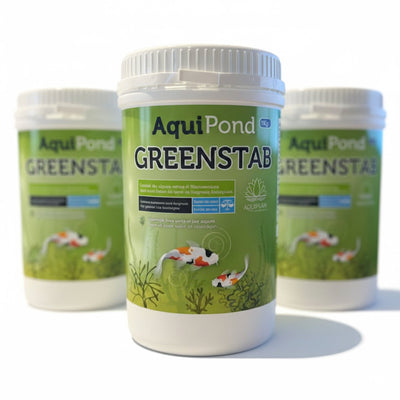 Aquipond Greenstab - Balanced pond water, limits algae
À partir de €36,70
 Aquipond Bacto Maintenance 500G – 0.5 Kg - Maintenance Bacteria - Treats 5m³ throughout the season
€31,30
 Sera Aqua-Test Set - The essential analysis kit for ponds and aquariums
€36,34


Comments
Leave a comment