


The Foudebassin.com team
Published
3 min read
Japanese fringetree (flowering creeper): the air-purifying plant with pink umbels
It is called a flowering rush, but it is not a rush. The butome (Butomus umbellatus) is a plant native to our banks, with thin, triangular leaves, which bears magnificent pale pink flower umbels at the top of tall stems in summer. Above all, it is one of the most effective pond plants for consuming nutrients, and a cornerstone of naturally balanced ponds.
Profile
| Criterion | Butome |
|---|---|
| Height | 1 to 1.50 m in flower |
| Flowering | Pink umbels, June to August |
| Water depth | 5 to 30 cm above the root ball |
| Exposure | Sun |
| Hardiness | Very hardy, native |
Why it is so purifying
The butome forms a creeping rhizome and a dense root system that quickly colonizes the substrate. Its rapid growth in spring and summer makes it consume a lot of nitrates and phosphates, at the very moment when algae take advantage of them. It also tolerates a wide variety of depths, making it an easy plant to place in a lagooning zone.
This is why we have included it in our natural filtration packs, with freshwater mussels that filter the water and water pepper that oxygenates: pack 1 to 5 m³, pack 5 to 10 m³ and pack 10 to 20 m³.
Planting
- Plant from April to July, in full sun.
- In a garden pond, use a wide basket, heavy soil and gravel on the surface.
- Place it with 5 to 30 cm of water above the soil. Young plants prefer the lower end of this range in the first year.
- In lagooning, plant directly in the mineral substrate, removing the soil from the root ball.
Our all-in-one kit butome arrives already in a 18 cm pot with its substrate: simply place it at the right level.
Making a butome flower
The butome does not always flower in the first year: it starts by establishing its roots. Then, three conditions matter: sun, enough space (a clump that is too tight flowers less) and an appropriate depth. Planted too deep, it produces floating leaves and forgets to flower.
Maintenance
- Cut off the faded umbels if you do not want seedlings.
- In autumn, cut back the yellowed leaves above the water and remove them from the pond.
- Divide every three years in spring: the butome forms small plantlets along the rhizome, which can be detached and replanted.
Associations
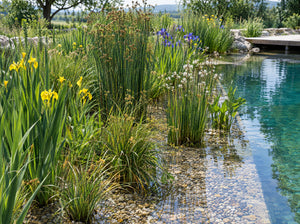
Its pink umbels match the blue of the water primrose, the yellow of the marsh iris and the lilac of the water mint. Its thin and light foliage contrasts with the large leaves of the water arum.
Delivery
Live plants delivered within a radius of 150 km around Nodebais; kit plants, such as the 18 cm potted butome, are shipped everywhere. One question: support@foudebassin.com or +32 10 86 03 54.
Frequently asked questions
Is the butome invasive?
It spreads moderately by its rhizomes and plantlets. In a basket, no worries.
Do koi eat it?
Its tough leaves interest them very little. Above all, protect the soil of the basket with pebbles.
How many butomes for my pond?
For a purifying role, count about two plants per cubic meter of water, spread with other bank plants. Our natural filtration packs are sized on this basis.
Also read: Creating a natural filter for your pond and List of filtering aquatic plants.
Produits et rayons conseillés

Products recommended by our experts
See the full selection Aquipond BactoClay - Montmorillonite clay 2 kg for koi ponds
€39,95
View product
 Minerall in One Aquipond - Increases GH & KH simultaneously - 2.5KG to treat 30M³
€49,00
View product
 Sera Aqua-Test Set - The essential analysis kit for ponds and aquariums
€34,61
 Aquipond KH+ 1kg - Increases Carbonate Hardness (KH)
€19,95
Read also
All our tips Sweet flag (Acorus): the riverside plant with a mandarin scent, cultivation and uses in ponds
Updated November 24, 20264 min read
 Do fish feel pain? What science knows today
Updated November 25, 20262 min read
 Do fish drink water? The surprising answer (and why it's different in the ocean)
Updated November 25, 20262 min read
Leave a comment