


Stéphane H. Rabary
Published
10 min read
The world's most expensive koi: $1.8 million for a fish, how is this possible?
A fish sold for more than a house. In 2018, a kohaku koi named S Legend, bred by the Japanese farm Sakai Fish Farm, was purchased for approximately 203 million yen (Nippon.com), or nearly $1.8 million at the European Central Bank exchange rate on October 4, 2018 (European Central Bank), by a Taiwanese breeder who was bidding on behalf of a client (TVBS). It had won the grand prize at the All Japan Combined Koi Show the previous year, in January 2017, as well as the ZNA title, the Japanese koi enthusiasts' association Zen Nippon Airinkai (Hikari, koi food manufacturer, interview with the breeder).
The essentials
- Known record: S Legend, a kohaku sold for 203 million yen in October 2018.
- At the time of the sale, it had won a national grand prize (2017) and the ZNA title, and measured 101 cm.
- The selection is fierce: out of approximately 200,000 carp born from a single spawn, only 500 to 1,000 become adults at the breeder's.
- For a garden pond, the prices are nothing like that: in the United States, a koi sells for an average of $8.55 when it leaves the farm.
203 M¥S Legend's price in 2018
101 cmits length at the time of the sale
2017national grand prize (48th competition)
140+types of koi identified by Niigata Prefecture
S Legend, the story of a champion
S Legend is a female kohaku, the white variety with red markings. She comes from Sakai Fish Farm, a farm in the Hiroshima region run by Kentaro Sakai (Khaleej Times), who has been breeding koi there for about 120 years according to the interview published by Hikari. Her career can be read in a few dates:
- January 2017: grand prize at the 48th All Japan Combined Koi Show. Before her sale, she also won the ZNA title, with 50 out of 50 votes.
- October 2018: auction, broadcast online, for 203 million yen. The buyer, Zhong Yingying, a koi breeder in Yunlin (Taiwan), was acting on behalf of a client; the fish was 9 years old and measured 101 cm (TVBS). The price smashed the previous record (Khaleej Times).
- After the sale, in 2019: second grand prize, at the 50th All Japan Combined Koi Show (Hikari).
This amount remains, to our knowledge, the highest published for a koi.
Why such a price?
- The pattern: in kohaku (white and red), the red patches must be clean, well distributed, with sharp edges, on a snow-pure white.
- The silhouette: powerful, symmetrical body, without flaws.
- The size: the great champions approach or exceed 90 cm; S Legend measured 101 cm at the time of her sale.
- The lineage: the reputation of the breeder and the parents.
- The titles: a grand prize increases the value; according to Nippon.com, prize-winning koi can sell for several tens of millions of yen.
- The rarity: out of thousands of fry, only a few become exceptional.
The breeder of S Legend summarizes these criteria in three words: pattern, proportions, and skin quality (Hikari). To learn how to recognize them on your own fish, see our article judging a koi like in a competition. Behind these criteria, four factors make the price.
The lineage
For Kentaro Sakai, nothing matters more than the lineage of the breeding male to obtain large fish, and poorly matched parents can produce young that stop growing. He also acknowledges that he can only predict the potential of a champion to a certain extent (Hikari). This is the whole art of tategoi: spotting a young koi that will become more beautiful.
The breeder
The name of the farm carries weight. Sakai Fish Farm had already won nine national grand prizes in 2017 and produced about 24 million fry per year (Hikari). In Japan, the historic region remains Niigata, where nishikigoi were born about two centuries ago, during the Edo period (Niigata Prefecture).
The variety
Niigata Prefecture identifies more than 140 types of koi. Not all have the same rating: the three great varieties, kohaku, taisho sanshoku (sanke), and showa sanshoku, dominate the competitions, and their patterns change even during growth (Nippon.com). Our guide to koi carp varieties presents the 16 families, and our article on Gosanke details what distinguishes a beautiful kohaku.
The competitions
Titles make the reputation of a fish. More than a thousand foreign buyers and enthusiasts usually come to the Niigata competition (Nippon.com), and a grand prize at the All Japan Combined Koi Show places the fish at the top.
A ruthless selection
Rarity is measured in numbers. Among the Yamakoshi breeders in Niigata, out of approximately 200,000 carp born from a spawn, only 500 to 1,000 reach adulthood: the others are discarded according to their pattern and health (Japanese Ministry of Land, Infrastructure, Transport and Tourism, MLIT). Niigata Prefecture gives a similar order of magnitude: about 0.5% of the young are kept for their colors or patterns (Niigata Prefecture).
Who buys these fish?
Wealthy collectors, especially in Asia: in 2019, Hong Kong was the top destination for Japanese koi exports by value, ahead of the Netherlands and Germany (Nippon.com). A champion can also continue to compete in Japan after its sale, like S Legend, crowned a second time in 2019. These koi are collector's items, a bit like works of art.
This market carries weight. Japanese koi exports reached 4.7 billion yen in 2019, two and a half times more than in 2005 (Nippon.com). About 80% of the koi produced in Japan go abroad (Nippon.com). To be exported, they must come from state-approved farms, about 150 throughout Japan, especially in Niigata and Hiroshima (Okayama Prefecture).
And a garden koi?
Rest assured: a pond koi costs infinitely less, according to its size, variety, and origin. In the United States, the average price leaving the farm was $8.55 per fish in 2023 (AgMRC, Iowa State University, according to the USDA census). See how much koi carp in your pond are worth.
Between the garden koi and the champion, the price gap is dizzying. The table below locates the major categories, according to published sources.
| Type of koi | What makes its price | Order of magnitude |
|---|---|---|
| Young koi 8 to 10 cm (United States) | Size, quality | $4 to $24 (AgMRC) |
| Koi 58 to 61 cm (United States) | Size, variety, beauty of the pattern | $660 to $3,000 (AgMRC) |
| Koi awarded in competitions in Japan | Titles, breeder, lineage, size | Several tens of millions of yen (Nippon.com) |
| Published record: S Legend (2018) | National grand prize and ZNA title, 101 cm, renowned breeder | 203 million yen (Nippon.com) |
For your pond, the right question is not "how much?" but "will my setup keep up?". A koi can live 25 to 35 years if well cared for (San Diego Zoo): the purchase price matters little compared to the pond, filtration, and food it will require for decades.
Buying a beautiful koi without making a mistake
You are not looking for a champion, but a beautiful, healthy koi adapted to your pond. In our experience, this method avoids most disappointments:
- First check your pond: volume, depth, and filtration must keep up with a growing koi. Our table how many koi according to volume helps you do the calculation.
- Ask for the origin: country, breeder, and if possible variety and age.
- Observe the swimming and the skin before the pattern: a fish that swims straight, without wounds or raised scales.
- Then judge the pattern, knowing that it will still evolve in a young koi.
- Plan a quarantine before mixing the newcomer with your fish.
Our article buying a koi carp: 12 quality and health criteria details each point.
An ordinary koi, well fed and in stable water, often becomes more beautiful than an expensive koi poorly cared for. Invest first in filtration and quality food: that's what will make the difference in your pond.
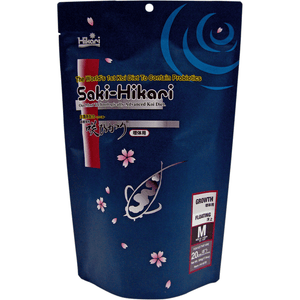
 Saki-Hikari Color Medium 2 kgJapanese daily food designed to support the colors of koi.See product
 Koi sock 120 cm – Koi ProTo take out and observe a large koi without hurting it, during transport or care.See product
Is your pond ready for beautiful koi?
Send us its dimensions: we will help you choose the right food and equipment.
Frequently asked questions
Does an expensive koi live longer?
Not necessarily. Longevity depends mainly on the quality of the water and care. A well cared for koi commonly lives 25 to 35 years, according to the San Diego Zoo, regardless of its price.
Can you find a gem in a cheap lot?
It's rare, but the pattern of a koi evolves as it grows: some become more beautiful with the years.
What is the most expensive koi in the world?
The published record is that of S Legend, a kohaku from Sakai Fish Farm sold for 203 million yen in October 2018, after a grand prize at the All Japan Combined Koi Show in 2017 and the ZNA title.
Why are Japanese koi more expensive?
They come from farms that have been selecting their breeding stock for generations and severely sorting their fry: in Niigata, 500 to 1,000 carp out of approximately 200,000 reach adulthood. For export, they must also come from farms approved by the Japanese state.
Is an expensive koi a good investment?
It's not an investment like any other. A koi is a living being: its pattern can change, it can get sick, and its value depends on competitions and very specialized buyers. Buy it for the pleasure of observing it.
And you?
How much would you be willing to pay for a koi? And which is the most beautiful in your pond?
Also read: 12 amazing things about koi, The chagoi and Koi carp varieties.
Produits et rayons conseillés

Products recommended by our experts
See the full selection Aquipond ImmunoFish – 1 Liter – Koï Mucus for 20 m³
€39,95
View product
 Aquipond ImmunoFish – 2.5 Liters – Koï Mucus for 50 m³
€59,95
View product
 Aquipond ImmunoFish – 5 Liters – Koï Mucus for 100 m³
€89,95
View product
 Malamix 17 – organic supplement for koi and pond fish – 1 L
€28,71


Leave a comment