


The Foudebassin.com team
Published
8 min read
Chagoi: the most sociable koi in the pond, the one who teaches the others to eat from your hand
In a pond full of red-and-white Kohaku and striking black Showa, the Chagoi is initially inconspicuous: a solid-colored fish in tea-brown, olive, or copper. Then you approach the edge, and it is the first to arrive, mouth open, almost breaking the surface. A few weeks later, it is eating from your hand, and the other koi, reassured, follow suit. This is why many enthusiasts recommend it for taming a pond.
The essentials
- The Chagoi is a solid-colored, brown, non-metallic koi, classified among the Kawarimono in competitions.
- It is renowned for being the first to approach people and for leading the more timid koi.
- It is one of the varieties that grow the largest: plan a pond to match its size.
- Its voracious appetite requires measured rations: what the group eats in about 5 minutes.
≈ 90 cmsize a koi can reach
5 minto finish the ration
4 stepsto hand-feed it
7 °Cthreshold below which to stop feeding
What is the Chagoi?
Its name literally means "tea-colored carp": cha (茶) means tea in Japanese (Jisho dictionary). It belongs to the family of solid-colored, non-metallic koi, such as the grey Soragoi or red Benigoi, and competes in the Kawarimono class (POND Trade Magazine, the industry's professional publication). Its color ranges from tan to deep brown, through olive and reddish-brown; Gin Rin specimens, with their shiny scales, have bronze or copper reflections. It has no pattern: all its beauty lies in the uniformity of its color and the network of its scales, whose darker edges create a mesh pattern; in large specimens, the visible skin between the scales (fukurin) adds a lighter lace-like effect.
A character apart
- Very tame: it is renowned for being the quickest to approach people, especially at feeding time (POND Trade Magazine).
- A leader: by coming to eat at the surface and from your hand, it leads the more timid koi. Our experts consider it one of the best koi for taming a pond.
- Hardy: like koi in general, which the University of Florida describes as robust and easy-to-raise fish (UF/IFAS).
On the koi's ability to recognize their owner, see our article Can a koi recognize its owner?
A giant of the pond
The Chagoi is one of the varieties that grow the fastest and largest (POND Trade Magazine). Under good conditions, a koi can reach about 90 cm (Smithsonian National Zoo), and the Chagoi is among the varieties that approach these sizes. It has also been used in breeding: according to breeder and dealer Taro Kodama, the Karashigoi is descended from a Kigoi and a Chagoi, and inherited its appetite and rapid growth (POND Trade Magazine). So plan a pond to match its size: see How many koi in my pond and What depth for a koi pond.
How to choose a beautiful Chagoi
- Uniform color from head to tail, without lighter or darker patches.
- A clear and regular scale mesh, with each scale well-aligned.
- A powerful body, symmetrical, with broad shoulders: the promise of a large koi.
- Clean pectoral fins, sometimes darker, which is appreciated.
- A clean head, without markings.
These are the criteria our experts look at first. A young Chagoi may appear dull: the scale mesh and fukurin become more pronounced with age (POND Trade Magazine). These are also the olive and deep brown shades they look for most.
Its cousins
| Variety | Color | Characteristic |
|---|---|---|
| Soragoi | Solid bluish-grey | As gentle as the Chagoi, very elegant |
| Ochiba Shigure | Blue-grey with brown pattern | "Dead leaves in the autumn rain": Chagoi-type brown pattern on a Soragoi-type grey body |
| Benigoi | Solid red | Very spectacular in a group |
| Chagoi Doitsu | Brown, reduced scales | Few or no scales; very rare |
The meaning of the name Ochiba Shigure and the description of its pattern come from Taro Kodama (POND Trade Magazine); the Chagoi Doitsu is described by POND Trade Magazine. The assessments of the Soragoi and Benigoi are the opinions of our experts. To place the Chagoi among all the families: the complete guide to koi varieties.
Feeding it
Its voraciousness is its signature, and also its pitfall: an overfed Chagoi becomes obese and fouls the water. Distribute what the group eats in five minutes, several times a day when the water is warm, and adjust throughout the season. The Alabama Cooperative Extension also holds the five-minute rule and advises not to feed below 7 °C (ANR-789 fact sheet, copy hosted by Texas A&M). To enjoy its growth potential without damaging the water, see feeding a jumbo koi and our selection of koi food.
Getting it used to eating from your hand
- Always come to feed in the same place and at the same time.
- Crouch at the edge, without sudden movements.
- Place a few floating pellets near you, then gradually bring your hand closer to the surface.
- After a few days to a few weeks, leave the pellets in your palm, at water level.
The Alberta Ministry of Agriculture also recommends feeding in the same place and at the same time, and considers hand-feeding the easiest for a recreational body of water (Alberta Agriculture, Agdex 485/50-1). In our experience, treats like dried shrimp or silkworms build confidence faster. See the treats that koi love.
Keep your hand flat, at water level, and let the koi come. Avoid stroking it or taking it out of the water unnecessarily: its skin is protected by a delicate mucus.
Common mistakes
- Giving in to its voraciousness. It is always asking for more: stick to the ration finished in a few minutes. Leftovers pollute the water.
- Underestimating its adult size. A young 15 cm Chagoi will become a large fish. A fact sheet from the Alabama Cooperative Extension recommends an area of at least 0.9 to 1.2 m deep in a permanent pond (ANR-789).
- Forgetting the timid koi. Throw a portion of the ration in another part of the pond so they can eat too.
- Feeding in cold water. When the water cools down, reduce the rations, then stop below 7 °C, as indicated above.
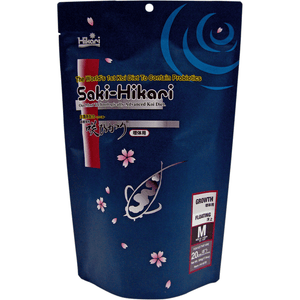
 Saki-Hikari Balance Medium 2 kgJapanese daily food for koi, practical for getting a Chagoi used to coming to eat.View the product
 Hikari Friend Medium 10 kgBasic food for koi and pond fish, in a large package.View the product
Want a Chagoi in your pond?
Send us the volume and depth of your pond: we will help you plan the food and filtration.
Frequently asked questions
Is a Chagoi expensive?
In our experience, a young pond Chagoi remains affordable. Large Japanese specimens with deep colors and a perfect mesh reach high prices, however. See how much the koi in my pond are worth.
Can you have several?
Yes. In our experts' opinion, one or two are enough to build the group's confidence, but a trio of Chagoi in different shades is very beautiful.
Is it aggressive toward other fish?
It is not known to be: koi live in groups without fighting, according to a note from the Okayama Prefecture. It is only faster than the others at feeding time. Make sure the more timid koi get their share.
How big does a Chagoi get?
It is one of the varieties that grow the largest. A koi can reach about 90 cm according to the Smithsonian National Zoo, if the pond and food allow it.
How to teach a Chagoi to eat from your hand?
Feed it in the same place and at the same time, crouch without sudden movements, gradually bring your hand closer to the floating pellets, then leave them in your palm at water level.
Also read: A koi can live for several decades, Kohaku, Sanke, Showa: the Gosanke and The most expensive koi in the world.
Produits et rayons conseillés

Products recommended by our experts
See the full selection Aquipond ImmunoFish – 1 Liter – Koï Mucus for 20 m³
€39,95
View product
 Aquipond ImmunoFish – 2.5 Liters – Koï Mucus for 50 m³
€59,95
View product
 Aquipond ImmunoFish – 5 Liters – Koï Mucus for 100 m³
€89,95
View product
 Malamix 17 – organic supplement for koi and pond fish – 1 L
€28,71
Read also
All our tips 12 amazing things you probably didn't know about koi carp
Updated November 24, 20268 min read
 The world's most expensive koi: $1.8 million for a fish, how is this possible?
Updated November 24, 202610 min read
 Wasps and bees drinking from the pond: should we worry or rejoice?
Updated November 24, 20266 min read
Leave a comment