


The Foudebassin.com team
Published
8 min read
Storks fishing in garden ponds: why it's becoming increasingly common, and how to protect your fish
We thought it was reserved for the rooftops of Alsace and postcards. Yet, every spring, pond owners in Belgium and northern France see a large white bird with black wings and a red beak land in their garden. The white stork is back, and sometimes it has discovered ponds.
The essentials
- The white stork is making a strong comeback: in France, numbers rose from 11 pairs in 1974 to nearly 6,000 in 2023, according to the LPO.
- It eats everything, including fish, and fishes on foot in shallow water.
- It is protected in France, Wallonia, and throughout the European Union: it is illegal to kill, capture, or intentionally disturb it.
- The best solution is a physical barrier: a taut net, a wire around the pond, a deep area, and hiding places.
11 breeding pairs in France in 1974
≈ 6,000 pairs in France in 2023
58 to 64 days at the nest before the young take flight
Annex I of the Birds Directive
A spectacular comeback
The white stork no longer nested in Belgium since the end of the 19th century and had almost disappeared from France in the 20th century, a victim of the loss of wetlands, power lines, and high mortality during migration and wintering in Africa. Thanks to reintroduction programs and its protected status, it is nesting again in many regions, and some even stay through the winter instead of migrating.
The figures speak for themselves. In Belgium, the Dutch ornithological journal Het Vogeljaar dates the last nesting to 1895. In France, the LPO 2026 avifauna barometer counts 11 pairs in 1974 and nearly 6,000 in 2023. The LPO attributes this recovery to reintroduction in Alsace, the installation of nesting platforms, the securing of power lines, and better wintering conditions in the Sahel. It also notes that some storks no longer migrate due to the lack of cold winters. More storks, and storks present for longer: this is what explains the visits to ponds.
What it eats
The stork is opportunistic. It roams through meadows and wetlands eating everything it can swallow: earthworms, insects, voles, frogs, lizards, and fish. In a shallow pond with gently sloping banks, goldfish and young koi are easy prey. It hunts on foot, entering the water like a heron.
The DREAL Grand Est species sheet, written by the LPO Alsace, lists terrestrial and aquatic insects, small mammals, amphibians, reptiles, and fish. The pond is therefore just one food source among others, but an easy one.
A strictly protected species
The white stork is protected in Belgium and France. It is illegal to kill it, capture it, destroy its nest, or intentionally disturb it. We are therefore protecting our fish, not attacking the bird.
Three texts apply:
- European Union: the Birds Directive 2009/147/EC lists the white stork in its Annex I, and Article 5 requires the prohibition of killing, capturing, and intentionally disturbing wild birds.
- France: the decree of October 29, 2009 lists it in Article 3, which prohibits the destruction of nests, capture, mutilation, and intentional disturbance.
- Wallonia: Article 2 of the nature conservation law fully protects all wild birds in Europe: prohibition of trapping, capturing, killing, or intentionally disturbing them.
Never do this. Shooting, trapping, glue, poison, nest destruction, or capture "to release it further away" are prohibited. A loose net in which the bird could get tangled is also to be avoided. The only protections we recommend prevent access to the water without targeting the bird.
Protecting your fish
The solutions are the same as against herons, with a difference in size: the stork is larger and heavier.
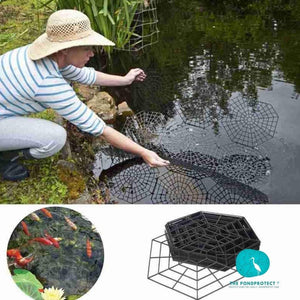
- A taut net over the water remains the most reliable protection. See installing a net on your pond.
- A perimeter wire at a height of 30-40 cm around the pond, which the bird hits when trying to enter on foot.
- Steep banks and an area of more than one meter deep where the fish take refuge.
- Hiding places: tubes, caves, floating plants.
Among our solutions against herons and fishing birds, prioritize physical barriers against storks: net and perimeter wire. Our guide how to chase away a heron reviews other methods; against a protected species, stick to those that do not injure or disturb it.
Depth should be planned from the start: our guide on the depth of a fish pond gives guidelines according to the species.
 Pond Cover Net 4 x 3 m + 10 stakes – SuperfishNet to stretch over the water, delivered with its stakes to keep it well taut.View the product
 Heron Stop – fencing kit – Velda8 stakes, 25 m of nylon line, and 8 bells for a perimeter wire around the pond.View the product
What to do if a stork fishes in your pond?
The answer boils down to one principle: make the water inaccessible without targeting the bird. Here is the procedure, in the order of the diagram:
- observe it without approaching, then assess your fish: number, injuries, behavior; our article a heron visited your pond details these checks, which also apply after a stork;
- stretch a net over the water, away from the surface and without letting it drag on the ground;
- add a perimeter wire at a height of 30-40 cm, which the bird hits when trying to enter on foot;
- provide refuges: an area of more than one meter deep, tubes or caves, floating plants;
- if a bird is injured or caught in a net, do not handle it yourself: call a wildlife rehabilitation center (a CREAVES in Wallonia) or a wildlife care center in France.
Install the net before spring, before the pairs feed their young: it is better that a bird never gets into the habit of fishing in your pond. The same principle applies to herons, as explained in our article on herons returning to the same pond.
When to see it?
According to the DREAL Grand Est sheet, migratory storks return to their nesting sites from March or April. Laying takes place between mid-March and the end of April, incubation lasts 33 to 34 days, and the young take flight at 58 to 64 days. The autumn migration spans from mid-July to mid-September. Food needs therefore peak during the rearing of the young, from April to July approximately.
An exceptional visit
Let's admit it: seeing a stork in your garden is a rare sight. If your pond is protected, take the opportunity to photograph it. It will leave to look for food in the neighboring meadows.
A net, but what size?
Send us the dimensions of your pond: we will help you choose a net and its installation.
Frequently asked questions
Can a stork catch a large koi?
It swallows medium-sized prey. In our experience, a koi of more than 30-35 cm is difficult for it to handle, but it can injure it.
Do fake herons make it flee?
In our experience, not permanently: motionless decoys quickly lose their effect.
When does it come?
Especially from April to July approximately, when the pairs feed their young. However, storks that no longer migrate can come all year round.
Do I have the right to scare away a stork to protect my fish?
You can prevent access to the water with a net or a wire. However, killing it, capturing it, destroying its nest, or intentionally disturbing it is prohibited in France as well as in Wallonia.
What to do if a stork gets caught in my net?
Do not handle it yourself: call a wildlife rehabilitation center, a CREAVES in Wallonia, or a care center in France. To avoid this, keep the net well taut.
And you?
Has a stork ever landed near your pond? We want to see the photos.
Also read: Your fish are disappearing from the pond without a trace?, Installing a heron-proof net on your pond and How to stop the heron from eating my fish.
Produits et rayons conseillés

Products recommended by our experts
See the full selection Aquipond ImmunoFish – 1 Liter – Koï Mucus for 20 m³
€39,95
View product
 Aquipond ImmunoFish – 2.5 Liters – Koï Mucus for 50 m³
€59,95
View product
 Aquipond ImmunoFish – 5 Liters – Koï Mucus for 100 m³
€89,95
View product
 Malamix 17 – organic supplement for koi and pond fish – 1 L
€28,71


Leave a comment