


Cyanobacteria: what if they weren’t your real problem?
“I have cyanobacteria, what should I use?” It is a phrase we hear more and more often, since the media began reporting every summer on lakes closed to swimming. Looking at the photos or samples brought to us in Nodebais, the pattern is consistent: a large proportion of these “cyanobacteria” are actually pollen, green algae, filamentous algae, or a harmless bacterial film. And when they really are cyanobacteria, they are never the cause of the problem: they are the symptom. Treating the surface without understanding what lies beneath means condemning yourself to start over.
— The short answer
Before taking action, check what you actually have: two simple tests, the stick and the jar, often make it possible to distinguish cyanobacteria, green algae, filamentous algae, and pollen. Then, whether or not they are cyanobacteria, look for the cause: excess phosphorus, stagnant water, sediment, overpopulation, insufficient filtration. That is what needs to be corrected. As long as any doubt remains, take precautions: no swimming, keep dogs away, and wear gloves when handling the water.

Cyanobacteria look-alikes
Several common and often harmless phenomena produce a green, yellow, or iridescent surface. Confusing them with cyanobacteria leads to unnecessary or even counterproductive treatments.
| What you see | What it probably is | Clue |
|---|---|---|
| Yellow-green powder on the surface in spring | Pollen | The same deposit on the car and garden furniture |
| Uniform pea-green water, without foam | Suspended green algae | Distinct color, spread throughout the water |
| Cottony clumps, strands that cling | Filamentous algae | Wrap around a stick like hair |
| Distinct small green discs | Duckweed | You can distinguish each tiny leaf with the naked eye |
| Iridescent film that breaks into patches | Bacterial film, often linked to iron | When touched with a finger, it fragments instead of reforming |
| Blue-green paint-like streaks, musty smell | Possible cyanobacteria | Spilled-paint appearance, accumulating along a bank |
Two field tests, with no equipment
The stick test
Dip a stick into the suspicious area and gently pull it back out. If it brings up strands or clumps that hang like wet hair, they are filamentous algae. If it comes out as though it had been dipped in green paint, with no visible structure, cyanobacteria are more likely. Wear gloves.
The jar test
Fill a transparent jar with water collected below the surface, close it, and leave it in a cool place away from direct light for a few hours, or even overnight. Thanks to their gas vesicles, cyanobacteria tend to rise and form a green ring at the surface. Green algae, on the other hand, tend to remain dispersed or settle on the bottom. This is not a laboratory analysis, but it is a useful guide for diagnosis. If you remain unsure, treat it as cyanobacteria: no swimming, keep dogs away, and wear gloves when handling it.
Even if they are cyanobacteria, look for the cause
Cyanobacteria are present in practically all freshwater. If they proliferate in your pond, it is because your pond offers them favorable conditions. Shallow-lake ecologists, beginning with Marten Scheffer, have clearly described this shift from a clear, plant-dominated state to a turbid, phytoplankton-dominated state when nutrients accumulate. The most frequent causes we encounter:
- Too much phosphorus: abundant food, leaves, planting soil, and runoff.
- A thick layer of silt that lacks oxygen and releases its nutrients.
- Stagnant water, without circulation, that heats up quickly.
- Too many fish for the volume and filtration.
- Too few plants to compete with phytoplankton.
- Poorly buffered water whose pH soars in the afternoon.
A complete water test is the starting point: phosphate, nitrate, pH, and KH often tell the pond's story better than the color of the surface.
Sera Aqua-Test Set
Drop test kit for measuring essential parameters and identifying the true cause of an imbalance. Direct price and add to cart:
Why “anti-cyanobacteria” treatments often disappoint
A product that destroys cells at the surface may make the water clearer for a few days. But the causes remain, and the growth returns. Worse, abruptly destroying a mass of cyanobacteria can release their toxins into the water and cause an oxygen drop due to decomposition. It is better to address the underlying causes: reduce inputs, strengthen the pond's biological balance, stabilize the water, and keep it circulating.
Getting the pond back on track
In practice, we generally recommend the same sequence: continuous aeration, reducing feeding, removing some of the silt, adding plants, then strengthening beneficial bacterial flora and stabilizing KH if the water is too soft. These bacteria compete for nutrients and break down organic matter. Well-buffered water, meanwhile, limits pH fluctuations that favor cyanobacteria.
AquaActiv BioKick 200 ml - Oase
Starter bacteria to restart the filter and pond biology after an imbalance. Live price and add to cart:
Nautex 5 kg - Aquipond
Coccolithic chalk for ponds, which helps stabilize carbonate hardness and therefore pH in water that is too soft. Live price and add to cart:

Also read
If the stick test brought up strands: How to get rid of filamentous algae?.
READ THE ARTICLEAre you unsure what is floating on the surface of your pond? Send us a clear photo or bring a sample to Aquiflor in Nodebais, in a closed jar: the Foudebassin team will help you make a diagnosis before you buy anything.
Frequently asked questions
— How can you tell whether they are cyanobacteria or green algae?
The jar test provides a good indication: cyanobacteria tend to rise to the surface within a few hours, while green algae remain dispersed or settle. Only microscopic analysis allows certain identification.
— Can pollen look like cyanobacteria?
Yes, especially in spring. Pollen forms a powdery yellow-green film, without an odor, which is also found on surfaces around the pond.
— Should you treat immediately if you suspect cyanobacteria?
Not with a shock treatment. Take health precautions first, increase aeration and identify the cause. Sudden destruction can release toxins.
— Why do cyanobacteria return every summer despite treatment?
Because the cause, most often excess phosphorus combined with warm, still water, has not been corrected. As long as it persists, the proliferation returns.
In summary
- Pollen, green algae, filamentous algae and bacterial films are often mistaken for cyanobacteria.
- The stick and jar tests help guide the diagnosis without equipment.
- Cyanobacteria are a symptom: phosphorus, sludge, stagnant water and overstocking are the real causes.
- When in doubt, health precautions first, treatment of the underlying cause second.
Sources and references
- Scheffer M., Ecology of Shallow Lakes, Chapman & Hall, 1998
- Wetzel R. G., Limnology, 3rd edition, Academic Press, 2001
- Technical data sheets from Sera (Aqua-Test Set), Oase (AquaActiv BioKick) and Aquipond (Nautex)
- Foudebassin consultation experience, Nodebais (Belgium)
Last updated: September 29, 2026.
Products recommended by our experts
See the full selection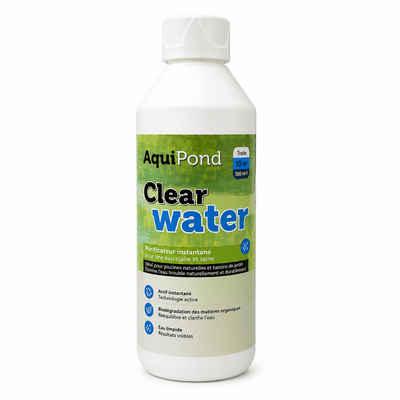 Aquipond ClearWater 10M³ - Works effectively on green water - Instant clarifier
€29,95
View product
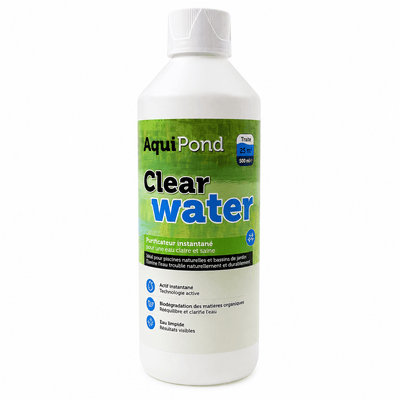 Aquipond ClearWater 25M³ - Works effectively on green water - Instant clarifier
€39,95
View product
 Aquipond Starter Pack (Nitriboost & Bacto Maintenance)
€89,95
 Aquipond BactoClay - Montmorillonite clay 2 kg for koi ponds
€39,95
View product


Leave a comment