


Cyanobacteria in Wallonia: why it is a public health issue
Every summer, the same scenario returns in the local press: a reservoir lake or municipal pond in Wallonia becomes covered with a greenish film, a prohibition sign appears on the jetty, and families who came to cool off leave disappointed. Behind this minor summer inconvenience lies a genuine public health issue. Cyanobacteria are not merely troublesome “algae”: some produce toxins capable of affecting the liver, nervous system or skin in humans and animals alike. And Wallonia, with its countless ponds, pools, reservoirs and garden ponds, is directly affected.
— The short answer
Cyanobacteria are a public health concern because their blooms can release toxins into waters where people swim, where dogs drink and, more rarely, into raw water used to produce drinking water. Warmer summers and excess phosphorus encourage them. Authorities monitor official bathing areas and tap water, but the thousands of private ponds escape all controls: their owner is the first link in prevention.

What exactly are we talking about?
Cyanobacteria, once called “blue-green algae,” are bacteria capable of photosynthesis. They exist in almost all freshwaters in small quantities and without causing problems. The trouble begins when they proliferate: this is known as a bloom. The water takes on an apple-green, blue-green or sometimes brownish tint, foam resembling spilled paint accumulates along the downwind shore, and a musty or decomposing freshly cut grass smell develops.
Not all blooms are toxic, and the same species may produce toxins one year and not the next. It is precisely this unpredictable nature that justifies caution: to the naked eye, no one can tell whether green water is dangerous or not. Only laboratory analysis can determine this.
The toxins involved and their effects
| Toxin family | Target organ | Typical exposure |
|---|---|---|
| Microcystins | Liver | Water swallowed while swimming, poorly treated raw water |
| Anatoxins | Nervous system | Dogs that drink the water or lick their fur, ingested foam |
| Cylindrospermopsin | Liver, kidneys | Ingestion of contaminated water |
| Irritant compounds | Skin, eyes, mucous membranes | Prolonged contact while swimming |
For swimmers, the most common symptoms remain mild: itching, redness, conjunctivitis, and digestive problems. Children are more exposed because they swallow more water and play at the edge, where foam accumulates. Dogs are the most severely affected: they drink the water, roll in the foam, then lick themselves, and fatal poisonings are regularly reported in Europe. In case of doubt, whether for a person or an animal, the Belgian Poison Centre can be reached at 070 245 245.
Why Wallonia is particularly affected
Wallonia has popular reservoir lakes, official bathing areas, thousands of fishing ponds, farm ponds, and garden pools. Many of these bodies of water receive phosphorus inputs from agricultural runoff, poorly treated domestic discharges, leaves, and intensive feeding of fish or ducks. Scheffer described well how a shallow body of water, once enriched, shifts from a clear state dominated by plants to a turbid state dominated by phytoplankton, and how difficult it is to reverse the process.
In addition, summers are becoming hotter and longer. Cyanobacteria thrive in warm, calm, stratified water: several days of a heatwave without wind give them a decisive advantage over green algae. As a result, temporary swimming bans at Walloon bodies of water have become an almost customary feature of the summer season.
What the authorities monitor
Official bathing areas are monitored by Walloon Region services during the bathing season, in accordance with European bathing water regulations. When a bloom is detected, a temporary bathing ban may be imposed until conditions return to normal.
For tap water, Directive (EU) 2020/2184 on the quality of water intended for human consumption introduced microcystin-LR among the parameters to be monitored when the raw water presents a risk of a bloom. In Wallonia, mains water comes mainly from groundwater, naturally protected from this risk; the share sourced from surface reservoirs is treated and monitored. Tap water is therefore not the everyday concern. The real risk is at the water's edge.
Sera Test PO4 – Phosphates
Drop test for monitoring the phosphorus in your pond or lake and taking action before it contributes to a bloom. Live price and add to cart:
Private ponds, the system's blind spot
No public service comes to test the pond in your garden, the pond in a neighbouring meadow or the ornamental pond at a guesthouse. Yet this is where children play and dogs drink during walks. At the Nodebais store, questions about cyanobacteria mainly come from owners of natural ponds at the end of a heatwave, often after a neighbour or veterinarian has raised the issue.
Pond owners therefore have a practical role to play. They can limit the phosphorus entering the pond, remove accumulated organic matter, encourage plants that compete with phytoplankton, keep the water circulating and, when a bloom occurs, keep children and animals at a safe distance. They should also avoid draining water during an active bloom into a ditch or stream, as this simply shifts the problem to others.
Oase AquaActiv Quicksticks 6 in 1
Test strips for checking pH, hardness, nitrites and nitrates in one minute, and spotting a pond that is becoming unbalanced. Live price and add to cart:
Aquipond Blue Lake 10 – 1 kg
Natural pond dye that filters part of the light and limits algae growth as a preventive measure. Live price and add to cart:

Read also
For details about the symptoms: What are the effects of cyanobacteria on humans?.
READ THE ARTICLEAre you unsure about the water in your pond? Send a photo of the surface and bank to the Foudebassin team, or come and see us in Nodebais: we can help you distinguish between algae and cyanobacteria and reduce the nutrient inputs that feed them.
Frequently asked questions
— Who monitors cyanobacteria in Walloon bathing areas?
The Walloon Region's services monitor official bathing areas during the bathing season and may temporarily prohibit swimming there. Private ponds are not monitored.
— Can tap water contain cyanobacterial toxins?
The risk is low: Walloon water comes mainly from underground sources, and European regulations require microcystin to be monitored when raw water is exposed to it.
— What should I do if my dog has drunk suspicious water?
Rinse it with clean water without letting it lick itself, and contact a veterinarian immediately, especially in case of vomiting, tremors, or weakness.
— Is my private pond affected?
Yes, whenever it receives a large amount of phosphorus and warms up in summer. It is the owner's responsibility to prevent them, monitor the pond, and keep children and animals away in the event of a bloom.
In summary
- Some cyanobacteria produce toxins that affect the liver, nervous system, or skin.
- Heat, still water, and phosphorus explain the increasing frequency of algal blooms in Wallonia.
- Official bathing areas and drinking water are monitored; private ponds are not.
- Dogs and children are most at risk: if in doubt, move away from the water.
Sources and references
- Directive (EU) 2020/2184 on the quality of water intended for human consumption
- Scheffer M., Ecology of Shallow Lakes, Chapman & Hall, 1998
- Wetzel R. G., Limnology, 3rd edition, Academic Press, 2001
- Foudebassin consulting experience, Nodebais (Belgium)
Last updated: September 29, 2026.
Products recommended by our experts
See the full selection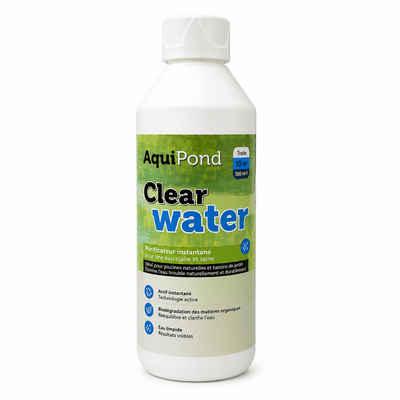 Aquipond ClearWater 10M³ - Works effectively on green water - Instant clarifier
€29,95
View product
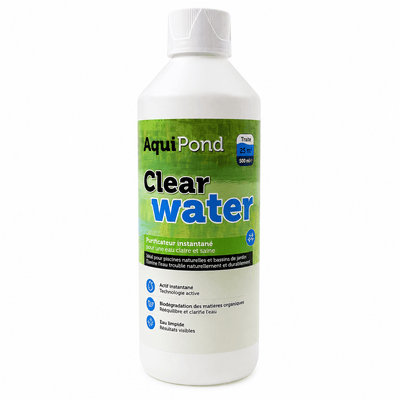 Aquipond ClearWater 25M³ - Works effectively on green water - Instant clarifier
€39,95
View product
 Aquipond Starter Pack (Nitriboost & Bacto Maintenance)
€89,95
 Aquipond BactoClay - Montmorillonite clay 2 kg for koi ponds
€39,95
View product


Leave a comment