


Filamentous algae: the month-by-month prevention and treatment calendar
Most pond owners start fighting string algae when it is already there, in May or June, with a shock treatment. This is when it is strongest and when the fight costs the most.
Ponds that stay clean all season have one thing in common: their owners take action ahead of time, at the right time of year. Here is the calendar we recommend, season by season. And it starts now, in autumn.
— The calendar at a glance
- September-November: remove organic matter, reduce sludge.
- December-February: light maintenance, prepare for spring.
- March-April: test the water, correct the KH, restart filtration, prevent problems.
- May-June: remove mechanically, treat selectively.
- July-August: maintain, provide shade, monitor oxygen levels.
Why do string algae prepare in autumn?
String algae feed mainly on the phosphates and nitrates available in the water. Much of these nutrients comes from organic matter that decomposes at the bottom during winter: leaves, dead plants, and leftover food. Everything you remove in autumn means less food for algae in spring.

Also read
To understand why they return after treatment, read String algae: why do they always come back after treatment?.
READ THE ARTICLESeptember to November: cut off their food supply
- Stretch a net over the pond before the leaves fall.
- Cut back wilted aquatic plants above the water level, without leaving the stems to rot in the pond.
- Remove the sludge by suction or treat it with sludge-reducing bacteria while the water is still above approximately 10 °C.
- Reduce then stop feeding as the water cools.
Aquipond Bactovase - 1Kg - Bacteria to reduce sludge - Treats up to 10M²
Bacteria that break down organic sludge at the bottom of the pond, to be applied as long as the water is not too cold. Live price and immediate add to cart:
Pondovac 5 – High-performance vacuum for ponds and swimming pools – Oase
Pond vacuum for removing sludge and debris from the bottom without draining the pond. Live price and immediate add to cart:
December to February: light maintenance
In winter, biological activity slows down. Take advantage of this to:
- Remove the last fallen leaves.
- Keep an opening in the ice for gas exchange.
- Continue a gentle maintenance treatment suited to low temperatures, if you use one.
- Prepare the equipment: order a replacement UV bulb and check the filter foams.
Aquipond Greenstab - Natural treatment against pond algae (even in winter)
Natural maintenance treatment against pond algae, usable even in winter, to prevent them from gaining a head start again. Live price and immediate add to cart:
March and April: the decisive moment
This is the time when the race between algae and the rest of the pond is decided. Algae start growing again as soon as the water warms slightly, while plants and filter bacteria are still slow to become active.
— Test and correct the KH
A low KH makes pH unstable, which stresses plants and bacteria but not algae. In spring, winter rains have often lowered the KH. A KH between 6 and 10 °dKH is a good target for most ornamental ponds.
Quick Pond Water Test 6 in 1 – pH, GH, KH, Chlorine, Nitrites, Nitrates
Quick test to measure pH, GH, KH, nitrites, and nitrates before treatment. Live price and immediate add to cart:
Aquipond KH+ 2kg - Increases carbonate hardness (KH)
KH corrector to stabilize pH when carbonate hardness is too low. Live price and immediate add to cart:
— Restart biological filtration
Clean the filter foams with pond water (never tap water), restart the system, and add nitrifying bacteria as soon as the water exceeds 10 to 12 °C.
— Prevent rather than cure
A natural preventive treatment applied when restarting slows algae growth while the rest of the pond wakes up.
May and June: if they are present, act in this order
- Remove as many filaments as possible mechanically, by hand or with a brush, before any treatment.
- Treat selectively, without overdosing.
- Remove dead algae that break away, so they do not release their nutrients back into the water.
- Monitor oxygen: decomposing algae consume it. An air pump helps a lot during this period.
Telescopic anti-filamentous algae brush for ponds & water gardens – 51 to 151 cm
Telescopic brush for winding up and removing filaments without chemicals, even between plants. Direct pricing and immediate add-to-cart:
Green Control 2.5kg - Natural algae treatment - Air-Aqua
Natural treatment for filamentous algae, to be used after mechanical removal. Direct pricing and immediate add-to-cart:
AquaActiv AlGo Direct 5 litres - Targeted algae treatment - Oase
Targeted treatment to act more directly on algae once they are well established. Direct pricing and immediate add-to-cart:
July and August: maintain and provide shade
- Remove new filaments as soon as they appear, before they form mats.
- Let water lilies and floating plants cover part of the surface.
- Top up evaporation losses, if possible with stored rainwater, which is low in nutrients but also low in minerals: monitor the KH in that case.
- Aerate day and night in hot weather.
To choose according to the season and type of algae, discover all our algae-control products.
Frequently asked questions
— Does the UV lamp work on filamentous algae?
No. Filamentous algae are attached to stones and walls: they never pass through the UV unit. UV acts on green water, not on “hair algae.”
— Can you treat in winter?
Traditional treatments are not very effective in cold water. Some products are designed for low temperatures: they are mainly used for preventive maintenance.
— Is a pond without any algae possible?
It is neither realistic nor desirable. Some algae are part of a healthy ecosystem. The goal is to prevent them from taking over the pond.
— Do fish eat filamentous algae?
Some nibble on them, but not enough to control an outbreak. And more fish means more nutrients.
In summary
- Autumn: netting, pruning plants, and reducing sludge.
- Winter: light maintenance and equipment preparation.
- Spring: testing, KH, restarting the filter, and prevention.
- Early summer: mechanical removal followed by targeted treatment.
- Midsummer: maintenance, shade, and oxygen.
Sources and references
- University of Florida IFAS Extension, guides on controlling filamentous algae in ponds
- US EPA, Nutrient Pollution: The Effects of Phosphorus and Nitrogen in Water Bodies
- Aquiflor field experience, an aquatic garden center in Nodebais (Belgium) for over 30 years
- Questions received by the Foudebassin.com customer service team
Last updated: September 27, 2026.
Products recommended by our experts
See the full selection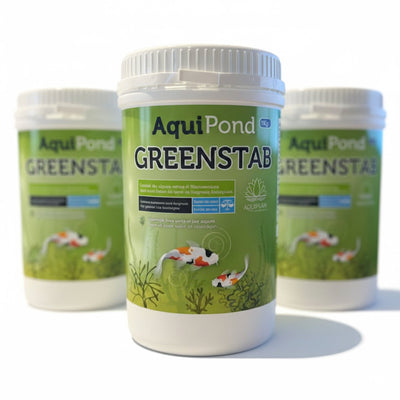 Aquipond Greenstab - Balanced pond water, limits algae
À partir de €34,95
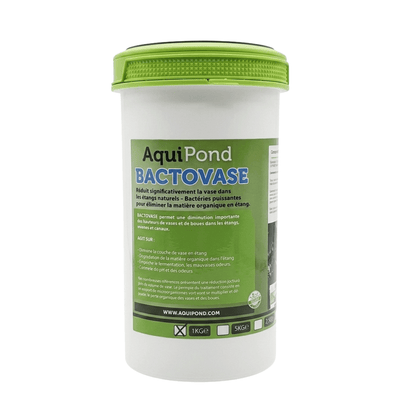 Aquipond Bactovase 1 kg – Bacteria for pond sludge reduction (5 to 10 m²)
€39,95
View product
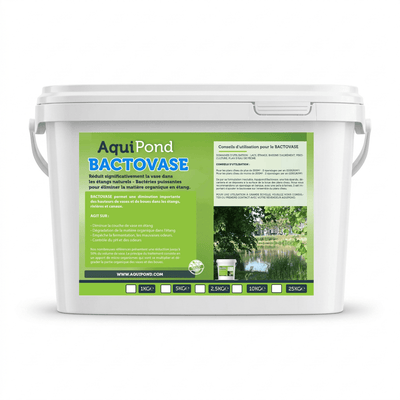 Aquipond Bactovase 2.5 kg – Bacteria to reduce pond sludge (12.5 to 25 m²)
€89,95
View product
 Aquipond Bactovase 5 kg – Bacteria to reduce pond sludge (25 to 50 m²)
€151,00
View product


Leave a comment