


The Foudebassin.com team
Published
6 min read
Gambusia for mosquitoes: the false good idea (and what really works)
On still recommends it on forums: “Add gambusias, they eat mosquito larvae.” The gambusia, a small North American fish only a few centimeters long, was indeed introduced to dozens of countries in the 20thth century to control malaria. A century later, the verdict is severe.
The essentials
- Gambusias (Gambusia affinis and G. holbrooki) are small live-bearing fish from North America.
- Their effectiveness against mosquitoes has not been proven; their effects on amphibians and small wildlife have.
- They have been on the European Union list since 2 August 2022: sale, possession and release are prohibited.
- To control mosquitoes, the most effective method is to remove small areas of standing water in the garden.
3 to 4 weeks gestation period
3 possible generations per year
2 August 2022 added to the Union list
0 gambusias to introduce
Why it's a false good idea
- It eats everything, not especially mosquito larvae: mainly small insects, according to FishBase, but also zooplankton and amphibian larvae.
- It attacks tadpoles and newt larvae: in experimental conditions, it injures the tails of many tadpoles (Shulse and Semlitsch, 2014) and significantly reduces the survival of newt larvae (Cabrera-Guzmán et al., 2017).
- It reproduces very quickly: it is a live-bearing fish; gestation lasts 3 to 4 weeks, females reach maturity at 4 to 6 weeks, and three generations can follow each other in one year (FishBase).
- It competes with other small fish: its impact on native fish ranges from negative to neutral depending on the environment (FishBase).
According to FishBase, introductions intended to control mosquitoes have had rare or even no effect on them. A leading scientific review concludes that solid evidence of its effectiveness remains rare, while its negative effects on native wildlife are well documented (Pyke, 2008).
The study on newts, conducted in Doñana National Park, Spain, provides a useful detail for a garden pond: in the laboratory, the gambusia captured insect larvae more effectively than newt larvae. It therefore deprives amphibians of their food, in addition to attacking them.
Banned since 2022
The two species of gambusia (Gambusia affinis and Gambusia holbrooki) have been on the European Union list of invasive alien species since 2 August 2022 (Implementing Regulation (EU) 2022/1203). Their sale, possession and release are prohibited (Article 7 of Regulation (EU) No 1143/2014).
| Where | Text | What it provides for |
|---|---|---|
| European Union | Regulation (EU) No 1143/2014; Implementing Regulation (EU) 2022/1203 | Prohibition of keeping, breeding, transporting, selling, exchanging, allowing to reproduce or releasing the two species. |
| France | Order of 14 February 2018, Annex II-4, added by the Order of 2 March 2023 | Same prohibitions. Exemption for pets already kept, to be declared to the prefecture “before 1st April 2023”: a deadline that had already expired when the Order was published in the Official Journal on 6 April 2023. |
| Wallonia | Decree of 2 May 2019, Article 6 | Applies the prohibitions of the European regulation to the species on the Union list in Wallonia. |
Do you already have gambusias?
They may have arrived with a batch of fish, or been recommended before 2022. The European regulation only allows a tolerance for individuals: keeping an animal kept before the listing until its natural death, provided it can neither reproduce nor escape. With a live-bearing fish that produces three generations per year, this is not realistic in a pond. Proceed as follows:
- Do not release them, give them away or sell them.
- Capture them with a fine net or a fry trap, preferably before summer.
- Ask for the procedure: in Wallonia, the Invasive Alien Species unit of the SPW (invasives@spw.wallonie.be); in France, the departmental service of the OFB or the DDT(M).
- Then reintroduce sustainable solutions: water movement, plants and natural predators.
What really works against mosquitoes in a pond
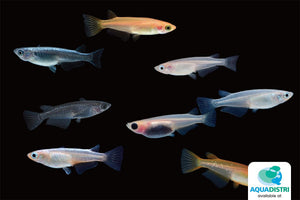
- Suitable fish: in our experience, goldfish, roach, tench or medaka in small ponds readily eat larvae on the surface.
- Movement: in our experience, a waterfall, fountain or aerator limit spawning, as mosquitoes prefer calm waters.
- Natural predators: dragonfly larvae, backswimmers, diving beetles, newts. See the wildlife that settles in the pond.
- Standing water in the garden: saucers, gutters, uncovered barrels. These are typical breeding sites for the tiger mosquito, which breeds in tires, barrels, rainwater drains and other containers (ECDC).
Our complete guide: eliminating mosquitoes from the pond.
| Criterion | Gambusia | Medaka |
|---|---|---|
| Origin | North America | East Asia (Japan, Korea, China, Vietnam) |
| Maximum size | 4.7 cm (male), 8 cm (female) | about 4 cm |
| Reproduction | live-bearing, 3 generations per year | lays eggs |
| Status | Union list since 2022: prohibited | sold for ponds; never release into the wild |
According to FishBase (Gambusia holbrooki, Oryzias latipes).
Go around the garden once a week in summer: plant saucers, watering cans, tarpaulins that collect water, clogged gutters. Water that remains still for several days in a small container is a possible breeding site. For the pond itself, also see methods against mosquito larvae.
 Medaka Mix Standard, 2-3 cm
Mosquitoes around the pond?
Describe your pond to us: we will help you choose suitable fish or water movement.
Frequently asked questions
And against the tiger mosquito?
The tiger mosquito mainly lays eggs in containers: tires, barrels, vases, rainwater drains (ECDC). In our experience, a pond with fish and water movement is rarely its spawning site.
I have gambusias, what should I do?
Do not release them. Ask for the procedure: in Wallonia, the Invasive Alien Species unit of the SPW; in France, the departmental service of the OFB or the DDT(M).
Can you still buy gambusias?
No. Since 2 August 2022, their sale has been prohibited throughout the European Union, as has their possession and transport.
Is the gambusia dangerous to frogs and newts?
Yes. Studies have shown that it injures tadpoles and significantly reduces the survival of newt larvae, by attacking them and taking their food.
And you?
Have you ever been advised to get a gambusia? Share this article: it is one of the most persistent misconceptions in the pond world.
Also read: The wildlife that settles in the pond, Mosquito larvae in a pond and Frogs, toads and newts in the pond.
Produits et rayons conseillés

Products recommended by our experts
See the full selection Aquipond BactoClay - Montmorillonite clay 2 kg for koi ponds
€39,95
View product
 Minerall in One Aquipond - Increases GH & KH simultaneously - 2.5KG to treat 30M³
€49,00
View product
 Sera Aqua-Test Set - The essential analysis kit for ponds and aquariums
€34,61
 Aquipond KH+ 1kg - Increases Carbonate Hardness (KH)
€19,95


Leave a comment