


The Foudebassin.com team
Published
7 min read
Newts and frogs: the "water scorpions" hiding in your pond
You can spend years living alongside these insects without ever seeing them. The water scorpion looks like a dead leaf, while the ranatra looks like a piece of twig. Yet both are formidable hunters, and their common nickname says it all: water scorpions.
The essentials
- The water scorpion and ranatra are aquatic bugs camouflaged as dead leaves and twigs.
- Their "tail" is a breathing tube, not a stinger.
- They hunt with grasping front legs, like a praying mantis.
- If picked up by hand, they can sting with their rostrum: the sting is painful.
18 to 22 mmlong for the water scorpion
30 to 35 mmlong for the ranatra, excluding the siphon
2 half-tubesform the breathing siphon
112the European emergency number in case of a severe reaction
The water scorpion, the dead leaf that hunts
The grey water scorpion (Nepa cinerea) measures about two centimetres, from 18 to 22 mm (British aquatic bug DELTA key). Its flattened, greyish-brown body mimics a decaying leaf. It sits motionless in the shallow mud near the edges, its front legs folded like pincers.
The ranatra, the aquatic stick insect
The ranatra (Ranatra linearis) is long and slender: 30 to 35 mm long, excluding its breathing tube (DELTA key). Brown and motionless among plant stems, it looks like a twig. It hunts by ambush, suspended in the vegetation.
Water scorpion or ranatra: how to tell them apart
Both belong to the same family, the Nepidae, and share a siphon and grasping legs. Their silhouette is enough to distinguish them.
| Feature | Grey water scorpion | Ranatra |
|---|---|---|
| Body length | 18 to 22 mm | 30 to 35 mm |
| Silhouette | Wide and flat, leaf-like | Very slender, stick-like |
| Where to find it | On the mud, near the edge | Among submerged stems |
The "tail" is not a stinger
The long appendage at the end of the abdomen, which gives them their scorpion name, is not a stinger at all. It is a breathing siphon: the insect points it toward the surface like a snorkel to breathe while remaining submerged; it is formed of two joined half-tubes (Missouri Department of Conservation). They therefore stay near the surface: on the mud at the edge for the water scorpion, suspended from stems for the ranatra.
Grasping legs
Their front legs work like those of a praying mantis: they snap shut on their prey. They catch aquatic insects and other invertebrates, tadpoles, and very small fish (MDC), then sting them with their rostrum and inject digestive saliva.
Do they sting?
If picked up by hand, yes, they can sting with their rostrum and inject digestive saliva: the sting is painful (MDC; University of California, Riverside). The "scorpion" siphon, however, does not sting.
What to do if you are stung?
The sting is treated like that of any other insect. The British health service (NHS) recommends:
- wash the area with soap and water;
- if it swells, apply cold (ice wrapped in a cloth or a cloth dampened with cold water) for up to 20 minutes, and elevate the area if possible;
- do not scratch, to avoid infection;
- ask a pharmacist for advice if the area becomes hot, red, very painful, or weepy;
- call emergency services (112, or 15 in France) in case of swelling of the lips or throat, difficulty breathing, or dizziness.
Known allergy? If you have previously had a severe allergic reaction to a sting, consult a doctor promptly after any new sting.
Their place in the pond
They are found mainly in natural, well-planted ponds. Their prey remain small, including very small fish (MDC: they are therefore mainly the fry that are exposed. In most water scorpions, the flight muscles are reduced and the insect does not fly; some still disperse by flight, like the other genera of the family, including the ranatra (Catalogue of Palaearctic Heteroptera, Naturalis). This is how these insects sometimes reach new bodies of water.
- Keep shallow, well-planted edges.
- Avoid chemical treatments.
- If you are raising fry, protect them in a separate tank.
Observing them without harming them
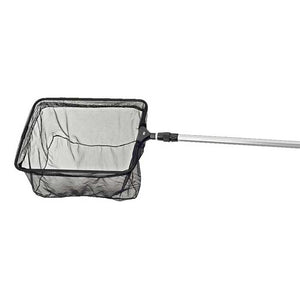
- Slowly pass a fine-mesh skimmer through the mud at the edge and between the stems.
- Empty it into a clear basin filled with water from the pond.
- Wait a few minutes: the "dead leaves" and "twigs" will eventually move.
- Look without picking them up by hand.
- Return everything to the pond, where you took it.
Do this survey in the summer and note what you find from year to year: it is a simple way to monitor the life of your pond. If dredging is planned, consult our guide for removing mud without harming wildlife first.
 Fine-mesh skimmer 140 cm – OaseFine mesh for reaching through the mud and plants at the edge without harming small animals.View product
 Long waterproof pond gloves S/MProtect your hands and forearms when emptying the skimmer or working in the plants at the edge.View product
A strange insect in your pond?
Send us a photo: we will help you identify it.
Frequently asked questions
Are water scorpions and notonects the same?
No. Both are aquatic bugs, but the notonect swims on its back in open water, while the water scorpion hides on the bottom.
How to observe them?
Gently pass a skimmer through the mud and plants at the edge, empty the contents into a clear basin of water, observe, then return everything to the pond.
How to tell a water scorpion from a ranatra?
The water scorpion is wide and flat like a dead leaf, and measures 18 to 22 mm. The ranatra is very slender like a twig and measures 30 to 35 mm, excluding its long siphon.
What to do if I am stung by a water scorpion?
Wash the area with soap and water, apply cold if it swells, and do not scratch. Call emergency services (112) in case of swelling of the lips or throat, or difficulty breathing, and consult a doctor if you have previously had a severe allergic reaction.
Are water scorpions a danger to my fish?
They eat invertebrates, tadpoles, and very small fish. Their prey remain small: therefore, it is mainly the fry that deserve to be protected in a separate tank.
And you?
Had you already spotted a water scorpion or ranatra in your pond? Or is this a discovery?
Also read: The wildlife that settles in the pond, Self-sustaining natural pond: how its ecosystem works and Creating a natural pond in your garden.
Produits et rayons conseillés

Products recommended by our experts
See the full selection Aquipond BactoClay - Montmorillonite clay 2 kg for koi ponds
€39,95
View product
 Minerall in One Aquipond - Increases GH & KH simultaneously - 2.5KG to treat 30M³
€49,00
View product
 Sera Aqua-Test Set - The essential analysis kit for ponds and aquariums
€34,61
 Aquipond KH+ 1kg - Increases Carbonate Hardness (KH)
€19,95


Leave a comment