


The Foudebassin.com team
Published Updated
9 min read
Catfish in a pond or lake: why it is not recommended (and why it is now banned)
You may still come across it in some ponds, and it is sometimes recommended to us for "cleaning the bottom". With its eight whisker-like barbels, the catfish has plenty to appeal. Yet, it is one of the worst choices for a pond, and the law has spoken.
The essentials
- The common catfish (Ameiurus melas) is a North American fish introduced to Europe in the 19th century.
- Since 2 August 2022, it has been included on the European Union's list of invasive alien species of concern.
- Keeping, transporting alive, selling or releasing it is prohibited in both France and Wallonia.
- If you have one in your pond, capture it, do not move it alive, and ask the relevant authorities what to do.
8 barbels around the mouth
15 to 30 cm usual size
2 August 2022 added to the EU list
€9,000 fine in France for introducing it into waters
What is the catfish?
The common catfish (Ameiurus melas) comes from North America. Introduced to Europe at the end of the 19th century, it spread through slow-flowing rivers, canals and ponds. It generally measures 15 to 30 cm, has a scaleless, brownish to blackish body with a yellowish belly, and has eight barbels around its mouth (fact sheet from the Corrèze prefecture). Its pectoral and dorsal fins are preceded by a sharp spine, and the one on the dorsal fin is described as venomous (OFB and GT-IBMA fact sheet).
According to this same fact sheet, some individuals escaped from aquariums at the National Museum of Natural History in Paris before the species was introduced several times for recreational fishing. The female lays eggs in a nest dug into the bottom, and both parents guard the eggs and then the fry, which swim in tight schools.
Why is it a problem?
- It can cloud the water: it feeds mainly at night, near the bottom (FishBase); in our experience, a pond that hosts many of them often has water clouded with suspended silt.
- It eats almost anything: invertebrates, fish, and also amphibians, according to the Corrèze prefecture.
- It forms dense populations of small, stunted individuals, which makes it unpopular in Europe according to FishBase.
- It is highly resilient: it tolerates oxygen-poor and polluted waters, and competes with local fish for food and spawning sites.
Banned since 2022
Since 2 August 2022, the common catfish has been included on the European Union's list of invasive alien species of concern (Implementing Regulation (EU) 2022/1203). Regulation (EU) No 1143/2014 therefore prohibits selling, exchanging, keeping, transporting alive, breeding or releasing it, in both Belgium and France.
The laws in France and Wallonia
Before 2022, French law mainly targeted its introduction into waters. Since its inclusion on the EU list, the entire chain is covered: keeping, breeding, transport, sale and release. Here are the laws that apply.
| Where | Law | What it provides for |
|---|---|---|
| European Union | Regulation (EU) No 1143/2014, Article 7; Implementing Regulation (EU) 2022/1203 | Prohibition of keeping, breeding, transporting, selling, exchanging, allowing to reproduce or releasing the species, since 2 August 2022. |
| France | Order of 14 February 2018, amended by the Order of 2 March 2023 (Annex II-4) | The same prohibitions under French law. Exemption for pets already kept, which must be declared to the prefecture "before 1st April 2023": a deadline that had already expired when the Order was published in the Official Journal on 6 April 2023. |
| France, rivers and bodies of water | Environmental Code, Article L. 432-10 and the list in Article R. 432-5, now D. 432-5 | Introducing a species from this list into waters is punishable by a €9,000 fine. The catfish is included under its former name, Ictalurus melas, alongside the sunfish. |
| Wallonia | Decree of 2 May 2019, Article 6 | Prohibits the activities covered by Article 7 of the European Regulation for species on the EU list. An offence is a second-category offence. |
Two clarifications. First, Article R. 432-5 was renumbered D. 432-5 by Decree No 2026-464, which came into force on 11 June 2026: it must now be searched for under this number. Secondly, according to a presentation note from the Ministry of Ecology, Article L. 432-10 also applies to enclosed waters since the Water Law of 2006; the DDT of Mayenne reminds that no species from this list should be introduced there, with the catfish and sunfish at the top of the list.
The European Regulation allows only one exception for individuals: keeping a pet kept before the inclusion, until its natural death, provided it cannot reproduce or escape (Article 31). In a garden pond where it can spawn, these conditions are difficult to guarantee.
Do not transport it alive, even to give it away. The transport and exchange of a species on the EU list are prohibited, as are releasing it into waters elsewhere.
Don't confuse it with
- The wels catfish, sometimes called catfish, is a giant European species. Since 11 June 2026, it has also been included on the French list of species likely to cause biological imbalances, but only in the Adour-Garonne and Loire-Bretagne basins (Decree No 2026-464, published in the Official Journal on 10 June 2026 and coming into force the next day).
- The coriadoras and other "catfish" from aquariums are tropical fish, made for heated water: they have no place in a pond.
| Criterion | Common catfish | Wels catfish |
|---|---|---|
| Origin | North America | Central and Eastern Europe, Western Asia |
| Usual size | 15 to 30 cm | – |
| Size at maturity | – | around 90 cm |
| Maximum published size | 66 cm | 273 cm |
| Status | EU list since 2022 | French list D. 432-5 in two basins since 2026 |
Sizes and origins: FishBase (Ameiurus melas, Silurus glanis) and the Corrèze prefecture.
Do you have one in your pond?
- Never release it into a river or public pond.
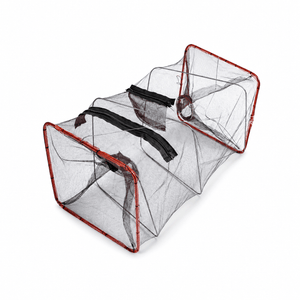
- Capture it using a baited trap at night, or by partially draining the pond.
- Report it and ask what to do: in Wallonia, contact the Invasive Alien Species unit of the SPW (invasives@spw.wallonie.be, wallonie.be); in France, contact the departmental service of the OFB or the DDT(M).
For capture, in our experience, a trap placed in the evening near the bottom, baited with an odorous food, gives better results than a net during the day. If you drain the pond, do so outside the amphibian breeding season and prepare a tank for your other fish: our article on the real reasons to drain a pond details the method. The fish kept will then go through a quarantine before any new mixing.
 Folding fish trap 40 x 80 cmPlaced on the bottom in the evening, baited, to capture unwanted fish without draining the pond.View the product
 Long waterproof pond gloves S/MFor emptying the trap and handling a fish with sharp spines while keeping your forearms protected.View the product
For "cleaning the bottom"
In our experience, no fish really cleans the bottom of a pond. Good filtration, bacteria, native snails and a pond vacuum do the job. See muck-eating fish: the truth.
Before adding a fish to a pond, check its scientific name, not just its commercial name: a "catfish" can refer to several species with very different statuses. For a selection of suitable species, see which fish to choose for an outdoor pond.
An unknown fish in your pond?
Send us a photo: we will help you identify it and choose the equipment to capture it.
Frequently asked questions
Does the catfish bite?
Yes, its spines can cause injury, and the one on the dorsal fin is described as venomous. Handle it with thick gloves; in case of a serious reaction, consult a doctor.
Can it be caught and eaten?
Yes, it is edible according to FishBase, while respecting local fishing rules. It must never be transported alive.
Can I keep the catfish I had before 2022?
The European Regulation allows an individual to keep a pet kept before the inclusion, until its natural death, if it cannot reproduce or escape. In France, the Order of 2 March 2023 required it to be declared to the prefecture before 1st April 2023, a deadline that had already expired when it was published in the Official Journal on 6 April 2023. In a garden pond, these conditions are rarely met.
Which article of the Environmental Code targets the catfish?
The list of species likely to cause biological imbalances, long the Article R. 432-5, now D. 432-5 on 11 June 2026; the species is named Ictalurus melas there, its former name. Introducing it into waters is punishable by a €9,000 fine by Article L. 432-10.
Is it also banned in Wallonia?
Yes. The Walloon Decree of 2 May 2019 prohibits the activities covered by the European Regulation for all species on the EU list, including the common catfish.
And you?
Have you ever been advised to keep a catfish in your pond? Share this article with those who are thinking about it.
Also read: Which fish to choose for an outdoor pond?, Quarantine for pond fish and Frogs, toads and newts in the pond.
Produits et rayons conseillés
Products recommended by our experts
See the full selection Aquipond ImmunoFish – 1 Liter – Koï Mucus for 20 m³
€39,95
View product
 Aquipond ImmunoFish – 2.5 Liters – Koï Mucus for 50 m³
€59,95
View product
 Aquipond ImmunoFish – 5 Liters – Koï Mucus for 100 m³
€89,95
View product
 Malamix 17 – organic supplement for koi and pond fish – 1 L
€28,71


Leave a comment