


The Foudebassin.com team
Published Updated
6 min read
Giant goldfish in lakes: when a released fish becomes a plague
Photos are making the rounds on social media: goldfish the size of rugby balls caught in a lake. They are not photoshopped. Once released from a bowl or pond, goldfish grow, breed in large numbers and transform the ecosystem.
The essentials
- Released into the wild, goldfish can grow to 40 cm and live for more than ten years.
- They cloud the water, damage submerged plants, encourage algae growth and can spread diseases.
- They are not on the European list of invasive species, but releasing them can be punishable in France and Wallonia.
- Surplus fish should be given away, returned to the retailer or managed in the pond, but never released into a public pond.
40 cm reached in Alberta waterways
18 cm by their first year in the Vasse River
3 possible spawnings per year
10 years and over age recorded in the Vasse River
Documented cases everywhere
In the United States, in 2021, the city of Burnsville (Minnesota) publicly asked its residents to stop releasing goldfish after discovering very large specimens in Keller Lake (CBS Minnesota). In Canada, the Government of Alberta states that some goldfish have reached 40 cm there and that tens of thousands have been removed from the wild in ten years. In Australia, in the Vasse River, they reach about 18 cm by their first year and live for more than ten years (Morgan and Beatty, 2007). In Europe too, goldfish live freely in ponds and canals, and sometimes hybridise with common carp (Hänfling et al., 2005).
Why it is a problem
- They root around the bottom and stir up silt: the water becomes cloudy, submerged plants disappear (Government of Alberta).
- They encourage algae growth: the Government of Alberta states that their gut promotes cyanobacteria, and Morgan and Beatty mention a risk of worsening algae blooms in nutrient-rich waters.
- They compete with native species for food and tolerate low-oxygen water better than they do.
- They carry diseases and parasites to wild fish.
- They breed quickly: a female lays 500 to 1,000 eggs per spawning, up to three times a year according to Alberta. They can also hybridise with wild carp (Hänfling et al., 2005).
In some British carp populations studied by Hänfling and his colleagues, hybrids were so numerous that no pure carp was caught. Common carp is the wild species closest to goldfish.
What the law says
In Belgium as in France, the introduction of fish into open waters is regulated, and releasing a pet into the wild can be punishable.
Goldfish are not on the European Union list of invasive alien species, even after its latest update (Implementing Regulation (EU) 2025/1422). Other texts therefore apply.
| Where | Text | What it provides for |
|---|---|---|
| France | Order of 11 August 2006 and Penal Code, Article 521-1 | Goldfish are listed as pets. Abandoning a pet is punishable by 3 years in prison and a €45,000 fine (justice.fr). |
| France, waterways and bodies of water | Environmental Code, Articles L. 432-10 to L. 432-12 | Fish introductions are regulated, notably the prohibition of introducing fish that do not come from approved facilities (DDT de la Mayenne). |
| Wallonia | Walloon Code of Animal Welfare, Articles D.7 and D.105 | The code applies to vertebrates, and therefore to fish. Abandoning an animal is prohibited and constitutes a second-category offence. |
The Walloon code defines abandonment as leaving an animal somewhere to get rid of it, without ensuring that another person takes responsibility for it.
What to do with surplus fish?
- Give them to other pond owners (neighbours, local groups).
- Return them to the pet shop or retailer that sold them to you, if they accept returns.
- Limit breeding: in our experience, feeding them less and letting natural predators such as dragonfly larvae regulate the fry is often enough.
The Government of Alberta adds two options: offer the fish to a fishkeeping club or a school, and, as a last resort, ask a vet for painless euthanasia. It advises against throwing a fish down the toilet, which can spread diseases and parasites.
In the pond, the best prevention remains keeping a population suited to the volume of water: our article on goldfish overpopulation in ponds details the three levers, and the one on raising fish in garden ponds explains the limits of breeding.
Do not let a pond overflow into a ditch or stream during heavy rain: fry can pass through with the water. An overflow equipped with a fine mesh prevents these discreet escapes.
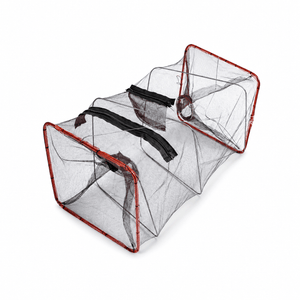
 Folding trap for capturing fryTo remove surplus young fish and entrust them to another owner.View the product
 Kit for limiting pond overpopulationA trap and Aquifood bait to attract and capture fry.View the product
Too many fish in your pond?
Give us the volume and the number of fish: we will help you find the right solution.
Frequently asked questions
Why do they become so big?
In our experience, they grow as long as they have space and food. In a nutrient-rich environment, such as the Vasse River in Australia, they reach about 18 cm by their first year (Morgan and Beatty, 2007).
Do they turn grey again?
In our experience with ponds, some of the fry are born bronze or olive and some never turn red.
Is goldfish banned like the sunfish?
No, it is not on the European list of invasive alien species. Releasing it into the wild can, however, be punishable, in France as in Wallonia.
What to do if I have too many goldfish?
Give them to other pond owners, return them to the retailer if they accept returns, and limit breeding. Never release them into a pond or river.
And you?
Have you ever seen goldfish in a public pond? Tell us where.
Also read: Goldfish overpopulation in ponds, Raising fish in garden ponds and Which fish to choose for an outdoor pond?
Produits et rayons conseillés

Products recommended by our experts
See the full selection Aquipond ImmunoFish – 1 Liter – Koï Mucus for 20 m³
€39,95
View product
 Aquipond ImmunoFish – 2.5 Liters – Koï Mucus for 50 m³
€59,95
View product
 Aquipond ImmunoFish – 5 Liters – Koï Mucus for 100 m³
€89,95
View product
 Malamix 17 – organic supplement for koi and pond fish – 1 L
€28,71


Leave a comment