


Which pump to use to limit silt in a pond? Solids-handling pump, vacuum, or bacteria: what really works
Sludge is inevitable: leaves, excrement, dead algae and dust always end up on the bottom. You might hope that a well-chosen pump would make it disappear as the water flows. A pump can slow its accumulation, but it will never eliminate it on its own. Here is what really works, and in what order.
— The short answer
Choose a large-passage filtration pump (which accepts particles several millimeters in size), placed at the lowest point and connected to a filter capable of trapping these particles. It prevents some of the debris from settling. For sludge that has already accumulated, a pond vacuum is essential. And to reduce the amount of sludge that forms, specialized bacteria break down the organic matter at the bottom.

Where sludge comes from and why it is a problem
Sludge is a mixture of decomposing organic matter and mineral particles. In a garden pond, it mainly comes from leaves that fall in autumn, leftover food, fish excrement and dead algae. Every year, a few millimeters to a few centimeters accumulate on the bottom.
The problem is not aesthetic. As it decomposes, sludge consumes oxygen, releases ammonia and, above all, phosphates, algae's favorite fertilizer. A pond that turns green every summer despite a good UV filter very often has a layer of sludge that is too thick. In the deepest areas, decomposition without oxygen can also produce foul-smelling gases.
What a pump can do
A filtration pump placed at the lowest point draws suspended particles in before they settle. For this to work, three conditions must be met:
- a large particle passage: AquaMax-type large pre-filter pumps accept debris several millimeters in size, where a fountain pump would clog;
- a location at the lowest point, raised by a few centimeters so it does not pump the sludge directly;
- a filter capable of retaining what it sends: without this, the particles are simply returned to the pond.
AquaMax Eco Classic 8500 - Oase
High-flow filtration pump, designed to vacuum particles from the bottom of the pond. Live pricing and immediate add-to-cart:
What a pump will not do
Even when properly positioned, a pump only vacuums around itself, within a limited radius. Leaves that settle in corners, on planting shelves, or between stones remain in place. And sludge that has already compacted does not resuspend on its own. In a pond more than two or three years old, relying solely on the pump is like emptying a bathtub with a spoon.
The vacuum: for sludge that is already established
A pond vacuum works like a workshop vacuum: it vacuums water and sludge into a tank, then discharges the dirty water into a ditch or at the foot of trees, where it makes excellent fertilizer. It is used in spring to remove what accumulated over the winter, and in autumn after the leaves have fallen.
Without emptying the pond or stressing the fish, you can remove in one hour what the pump would take years to move. This is the tool that makes the biggest difference to the water quality of a pond that has been established for several years.
Pondovac 4 - Oase
Continuous-operation pond vacuum: it vacuums and drains at the same time, without interruption. Live pricing and immediate add-to-cart:
Bacteria: reducing sludge at the source
The third approach targets the sludge itself. Selected bacteria, deposited at the bottom, break down organic matter faster than the pond's natural flora would. The sludge layer gradually decreases, along with the amount of nutrients released into the water. This explains why a cleaner bottom generally goes hand in hand with a more balanced pond, less conducive to algae growth.
These bacteria need water at least 10 to 12 °C to be active, as well as oxygen: they deliver their best results from April to October, in a well-aerated pond.
Aquipond Bactovase - 1 kg
Specialized bacteria that break down sludge at the bottom of the pond, covering up to 10 m². Live pricing and immediate add-to-cart:
The winning strategy: combine all three
| Tool | Role | When |
|---|---|---|
| Large-passage pump + filter | Prevent some of the deposits | Continuously, throughout the season |
| Vacuum cleaner | Remove accumulated sediment | Spring and autumn |
| Anti-sediment bacteria | Reduce the remaining organic matter | From April to October, water > 10 °C |
| Anti-leaf net | Prevent the main source of debris | September to December |

Read also
For more information: Sediment in the pond: should you vacuum it or use bacteria?.
READ THE ARTICLEVacuum cleaners, bacteria, large-passage pumps: all our solutions for eliminating sediment. Tell us the surface area of your pond and the thickness of the sediment, and we will recommend the right combination.
Frequently asked questions
— Is there a pump that can vacuum up sediment on its own?
No fixed pump cleans the entire bottom. Large-passage pumps draw in whatever passes nearby; for the rest, you need a vacuum or a bottom drain connected to a gravity-fed filter.
— Can a bottom drain replace the vacuum?
It greatly reduces deposits in ponds designed for this purpose, with a sloped bottom. In a standard pond with shelves, a vacuum is still necessary for remote areas.
— Can anti-sediment bacteria be used with fish?
Yes, they are safe for fish and plants. Simply turn off the UV for 24 to 48 hours after application and ensure good oxygenation.
— What should you do with the vacuumed sediment?
It is an excellent soil amendment for the garden: spread the water and sediment at the base of hedges, trees, or on the compost.
In summary
- A large-passage pump limits deposits but does not eliminate sediment.
- The vacuum removes sediment that has already accumulated, without emptying the pond.
- Specialized bacteria reduce organic matter at the source.
- A net in autumn prevents most of the debris from entering.
Sources and references
- Wetzel R. G., Limnology: Lake and River Ecosystems, Academic Press (sediments and phosphorus release)
- Boyd C. E., Water Quality: An Introduction, Springer (decomposition of organic matter and dissolved oxygen)
- Aquiflor field experience, an aquatic garden center in Nodebais (Belgium) for over 30 years
Last updated: September 28, 2026.
Products recommended by our experts
See the full selection Aquipond Bactovase Liquide 1 L or 5 L - Anti-sludge bacteria for ponds
À partir de €39,00
View product
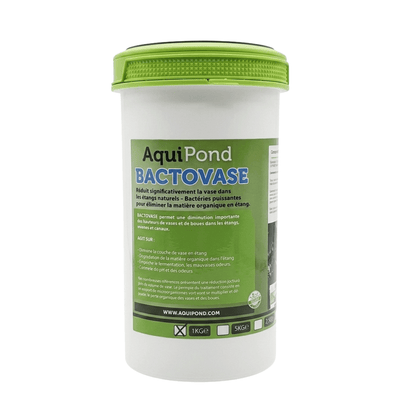 Aquipond Bactovase 1 kg – Bacteria for pond sludge reduction (5 to 10 m²)
€39,95
View product
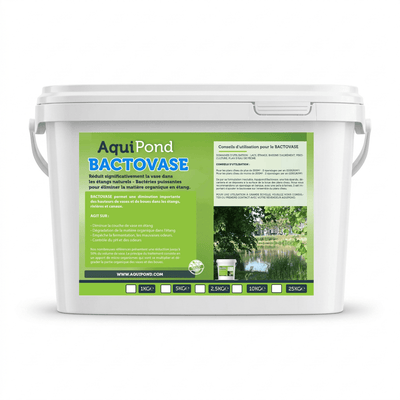 Aquipond Bactovase 2.5 kg – Bacteria to reduce pond sludge (12.5 to 25 m²)
€89,95
View product
 Aquipond Bactovase 5 kg – Bacteria to reduce pond sludge (25 to 50 m²)
€151,00
View product


Leave a comment