


The Foudebassin.com team
Published Updated
7 min read
Sunfish: the pretty multicolored fish that empties your pond of its fry (and what the law says)
You would think it came straight out of a tropical aquarium: a round, flattened body, turquoise-blue reflections, a bright orange belly, and a small black spot edged in red on the operculum. The sunfish (Lepomis gibbosus) was long sold as a pond fish. Those days are over, and for good reason.
The essentials
- The sunfish is a North American fish, introduced to Europe at the end of the 19th century for ornamental and fishing purposes.
- It eats invertebrates, amphibian larvae, eggs, and fish fry.
- It has been on the European Union's list of invasive alien species since 15 August 2019.
- In France, it was already on the list of species likely to cause biological imbalances.
10 cmcommon size
2019added to the Union list
1884first recorded in Belgium
€9,000fine in France for introducing it into waters
An American established everywhere
Native to North America, the sunfish was introduced to Europe as early as the end of the 19th century as an ornamental fish. It escaped and now lives in many ponds, canals, and slow-flowing rivers; according to the OFB and GT-IBMA fact sheet, it was introduced both deliberately, with carp fry, and by individuals escaping from farms. In Belgium, the Harmonia platform has recorded it in the wild since 1884. It often measures about ten centimetres; FishBase lists a maximum size of 40 cm, an exceptional size.
How to identify it
The sunfish has a disc-shaped body, compressed on the sides, a small mouth, and a single long dorsal fin, the front part of which is spiny. Its blue-green to olive colour intensifies during spawning, the belly is yellow to orange, and males carry the black spot edged in red on the operculum that makes it so recognisable. The common perch, meanwhile, is a native European fish.
| Feature | Sunfish | Common perch |
|---|---|---|
| Origin | North America | Europe |
| Silhouette | round, disc-shaped | elongated |
| Dorsal fins | one, long | two, well separated |
| Markings | black spot edged in red on the operculum | 5 to 8 dark vertical bands, black spot on the 1st dorsal fin |
| Common size | about 10 cm | about 25 cm |
According to the OFB and GT-IBMA fact sheet and FishBase (Lepomis gibbosus, Perca fluviatilis).
Why it is a problem
- It eats the eggs and fry of other fish, as well as tadpoles and insect larvae (Harmonia). In our experience, the fry of other fish survive very poorly in a pond that harbours them.
- It defends its nest: the male builds a circular nest in shallow water, then guards the eggs and fry (OFB and GT-IBMA fact sheet).
- It breeds quickly: the female spawns several times a year, and the species can become very abundant in a body of water.
Banned since 2019
The sunfish has been on the European Union's list of invasive alien species of concern since 15 August 2019 (Implementing Regulation (EU) 2019/1262). It is prohibited to sell, keep, transport alive, or release it (Article 7 of Regulation (EU) No 1143/2014). In France, it was already classified as a species likely to cause biological imbalances (Article R. 432-5 of the Environment Code, renumbered D. 432-5 by Decree No 2026-464).
| Where | Text | What it provides for |
|---|---|---|
| European Union | Regulation (EU) No 1143/2014; Implementing Regulation (EU) 2019/1262 | Prohibition on keeping, breeding, transporting, selling, trading, allowing to reproduce, or releasing the species. |
| France | Order of 14 February 2018, Annex II-3, added by the Order of 10 March 2020 | Same prohibitions under French law. |
| France, waterways and bodies of water | Environment Code, Article L. 432-10 and list D. 432-5 | Introducing it into waters, including enclosed waters, is punishable by a €9,000 fine. |
| Wallonia | Decree of 2 May 2019, Article 6 | Applies the prohibitions of the European regulation to the species on the Union list in Wallonia. |
Fine amount and application to enclosed waters: presentation note from the Ministry of Ecology on Article R. 432-6; example of the sunfish cited by the DDT of Mayenne.
Do you have one in your pond?
- Never release it into the wild.
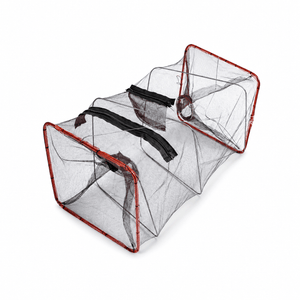
- In our experience, it is easily caught on a line with a small worm, or in a minnow trap.
- Report it and ask for the procedure to follow: in Wallonia, the Invasive Alien Species unit of the SPW (invasives@spw.wallonie.be); in France, the departmental service of the OFB or the DDT(M).
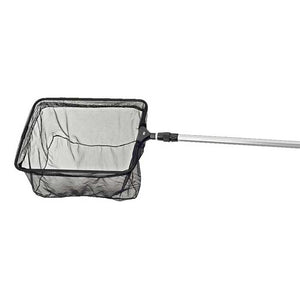
If it has already spawned, look for nests: round, clear depressions in the gravel, in shallow water, with a male circling above. This is where a minnow trap or landing net is most useful. The fish you keep can then go through a quarantine before being mixed with new arrivals.
 Folding minnow trap 55 x 25 x 25 cmSmall size for small fish, to be placed near shallow areas.View product
 Large fish landing net 140 cm – OaseFor sorting your fish during a partial drain and removing unwanted ones.View product
Colourful fish that are allowed
For colour, shubunkins, golden koi, comet goldfish, or rainbow goby are beautiful choices. See the rainbow goby and our list of cold-water fish.
When you are offered a fish “for colour”, ask its Latin name and check it on the European Union list before buying it. For choosing species, our guide which fish to choose for an outdoor pond is a good starting point.
Unsure about a fish in your pond?
Send us a photo: we will help you identify it and choose the right equipment.
Frequently asked questions
Is it edible?
Yes, but small. If you catch one, do not transport it alive or release it elsewhere: European regulation prohibits it.
Why are there still so many?
Because it has been established for over a century in many environments. The ban aims to prevent the situation from worsening.
How to distinguish it from a common perch?
The sunfish is round, with a single dorsal fin and a black spot edged in red on the operculum. The common perch is elongated, has two well separated dorsal fins and dark vertical bands.
Can you still buy it in garden centres?
No. Since 2019, its sale has been prohibited throughout the European Union, in France as in Belgium.
What to do if it has already spawned in my pond?
Locate the nests, those round depressions in shallow water, and catch the adults in a minnow trap or with a landing net. Do not release any individuals and ask the SPW in Wallonia, or the OFB or the DDT(M) in France, for the procedure to follow.
And you?
Did you have a sunfish in your pond without knowing it was banned? You are not the only one.
Also read: Which fish to choose for an outdoor pond?, Cold-water fish for ponds and Frogs, toads and newts in ponds.
Produits et rayons conseillés
Products recommended by our experts
See the full selection Aquipond BactoClay - Montmorillonite clay 2 kg for koi ponds
€39,95
View product
 Minerall in One Aquipond - Increases GH & KH simultaneously - 2.5KG to treat 30M³
€49,00
View product
 Sera Aqua-Test Set - The essential analysis kit for ponds and aquariums
€34,61
 Aquipond KH+ 1kg - Increases Carbonate Hardness (KH)
€19,95


Leave a comment