


The Foudebassin.com team
Published Updated
6 min read
Pseudorasbora: the small invasive fish that hides among goldfish and can decimate a pond
You bought some goldfish or rescued fish from a pond, and a few months later your pond is swarming with small silver-grey fish you never put in. It may be a pseudorasbora (Pseudorasbora parva), also known as the Asian gudgeon, one of Europe's most widespread invasive fish.
The essentials
- The pseudorasbora is a small fish from East Asia, recognisable by its upward-facing mouth and lack of barbels.
- It usually arrives hidden in batches of fish or in pond water.
- It can carry a parasite, Sphaerothecum destruens, without showing any symptoms, which can be fatal to other fish.
- It has been on the European Union list since 2016: keeping, transport and release are prohibited.
8 cmcommon size
3 to 4spawns per season
2016added to the Union list
32 countriesinvaded in less than 50 years
Recognising it
- Small size: often 4 to 8 cm, 12.5 cm at most according to FishBase.
- Elongated, silver body with purple-tinged flanks (Canal & River Trust).
- Small, upward-facing mouth, without barbels.
- In adult males, a small hump forms behind the head.
Its nickname, the "Asian gudgeon", is confusing: our native gudgeon has barbels, while the pseudorasbora has none.
| Feature | Pseudorasbora | Gudgeon | Minnow |
|---|---|---|---|
| Barbels | none | yes, as long as the eye | none |
| Mouth | small, upward-facing | surrounded by barbels | – |
| Flanks | silver, purple-tinged | – | row of elongated dark spots |
| Common size | 8 cm | 12 cm | 7 cm |
According to FishBase (Pseudorasbora parva, Gobio gobio, Phoxinus phoxinus) and the Canal & River Trust.
How it arrives
Native to East Asia, it has spread across Europe since the 1960s, mainly through the transfer of Chinese carp for aquaculture (Gozlan et al., 2010). In our experience, it still travels today in poorly sorted batches of fish, in anglers' buckets, or as fish "given" by a neighbour emptying their pond.
According to this same study, 32 countries, from Central Asia to North Africa, were invaded in less than fifty years, and the species was detected on average only four years after its arrival. In Belgium, the Harmonia platform has recorded it in the wild since 1989, in ponds, ditches and silted streams rich in plants.
Why it is dangerous
- It breeds in large numbers: the female spawns 3 to 4 times per season and the male guards the eggs (FishBase). In the United Kingdom, densities of more than 60 fish per square metre have been recorded (Canal & River Trust).
- It eats the eggs and competes with other fish for food.
- It can carry a parasite, Sphaerothecum destruens, without becoming ill; this parasite can cause mortality in other fish, including the Heckel bleak (Gozlan et al., 2005).
Harmonia adds that by consuming large amounts of small planktonic crustaceans, it promotes phytoplankton, leading to greener water with higher nutrient levels.
Prohibited in the European Union
The pseudorasbora has been on the European Union's list of invasive alien species of concern since 3 August 2016 (Implementing Regulation (EU) 2016/1141): keeping, transport and release are prohibited (Article 7 of Regulation (EU) No 1143/2014).
| Where | Text | What it provides for |
|---|---|---|
| European Union | Regulation (EU) No 1143/2014; Implementing Regulation (EU) 2016/1141 | Prohibition on keeping, rearing, transporting, selling, exchanging, allowing to breed or releasing the species. |
| France | Order of 14 February 2018, Annex II-1 | Same prohibitions under French law, including keeping and transport. |
| Wallonia | Decree of 2 May 2019, Article 6 | Applies the prohibitions of the European regulation to the species on the Union list in Wallonia. |
Preventing it
- Buy your fish from a professional who knows their batches.
- Never introduce fish or water from a natural pond.
- Place new fish in quarantine for a few weeks in a separate tank: you will spot an intruder before it breeds. See quarantine and the salt bath.
Getting rid of it
It is difficult in a large pond. In our experience, a fine baited trap catches many individuals. A partial drain allows sorting with a net. In serious cases, a complete drain remains, in our experience, the safest solution; in the United Kingdom, the Environment Agency is also carrying out an eradication programme for the species (Canal & River Trust). Report it and ask for the procedure to follow: in Wallonia, to the Invasive Alien Species unit of the SPW (invasives@spw.wallonie.be); in France, to the departmental service of the OFB or the DDT(M).
What to do if unknown small fish appear in your pond? Proceed in this order:
- Catch a few with a fine net and observe the mouth and lack of barbels.
- Take a clear, profile photo to confirm identification.
- Place a fine baited trap for several nights in a row to remove as many as possible.
- Do not release any captured fish and do not give them away: their transport is prohibited.
- If the pond is infested, plan a drain with sorting, putting your other fish in a quarantine tank.
During a drain, sort in shallow, well-lit tanks: at this size, a pseudorasbora easily hides among goldfish fry. Our article on goldfish overpopulation provides other ways to regain control.
 Koi Bowl, 67 cm tank – Koi ProA separate tank for observing new fish or sorting during a drain.View product
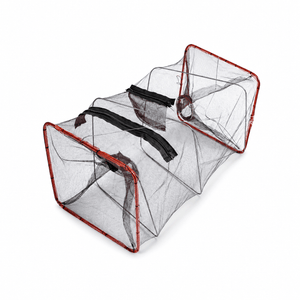
 Folding fish trap 55 x 25 x 25 cmDesigned for small fish and fry, to be placed for several nights in a row.View product
Unknown small fish in your pond?
Send us a profile photo: we will help you identify them.
Frequently asked questions
Is it dangerous for my koi?
It can transmit a parasite to cyprinids and compete with them for food. It is better to remove it.
How to distinguish it from a minnow?
The minnow has a row of elongated dark spots along its flank; the pseudorasbora has a small, distinctly upward-facing mouth (FishBase).
How did it get into my pond?
Most often with other fish, or with water taken from a pond. Quarantining new arrivals allows you to spot it before it breeds.
Can I give it to a neighbour or release it into a pond?
No. The European regulation prohibits transporting, exchanging and releasing it, in France as in Wallonia.
And you?
Small grey fish appeared in your pond without you putting them in? Describe them in the comments, we will help you identify them.
Also read: Pond fish quarantine, Goldfish overpopulation and Which fish to choose for an outdoor pond?
Produits et rayons conseillés

Products recommended by our experts
See the full selection Aquipond ImmunoFish – 1 Liter – Koï Mucus for 20 m³
€39,95
View product
 Aquipond ImmunoFish – 2.5 Liters – Koï Mucus for 50 m³
€59,95
View product
 Aquipond ImmunoFish – 5 Liters – Koï Mucus for 100 m³
€89,95
View product
 Malamix 17 – organic supplement for koi and pond fish – 1 L
€28,71


Leave a comment