


The Foudebassin.com team
Published
14 min read
Water primrose in a pond: how to identify and remove it
Ludwigia is recognizable by its yellow flowers with five petals, borne on stems that stand above the water, and its long creeping stems that gradually cover the surface. Two species are involved: greatwaterweed (Ludwigia grandiflora) and creeping Ludwigia (Ludwigia peploides). “Native to South America,” they were accidentally introduced to southern France around 1830, then used ornamentally (OFB). Both are on the European Union’s list of invasive alien species of concern: in France and Wallonia, European bans apply (possession, transport, sale, etc.); in Wallonia, their presence must also be reported to the SPW. To remove Ludwigia, pull up the entire plant, roots included, without leaving any fragments behind, then monitor the pond for several years. This sheet complements our guide to invasive aquatic plants.
Key points
- Yellow flowers with 5 petals: 2 to 5 cm, with overlapping petals in greatwaterweed; 2 to 3 cm and separate petals in creeping Ludwigia.
- A stem fragment with a single node is enough to grow a new plant: do not cut or shred; pull it up.
- Pull up in June–July and again in September, before fruit forms, using a fine-mesh net downstream.
- No compost in the garden: incinerate or use a controlled disposal route, according to your local council’s guidelines.
- After it appears to have disappeared, monitor the area every 3 to 6 months for at least 5 years.
- Report it: in France to the Invasive Alien Species Resource Centre or the OFB; in Wallonia to the SPW.
2 to 5 cm yellow flowers of greatwaterweed
1 node on a stem fragment is enough to grow a new plant
< 1 cm mesh size for the net placed downstream
5 years of monitoring after apparent disappearance
How to recognize Ludwigia?
Ludwigia is an amphibious plant with an aquatic form and a terrestrial form. In spring, it remains inconspicuous underwater; by late spring, its stems float, then straighten and flower. Info Flora, the Swiss national database on flora, describes greatwaterweed as follows (Info Flora, L. grandiflora sheet):
- Stems: creeping and floating, up to 6 m long, straightening to 40 to 80 cm above the water, often reddish;
- Leaves: alternate, lanceolate, blue-green, with a short petiole (less than 2 cm);
- Stipules: small, black, and triangular at the leaf axils, a characteristic unique to the species;
- Flowers: yellow, with 5 overlapping petals, 2 to 5 cm in diameter, from June to September;
- Roots: anchoring roots and whitish, spongy roots that help the plant breathe and float.
Creeping Ludwigia has dark green, glossy leaves with long petioles (more than 2 cm), pale brown kidney-shaped stipules, and flowers 2 to 3 cm across with separate petals, from June to October (Info Flora, L. peploides sheet). Both species are managed in the same way.
Also inspect dry land: the terrestrial form colonizes banks and damp grasslands, growing close to the ground with small rounded leaves (Info Flora).
Which plants can it be confused with?
| Plant | Status | Flowers | Leaves | Flowering |
|---|---|---|---|---|
| Greatwaterweed (Ludwigia grandiflora) | Invasive alien | Yellow, 5 overlapping petals, 2 to 5 cm | Alternate, short petiole, black stipules | June to September |
| Creeping Ludwigia (Ludwigia peploides) | Invasive alien | Yellow, 5 separate petals, 2 to 3 cm | Alternate, glossy, long petiole, pale brown stipules | June to October |
| Marsh Ludwigia (Ludwigia palustris) | Native | Small, light green, no petals | Opposite | July–August (in Switzerland) |
| Lesser water-primrose (Caltha palustris) | Native | Yellow, 5 petal-like sepals, 1.5 to 5 cm | Kidney-shaped, glossy, crenate | March to June |
| Lesser spearwort (Ranunculus flammula) | Native | Yellow, 5 petals, 7 to 20 mm, long peduncles | Oval to elongated, then almost linear | May to September |
Sources: Info Flora for the three Ludwigia species, and its L. palustris sheet for the flowering of marsh Ludwigia (Swiss data); National Botanical Conservatory of Brest for the water-primrose and lesser spearwort.
Native marsh Ludwigia is being displaced by greatwaterweed in ponds in the Landes region (OEPP): do not pull it up by mistake. If in doubt, photograph the flower, leaf and stipules, and ask the services listed below for confirmation.
Why is Ludwigia a problem?
- Huge biomass. Greatwaterweed can double its weight in 2 to 3 weeks and reach 2 kg of dry matter per square metre, with a record of 7 kg (Info Flora).
- Less oxygen. Dense vegetation covers the surface, deprives submerged plants that produce oxygen of light, and its roots consume oxygen: levels below 1 mg/L have been recorded in infested waters (OEPP). See also why sludge consumes oxygen in the pond.
- A pond that fills in. Biomass decomposes in winter, fuels eutrophication and silts up the bottom, accelerating sedimentation (Info Flora).
- Loss of biodiversity. In Belgian ponds, a study cited by the OEPP measured a 70% reduction in the number of native plant species in invaded areas compared to non-invaded areas; declines in invertebrates and fish have also been recorded in France (OEPP).
What the law says in France and Wallonia
| Level | Text | Key points |
|---|---|---|
| European Union (France and Belgium) | Regulation (EU) 1143/2014; Commission Implementing Regulation (EU) 2016/1141 | Both Ludwigia species are on the Union list: prohibited from being introduced, kept, cultivated, transported, placed on the market, used, traded or released |
| France | Order of 14 February 2018 (plant species), Annex I-1 | Prohibited for live specimens: introduction into the territory and the natural environment, possession, transport, peddling, use, trade, offering for sale, sale and purchase |
| Wallonia | Decree of 2 May 2019; ministerial order of 15 September 2022 | European bans apply; species “not yet widely spread”; presence on your property must also be reported to the SPW |
Commission Implementing Regulation 2016/1141 includes both Ludwigia species on the Union list (EUR-Lex). Regulation 1143/2014 applies directly in both countries; it excludes from the transport ban “transport of species to facilities for eradication purposes” (Article 7, paragraph 1, point (d)) (EUR-Lex, Regulation 1143/2014).
In France, these bans apply “throughout the metropolitan territory at all times”; the 2018 order replaced that of 2 May 2007, which already targeted both Ludwigia species. It does not reproduce the European exception for transport to an eradication facility verbatim: it provides for administrative authorisation under the conditions of Article L. 411-6, II, of the Environment Code (Article 2, II), and its Article 3, amended in 2024, only covers commercial stocks (AIDA, Order of 14 February 2018). For the waste disposal route that accepts it, ask your local council; for any authorisation, contact the DDT(M) or the prefecture.
In Wallonia, the European bans also apply, and both Ludwigia species are on the list of species “not yet widely spread” (Wallex, Order of 15 September 2022). The Decree of 2 May 2019 refers to the prohibitions of the European regulation and also requires that the possession of a listed species be reported (Wallex, Decree of 2 May 2019). The owner who finds it on their land must report it “without delay” using a free online form; the SPW responds within one month (Wallonie.be).
For Flanders and Brussels, contact the regional administration. This information does not replace legal advice.
How to remove Ludwigia from a pond?
In a private pond, the realistic goal is to eradicate an early-detected infestation. Near Geneva, a 900 m² pond had approximately 120 m² of Ludwigia in 2002: pulled up by hand, bagged and incinerated, then pulled up again in 2003, it was considered eradicated from the site in 2009 (OEPP, 2011).
- Place a net downstream. Stretch a net with mesh size less than 1 cm across the water outlet or downstream of the work area (Info Flora).
- Pull up the entire plant. Pull the stems by hand down to the roots without breaking them: a fragment with a node will grow into a new plant (GT IBMA / ONEMA) and remain viable in water for several weeks (Info Flora).
- Collect every fragment with a fine-mesh skimmer, and empty the net after each session.
- Bag it on site in sealed bags. Experience shows it is better to store them out of the water and away from flood zones.
- Dispose of the waste. Info Flora recommends incineration, industrial composting or anaerobic digestion, and “never” garden composting (Info Flora). Ask your local council which disposal route to use before moving the bags (see the legal section).
For the work itself, we recommend using chest waders to avoid damaging the bank, and cleaning boots, tools and nets before leaving: equipment with attached pieces spreads the plant (Info Flora).
When to intervene?
| Period | Objective |
|---|---|
| June–July | Remove as much as possible before the peak of growth |
| Every 3 to 6 weeks | Remove regrowth from small fragments |
| September | Remove remaining stems before fruit forms |
| Then every 3 to 6 months, for at least 5 years | Monitor after apparent disappearance |
Schedule based on Info Flora. Monitoring is essential: some populations produce up to 10,000 seeds per square metre, which germinate in April–May. Include these checks in your natural pond maintenance schedule.
Large infestations or ponds connected to a watercourse
Manual pulling is suitable for recent infestations; the OEPP reserves mechanical pulling for heavily infested sites, before manual follow-up (OEPP). In this case, our experts advise hiring a specialist company. If the pond connects to a watercourse, the intervention may fall under water law: the Nièvre DDT guide, for example, requires prior approval from the DDT in the event of mechanical pulling, machinery or invasive species in the watercourse (Nièvre DDT). In Wallonia, the SPW indicates the management measures in response to the report (Wallonie.be).
Report and replant
In France, the OFB recommends reporting a suspected species to the Invasive Alien Species Resource Centre or its regional offices (OFB). It is also useful to notify the local town hall if the pond connects to a ditch or stream. In Wallonia, report its presence to the SPW Agriculture, Natural Resources and Environment using the online form or by emailing invasives@spw.wallonie.be (Wallonie.be).
Do not leave the bank bare. Large emergent plants such as reeds, bulrush, or water primrose help prevent the spread of water primrose, although they do not stop it from establishing (OEPP). Choose suitable replacements from our list of native aquatic plants.
What Not to Do
- Mowing, cutting or shredding: each piece becomes a cutting, and poorly carried out mechanical maintenance promotes dispersal (OEPP).
- Draining and covering: this is ineffective; on the bank, covering for 10 to 15 days only reduced the number of stems to be pulled out (Info Flora).
- Relying on drying out: the terrestrial form is more resistant to drying out (Info Flora), and the OEPP only recommends drying out in a Mediterranean climate (OEPP). Before draining, read our article on drying out a pond.
- Using a weedkiller: herbicides are generally prohibited in aquatic environments (OEPP). In France, the Labbé law also prohibits individuals from using and possessing phytopharmaceutical products, except for biocontrol, low-risk products and products authorized in organic farming, since January 1, 2019 (AIDA, Law No. 2014-110). In Wallonia, check with the SPW.
- Throwing waste into the water, a ditch or the compost, or emptying an aquarium or pond into the environment.
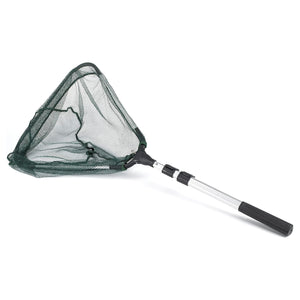
 Fine-mesh plant net 140 cm – OaseTo collect floating fragments without letting them drift away.View product
 PVC waders – ArcaTo pull out water primrose from the water without trampling the bank.View product
 Butomus umbellatus – flowering rushA native bank plant to recolonize the shore after pulling out the water primrose.View product
Is your situation different?
Are you unsure about identification or the extent of the infestation? Send us a photo of the flower and stem.
Free water analysis · Pond and lake calculators · Write to us
Experts since 1998 · Free delivery from €149 (excluding bulky items)
Equip yourself before pulling out the water primrose
A fine-mesh net to ensure no fragment is missed, and expert advice if you are unsure about identification: send us a photo of the flower, leaves and stipules.
View nets Ask our experts for adviceFrequently Asked Questions
Is water primrose prohibited?
Yes. In both France and Wallonia, European prohibitions apply: it is prohibited to possess, transport (except to the disposal facility indicated by your municipality), plant or sell it. In Wallonia, its presence must also be reported to the SPW.
What is the difference between large-flowered water primrose and creeping water primrose?
Look at the petals and stipules: large-flowered water primrose has overlapping petals and black stipules, while creeping water primrose has separate petals and light brown stipules.
Can water primrose be composted?
Not in the garden: incineration, industrial composting or anaerobic digestion, depending on the disposal method indicated by your municipality.
How long does it take to get rid of it?
Several years, including the monitoring phase following its apparent disappearance. The Geneva infestation, recorded in 2002, was considered eradicated in 2009.
Is marsh water primrose invasive?
No: Ludwigia palustris, which has no yellow petals, is native. Leave it in place.
In summary
In both France and Wallonia, European prohibitions apply to water primrose; in Wallonia, its presence must also be reported to the SPW. To eliminate it: use a net downstream, pull it out completely in June-July and then in September, collect every fragment, bag the waste and keep it out of the compost, then monitor regularly. For other species, see our guide to invasive aquatic plants.
About the author. This article was written by the Foudebassin.com team, experts in aquatic environments since 1998, using Info Flora data sheets, the GT IBMA, ONEMA data sheets, the OEPP risk assessment, data sheets from the National Botanical Conservatory of Brest, the OFB, and the cited European, French and Walloon regulations. Discover the history of Foudebassin; for questions about your pond, contact our experts.
Header photo: Traumrune, Wikimedia Commons, CC BY-SA 3.0 license, cropped image.
Last updated: November 24, 2026.
Produits et rayons conseillés


Products recommended by our experts
See the full selection Aquipond BactoClay - Montmorillonite clay 2 kg for koi ponds
€39,95
View product
 Minerall in One Aquipond - Increases GH & KH simultaneously - 2.5KG to treat 30M³
€49,00
View product
 Sera Aqua-Test Set - The essential analysis kit for ponds and aquariums
€34,61
 Aquipond KH+ 1kg - Increases Carbonate Hardness (KH)
€19,95
Read also
All our tips Pond salamanders: identifying species and managing them
Updated November 24, 202614 min read
 Fish mortality in ponds: causes and solutions
Updated November 24, 202616 min read
 Price of lime for ponds: which product to choose and what budget to plan for based on the surface area
Updated September 9, 20197 min read