


The Foudebassin.com team
Published
13 min read
Brazilian waterweed: identify Brazilian waterweed and take action
The word “myriophyllum” refers to several aquatic plants of the genus Myriophyllum, with feather-like divided leaves. Three are native: spike myriophyllum, whorled myriophyllum and alternate-flowered myriophyllum. Two exotic species are banned throughout the European Union: Brazilian myriophyllum (Myriophyllum aquaticum) and heterophyllous myriophyllum (Myriophyllum heterophyllum). The most telling sign: Brazilian myriophyllum sends blue-green leafy stems above the water, like little fir trees, while native myriophyllums remain submerged and only their flower spikes emerge. Here is how to tell them apart, what the rules say in France and Wallonia, and how to get rid of them without spreading them.
Key points
- Native myriophyllums: spike (M. spicatum), whorled (M. verticillatum) and alternate-flowered (M. alterniflorum). Only their flower spikes emerge above the water.
- Brazilian myriophyllum: emergent stems up to 40 cm, 4 to 6 leaves, blue-green. On the Union list since 3 August 2016.
- Heterophyllous myriophyllum: mostly submerged, stems often reddish, flowering tip emerging with thick, toothed leaves. On the Union list since 2 August 2017.
- The two exotic species can regrow from a single stem fragment bearing a node.
- Pull out the entire plant, use a net with mesh sizes of less than 1 cm downstream, dispose of waste in the general waste or at a waste disposal site, never in the garden compost.
40 cmmaximum height of Brazilian myriophyllum emergent stems
< 1 cmmesh size of the net placed downstream of the work area
3 to 6 monthsbetween two inspections, for at least 5 years
2016 · 2017listing of the two exotic species on the Union list
What are the different myriophyllums?
They are perennial rooted plants with leaves arranged in whorls (several leaves at the same level on the stem).
The three native myriophyllums
Tela Botanica classifies M. spicatum, M. verticillatum and M. alterniflorum as native in France (Tela Botanica, M. spicatum; M. verticillatum; M. alterniflorum). According to Info Flora, the Swiss national centre for plant data (Info Flora, M. aquaticum fact sheet):
- Spike myriophyllum: leaves usually in 4s, with 15 to 40 segments, stem often reddish, spikes upright and robust.
- Whorled myriophyllum: leaves in 5s or 6s, emergent spike 5 to 20 cm, winter buds (turions).
- Alternate-flowered myriophyllum: leaves in 4s, rarely 5, with 8 to 18 segments at most 1.5 cm long, small, sparse spike. The Luxembourg Nature Administration locates it in limestone-poor lakes and ponds (ANF Luxembourg, heterophyllous myriophyllum fact sheet).
The spike bracts (the small leaves bearing the flowers) help to distinguish them. According to the Coste flora reproduced by Tela Botanica, those of whorled myriophyllum are pinnate and much longer than the flowers; those of spike myriophyllum are incised at the base of the spike, then entire and shorter than the flowers; those of alternate-flowered myriophyllum are very small and entire (Tela Botanica, Coste flora: M. spicatum, M. verticillatum, M. alterniflorum).
These species are not regulated. Spike myriophyllum can proliferate in water that is too rich, as our guide to invasive aquatic plants in ponds reminds us: it is then managed by partial removal, not eradication.
The two invasive exotic myriophyllums
The Brazilian myriophyllum, or aquatic myriophyllum, comes from South America. Introduced for ornamental purposes in France in 1880 in the Bordeaux region, it is mainly present on the Atlantic coast. Only female plants are observed there: it does not produce seeds and multiplies only by fragmentation and cuttings (GT IBMA / French IUCN Committee).
The heterophyllous myriophyllum, or two-leaved myriophyllum, comes from eastern North America. Its stems reach 1 m underwater; only the flowering tip emerges, by 10 to 15 cm. It does not produce seeds in Europe, but a stem fragment of less than one centimetre bearing a node can grow into a plant (Info Flora, M. heterophyllum fact sheet).
How to recognize Brazilian myriophyllum?
First, look above the water. Info Flora describes emergent stems that “resemble little fir trees”, densely leafy, up to 40 cm above the surface. The emergent leaves are light glaucous green, 2.5 to 4 cm long, in whorls of 4 to 6, divided into 8 to 30 fine segments (Info Flora). According to Dutch botanists, this glaucous appearance comes from a waxy coating that can be removed by rubbing (Van Valkenburg et al., European Journal of Taxonomy, 2022). The flowers are white and tiny (1 mm), in the leaf axils (GT IBMA).
| Criterion | Brazilian myriophyllum (exotic) | Heterophyllous myriophyllum (exotic) | Spike myriophyllum (native) | Whorled myriophyllum (native) | Alternate-flowered myriophyllum (native) |
|---|---|---|---|---|---|
| Above water | Leafy stems up to 40 cm, like “little fir trees” | Flowering stems of 10 to 15 cm | Flower spike only | Spike of 5 to 20 cm | Small, sparse spike |
| Leaves per whorl | 4 to 6 | 4 to 6 (submerged) | Generally 4 | 5 or 6 | 4, rarely 5 |
| Segments per leaf | 8 to 30 (emergent) | 4 to 15 (submerged) | 15 to 40 | 15 to 40 | 8 to 18 |
| Emergent leaves | Glaucous green, bluish | Thick, rigid, toothed | None | None | None |
| Spike bracts | Similar to leaves | Undivided, toothed | Lower ones incised, upper ones entire, shorter than the flowers | Pinnate, much longer than the flowers | Very small, entire |
| Stem | Green | Often reddish | Often reddish or pinkish | — | — |
| Status | Union list (2016) | Union list (2017) | Native | Native | Native |
Sources: Info Flora, M. aquaticum and M. heterophyllum, GT IBMA; native bracts: Coste flora via Tela Botanica. The undivided bracts of the heterophyllous myriophyllum distinguish it from whorled myriophyllum, but not from spike myriophyllum or alternate-flowered myriophyllum: in the latter, look instead at the thick, toothed emergent leaves.
The common bulrush (Hippuris vulgaris), which is native, can also be confusing: its emergent stems bear linear, entire leaves in 6s to 13s (Info Flora). Without flowers, a submerged myriophyllum remains difficult to identify: photograph the stem and leaves and have the identification confirmed.
Beware of trade names
According to Dutch botanists who studied trade in the Netherlands, a plant labelled “brasiliensis” has taken the place of Brazilian myriophyllum there since 2016. Described in 2022 as Myriophyllum rubricaule, it has purple-red emergent stems and non-waxy leaves; it is not on the Union list (Van Valkenburg et al., 2022; OEPP, 2025 update). Heterophyllous myriophyllum, meanwhile, is often sold under other names, including M. propinquum or M. hippuroides (Info Flora). And M. proserpinacoides, a synonym of Brazilian myriophyllum (OEPP), has been found on plants that were either M. aquaticum or M. rubricaule (Van Valkenburg et al.). Trust the plant, not the label.
Why is Brazilian myriophyllum a problem?
It forms dense monocultures that can cover an entire body of water, block light, slow the water, and create anaerobic conditions (ANF Luxembourg, 2024 action plan). Despite its nickname as an “oxygenating plant”, it eventually lowers dissolved oxygen: its biomass decomposes in winter, and this dead matter contributes to eutrophication while its sedimentation silts up the environment (Info Flora). Our article on pond eutrophication explains how to reduce nutrients.
The koi carp can do nothing about it: it abandons Brazilian myriophyllum (ANF Luxembourg).
What does the law say in France and Wallonia?
Throughout the European Union
Brazilian myriophyllum has been on the Union list of invasive alien species of concern since Implementing Regulation (EU) 2016/1141 (EUR-Lex), and heterophyllous myriophyllum since Implementing Regulation (EU) 2017/1263 (EUR-Lex). Wallonia records the listing dates as 3 August 2016 and 2 August 2017 (Wallex). Regulation (EU) No 1143/2014 prohibits, among other things, keeping, cultivating, selling, exchanging and releasing them into the wild; their transport is only permitted to eradication facilities (EUR-Lex, Art. 7).
In France
The order of 14 February 2018 prohibits “throughout the metropolitan territory and at all times” the introduction into the territory, introduction into the natural environment, possession, transport, peddling, use, exchange, offering for sale, sale or purchase of live specimens (AIDA, consolidated version). The two myriophyllums have been included since its publication in the Official Journal on 22 February 2018: Brazilian myriophyllum in Annex I-1, heterophyllous myriophyllum in Annex I-2 (JORF of 22 February 2018, FAOLEX copy). The official booklet intended for private individuals invites anyone holding a listed plant to “destroy it, taking care to avoid its spread”, and to report any observation in the wild using the INPN Espèces app (AFB, MTES, ONCFS, 2018).
In Wallonia
The decree of 2 May 2019 prohibits the activities covered by the European regulation (Art. 6) for the listed species and requires anyone who intentionally holds them to notify the administration (Art. 7) (Wallex, decree of 2 May 2019, version in force). The two exotic myriophyllums are on the list of species “not yet widely spread in Wallonia” from the ministerial order of 15 September 2022 (Wallex, for which the decree aims at “rapid, total and permanent elimination” (Art. 18). Report any observation, with supporting photos, via the SPW form (biodiversite.wallonie.be).
This information does not replace legal advice; check the version in force of the texts.
How to get rid of Brazilian myriophyllum?
- Report. With supporting photos, via INPN Espèces in France or the SPW form in Wallonia.
- Choose the season. Autumn and winter, when the plant has few reserves (Info Flora).
- Place a net downstream. Info Flora recommends mesh sizes of less than 1 × 1 cm downstream of the work area; the Luxembourg administration considers these barriers “imperative” (Info Flora; ANF Luxembourg). Our experts also advise screening the outlet of the monk and the overflow during the work, without ever blocking them: in case of heavy rain or flooding, the water must be able to drain.
- Pull out the entire plant. On a small area, manual pulling is the most effective technique, provided that aerial parts and roots are removed (ANF Luxembourg). Pull from the base, without cutting, and scoop up each fragment with a net.
- Dispose of waste properly. Do not use garden compost: household waste, industrial composting, anaerobic digestion or incineration, without dispersal during transport (Info Flora). The OFB recommends disposing of invasive species from the garden at a waste collection centre (OFB). Our experts recommend letting the plants drain on a tarp, away from water and outside flood zones, then bagging them before taking them.
- Clean the equipment. Waders, skimmers, nets, boats: a single attached fragment is enough to contaminate another body of water.
- Monitor. After apparent removal, Info Flora recommends checking every 3 to 6 months for at least 5 years (Info Flora).
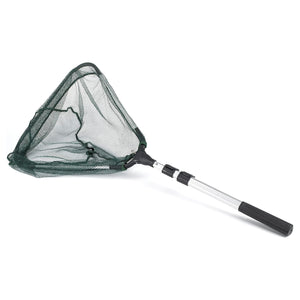
 For step 4Professional 190 cm plant skimmer – Oase
In a pond that can be completely emptied, eradication is more effective, especially if the drying out coincides with a period of frost (ANF Luxembourg). Our guide to drying out a pond details the process; always empty the net in place.
What not to do
- Cut or weed-whack: every piece with a node can grow back.
- Leave piles on the bank, throw away or give away the plant.
- Pour herbicide: the province of Liège "under no circumstances" allows chemical treatments, which risk permanently disrupting the environment (Province of Liège).
For a proliferating native myriophyllum, the response is gentler: partial removal in autumn and nutrient reduction. In our practice, a pond dye helps slow down submerged plants; however, it has no effect on the emergent stems of Brazilian myriophyllum. And to replace it, the province of Liège offers three native myriophyllums (Province of Liège); our list of native aquatic plants completes the choice.
 Hornwort (Ceratophyllum demersum)Native oxygenating plant, a safe alternative to exotic myriophyllums.View the product
 Fine-mesh plant skimmer 140 cm – OaseTo retrieve fragments, which easily grow back.View the product
 Aquipond Blue Lake 10 – 1 kgPond dye to slow down submerged plants; no effect on emergent stems.View the product
Is your situation different?
Unsure whether it is native myriophyllum or Brazilian myriophyllum? Send us a photo of the stems out of the water.
Free water analysis · Pond and lake calculators · Write to us
Experts since 1998 · Free delivery from €149 (excluding bulky items)
Replace an exotic myriophyllum or clear up identification doubts?
Choose oxygenating plants for your pond, or send us a photo of the stems out of the water: our experts will answer you.
View oxygenating plantsAsk an expert's opinionFrequently Asked Questions
Is spike myriophyllum invasive?
Not in the regulatory sense: it is native and not listed. It can become overgrown in nutrient-rich water; it is managed by partial removal.
Am I allowed to keep Brazilian myriophyllum in my pond?
No. Its possession, cultivation, exchange and sale are prohibited in the European Union, and therefore in France and Wallonia. The official French guide recommends destroying it without spreading it.
Can pulled myriophyllum be composted?
Not in the garden: fragments can grow back. Dispose of it as household waste or at a waste collection centre, in sealed bags, or through an industrial composting, anaerobic digestion or incineration channel (Info Flora).
Is heterophylly myriophyllum present in France?
Yes. Info Flora lists it as naturalized notably in France, Belgium, Germany and the Netherlands (Info Flora). It has been on the Union list since 2017 and on the French decree since its publication in February 2018.
In summary
Spike, whorled and alternate-flowered myriophyllums are native; Brazilian and heterophylly myriophyllum are prohibited in the European Union. For the latter: report it, remove it completely with a net downstream, dispose of waste outside compost, and monitor for several years. For other species to monitor, consult our guide to invasive aquatic plants.
About the author. This article was written by the Foudebassin.com team, specialists in aquatic environments since 1998, based on Info Flora sheets, the IBMA GT, the Luxembourg Administration of Nature and Forests, the province of Liège, Tela Botanica and the OEPP, published botanical works and European, French and Walloon regulatory texts cited. Discover the history of Foudebassin; for a question about your pond, contact our experts.
Header photo: Marie-Lan Nguyen, Wikimedia Commons, CC BY 2.5 license, cropped image.
Last updated: November 24, 2026.
Produits et rayons conseillés


Products recommended by our experts
See the full selection Aquipond BactoClay - Montmorillonite clay 2 kg for koi ponds
€39,95
View product
 Minerall in One Aquipond - Increases GH & KH simultaneously - 2.5KG to treat 30M³
€49,00
View product
 Sera Aqua-Test Set - The essential analysis kit for ponds and aquariums
€34,61
 Aquipond KH+ 1kg - Increases Carbonate Hardness (KH)
€19,95


