


The Foudebassin.com team
Published
14 min read
Pond salamanders: identifying species and managing them
Pondweeds (genera Potamogeton and Stuckenia) are native aquatic plants in France and Belgium. They provide habitat and food for wildlife, so they are not plants to be eliminated. In a nutrient-rich pond, some species can cover much of the water surface; they should then be contained, not eradicated. Here is how to identify common pondweeds (floating, curly, sago, shiny, and perforated), understand why they proliferate, and intervene at the right time, in accordance with French and Walloon regulations.
The essentials
- Pondweeds are native: they are not listed as invasive alien species. Some are even protected in certain regions.
- Curly-leaf pondweed has wavy, toothed leaves, grows in winter and spring, then dies around mid-July, leaving turions (overwintering buds) in the mud.
- Proliferation is first a sign of excess nutrients. Shallow water and clear water help most species, but not curly-leaf pondweed, which tolerates murky water.
- Cut or pull out plants in sections, always remove them from the water, and keep some of the cuttings.
- France has banned synthetic herbicides for private individuals since 2019; Wallonia requires a pesticide-free buffer zone of at least 6 m along surface waters.
18pondweeds numbered for Belgium and neighbouring regions
1 to 3 mdepth where curly-leaf pondweed mainly grows
5 yearsdormant turions can survive
6 mpesticide-free buffer zone in Wallonia
What is a pondweed?
Pondweeds are divided into two genera, Potamogeton and Stuckenia (Texas A&M AquaPlant). The New Flora of Belgium numbers 18 pondweeds for Belgium and neighbouring regions, including sago pondweed, from the most common to those that have disappeared (New Flora of Belgium). They are perennial plants: in floating and curly-leaf pondweed, stems grow from rhizomes buried in the bottom (Texas A&M AquaPlant; Québec.ca), so cuttings can regrow in the same place.
They are useful plants: highly consumed by ducks, they provide habitat for invertebrates that feed fish and amphibians (Texas A&M AquaPlant), and aquatic vegetation provides cover and breeding habitat for fish (Pas-de-Calais Departmental Directorate of Territories and the Sea). Even curly-leaf pondweed provides food and cover in winter, when other plants have disappeared (Penn State Extension).
How to identify common pondweeds?
Leaf shape is usually enough. However, hybrids are common in this genus (Flora of the Burren): if in doubt, have a botanist confirm.
| Species | Leaves | Habitat | Distinguishing feature |
|---|---|---|---|
| Floating pondweed (Potamogeton natans) | Floating, oval, thick, 5 to 10 cm, on a long petiole; submerged leaves reduced to narrow stems | Still or slow-flowing water | Mat of leaves on the surface, like a small water lily |
| Curly-leaf pondweed (P. crispus) | Submerged, 4 to 10 cm long and 5 to 10 mm wide, with wavy and finely toothed edges | Calm, nutrient-rich water, especially 1 to 3 m deep | “Lasagna-edge” margins, teeth visible to the naked eye |
| Sago pondweed (Stuckenia pectinata) | Submerged, thread-like, 5 to 15 cm long and 0.2 to 4 mm wide; stems often highly branched | Base-rich water, sometimes slightly brackish or lightly polluted | Sheath wrapped around the stem at the base of the leaves |
| Shiny pondweed (P. lucens) | Submerged, thin, translucent, slightly wavy, with a short petiole | Still or slow-flowing, base-rich water | Translucent leaves; plant 50 to 300 cm tall |
| Perforated pondweed (P. perfoliatus) | Submerged, oval to triangular, up to 11.5 × 4.2 cm, without a petiole | Streams, canals, highly mineralised water | Heart-shaped base clasping the stem |
Sources, by species: floating (Burren, New Flora; curly-leaf (Burren, Québec.ca; sago (Burren, New Flora; shiny (Burren, New Flora; perforated (Burren, New Flora).
Note: curly-leaf pondweed can have barely wavy leaves in young shoots and some populations (New Flora of Belgium). Perforated pondweed is protected in certain regions: see the “Pondweed: protected or invasive?” section below before taking any action.
The life cycle of curly-leaf pondweed and its turions
Curly-leaf pondweed grows out of season. According to Rutgers, its turions germinate when the water cools, from late summer to early autumn. The plant grows slowly throughout winter, even under ice, gets ahead of other species in spring, and reaches its maximum growth in late spring; it has disappeared by around mid-July (Rutgers Cooperative Extension).
In late June and early July, it produces seeds and turions in large quantities. The turions, hard and 1 to 2 cm long, float for a while and then sink to the bottom; 15 to 40% remain dormant and can survive for five years. By decomposing early, the plant releases phosphorus, often associated with cyanobacteria blooms (Québec.ca), and can consume enough oxygen to cause fish kills (Rutgers).
Curly-leaf pondweed remains native here, fairly common in several Belgian districts (New Flora of Belgium: North American sheets that treat it as invasive describe a continent where it was introduced. Floating pondweed, on the other hand, follows a classic rhythm and flowers from May to September (New Flora of Belgium).
Why do pondweeds invade a pond?
- Too many nutrients, above all. Excessive growth is a symptom of excess phosphorus and nitrogen (Penn State Extension). Fertilizers, runoff, fallen leaves and silt are the usual sources; see our article on pond eutrophication.
- Shallow water and clear water. Submerged plants generally grow in less than three feet of water, about 90 cm, and the depth they colonise depends on transparency (Penn State Extension). A pond that is silting up offers them more and more space.
- The case of curly-leaf pondweed. It mainly grows between 1 and 3 m and tolerates shade and murky or polluted water (Québec.ca). For it, depth and transparency matter little: reducing nutrients and pulling it out early are the real levers.
A partial herbarium is a sign of good health. Our experts advise intervening only if pondweeds interfere with use, cover most of the surface in summer, or if their decline is accompanied by fish kills.
How to manage pondweeds in a pond?
Cut or pull out, then export
Rake, brush cutter or pulling by hand: the tool matters less than two rules.
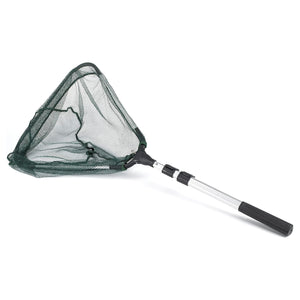
- Remove everything you cut. Many submerged plants regrow from fragments (Texas A&M AquaPlant). Collect them with a net, with a mesh held taut on the side where the wind or current pushes the fragments. Removing the plants also removes their nutrients from the pond (Penn State Extension).
- Deposit them away from the bank, outside flood zones, so that their nutrients do not return to the water (Pas-de-Calais Departmental Directorate).
 Fine-mesh net for plants 140 cm – Oase
For curly-leaf pondweed, brush cutting is not recommended: it disperses turions that cannot be collected. Quebec recommends pulling out or raking from spring, before turions form, allowing for several years of effort (Québec.ca). Work in small areas, avoiding spawning grounds; if the pond is connected to a stream, consult the Departmental Directorate of Territories (DDT or DDTM) first.
At what time?
We have not found an official calendar specific to private ponds. For second-category fishery streams (white fish), the Pas-de-Calais Departmental Directorate of Territories and the Sea recommends brush cutting between July 15 and January 15, never entirely, keeping refuge strips; it reminds that the destruction of spawning grounds is punished by a 20,000 euro fine (regulatory framework for brush cutting).
| Situation | When | How |
|---|---|---|
| Curly-leaf pondweed | In spring, before the end of June | Pulling out or raking in small areas, outside spawning grounds, without brush cutting |
| Floating, sago, shiny pondweeds | From mid-July to autumn | Cut in strips, remove all plants |
| Perforated pondweed | Depending on your region | Check its status first: it is protected in the former Nord-Pas-de-Calais |
| Pond connected to a stream | Before any work | Consult the DDT(M) in France or the Walloon Public Service (SPW) |
The second row applies the stream calendar to ponds out of caution. From experience, we advise not to treat more than half of the herbarium in the same year; our calendar for maintaining a natural pond places these works in the year.
Koi and dye
Koi readily eat pondweeds, but rarely control vegetation in the first year (Texas A&M AquaPlant). In France, its introduction requires authorization from the prefect, with a density that should not exceed 30 kg per hectare, and is in principle not authorized in ponds (AIDA, note of October 22, 2013). For Walloon rules, see how many koi to put in a pond.
Dye reduces light and slows submerged plants, but also impoverishes the pond's food chain (Texas A&M AquaPlant). It targets submerged pondweeds, not the floating leaves of floating pondweed. Our guide to pond dye specifies the dosage.
Reduce nutrients, deepen if necessary
Reducing inputs leads to a gradual decline of plants and algae (Penn State Extension): grass buffer, no fertilizer nearby, collection of fallen leaves. It is the sustainable solution for all species. A dredged pond also leaves less room for shallow-water pondweeds, but not for curly-leaf pondweed, which is comfortable up to 3 m.
Herbicides: almost excluded
In France, since 1 January 2019, the sale, use and possession of plant protection products for non-professional use have been banned; only biocontrol products, low-risk products or those usable in organic farming, bearing the label "authorised for use in gardens", remain available (ministerial response, National Assembly).
In Wallonia, away from crops and grasslands, a pesticide-free buffer zone of at least six metres from the top of the bank is required along surface waters (Walloon Government decree of 11 July 2013, art. 9).
We have not found any aquatic herbicide authorised for private use in France or Wallonia. In Pennsylvania, moreover, any herbicide applied to a pond requires a permit (Penn State Extension). To check a product, consult e-phy, the catalogue of the National Agency for Food, Environmental and Occupational Health Safety (ANSES), or Fytoweb in Belgium.
Pondweed: protected or invasive?
The European Union's lists of invasive species only include exotic species, i.e. those introduced outside their natural range (Regulation (EU) No 1143/2014, art. 3). As native species, pondweeds are not included: no Potamogeton or Stuckenia appears on the Union list (consolidated Implementing Regulation (EU) 2016/1141), nor in the French and Walloon lists mentioned in our guide to invasive aquatic plants. Several are, on the contrary, rare and protected.
- In France, we have not found any common pondweed protected at the national level, but regional decrees, still in force, protect several in the Hauts-de-France region (formerly Nord-Pas-de-Calais and Picardy). In the former Nord-Pas-de-Calais, the destruction, cutting and pulling up of curly pondweed, colour pondweed, horned pondweed and savetweed are prohibited (decree of 1 April 1991). In former Picardy, the protected species are alpine pondweed, colour pondweed, savetweed and horned pondweed (decree of 17 August 1989). Other regions have their own lists.
- In Wallonia, broad-leaved pondweed, savetweed and alpine pondweed are listed in Annex VIb of the Nature Conservation Act (Annex VIb). They are fully protected: it is prohibited to pick, cut, uproot or destroy them in the wild, or to damage their habitats (Act of 12 July 1973, art. 3). Shining pondweed is not listed there, but it is quite rare to very rare in most Belgian districts (New Flora of Belgium).
Before pulling up an unknown herbarium in a natural pond, have it identified.
Shining pondweed in the pond
Shining pondweed can also be cultivated: we offer it as an oxygenating plant, and it prefers alkaline waters (New Flora of Belgium). In our experience, pond enthusiasts like its submerged and translucent foliage; removing the surplus each year is enough to contain it. To combine it with other species, consult our list of oxygenating plants.
 Potamogeton lucens – shining pondweedNative pondweed appreciated in ponds for its submerged foliage.View product
 Professional 190 cm plant net – OaseFor removing cut herbariums and their fragments.View product
 Aquipond Blue Lake 10 – 1 kgDye that limits the light used by submerged pondweeds.View product
Is your situation different?
Don't know which pondweed is invading your pond? Send us a photo of a floating leaf and a submerged leaf.
Free water analysis · Pond and lake calculators · Write to us
Experts since 1998 · Free delivery from €149 (excluding bulky items)
Contain your pondweeds without emptying the pond
Removing cut plants and their fragments is the basic rule. Equip yourself with a suitable net, or send us a photo: our experts will help you identify the species.
View netsAsk for adviceFrequently asked questions
Is pondweed an invasive plant?
Not in the regulatory sense: pondweeds are native, while invasive species lists only target exotic species. Some, such as curly or colour pondweed, can however proliferate in a nutrient-rich pond.
How to get rid of pondweed?
Cut or pull up by areas and remove all plants from the water. Then reduce nutrient inputs: this is the only sustainable solution. For curly pondweed, pull up early in spring, without mowing; deepening the pond does not bother it much.
How to recognize curly pondweed?
Its submerged leaves, 4 to 10 cm long, have a wavy and finely serrated edge, visible to the naked eye. It is already green in winter, often under the ice, and disappears around mid-July.
Floating pondweed or water lily?
The floating leaves of floating pondweed are oval, 5 to 10 cm long, with a slightly heart-shaped base and a petiole longer than the blade (Texas A&M AquaPlant). Its flowers form small dense and greenish spikes, generally upright above the water, with nothing in common with the large flowers of a water lily.
Can a weedkiller be used against pondweed?
In France, synthetic herbicides have been banned for private individuals since 2019. In Wallonia, a pesticide-free buffer zone of at least six metres is required along surface waters. Beyond these prohibitions, we have not found any aquatic herbicide authorised for private use.
In summary
Pondweeds are useful native plants, sometimes locally protected: identify them before taking action. When they invade the pond, the primary cause is an excess of nutrients; lack of depth and clear water worsen the situation for most species, but not for curly pondweed. Intervene by areas and always remove cut plants: in spring for curly pondweed, after mid-July for other unprotected species. Then work on inputs and, if the pond silts up, on depth.
About the author. This article was written by the Foudebassin.com team, specialists in aquatic environments since 1998, using the New Flora of Belgium, Flora of the Burren (Naturalis), Quebec government fact sheets, Penn State, Rutgers and Texas A&M extension services, and the cited European, French and Walloon regulatory texts. Discover the history of Foudebassin; for a question about your pond, contact our experts.
Header photo: Stefan.lefnaer, Wikimedia Commons, CC BY-SA 4.0 license, cropped image.
Last updated: November 24, 2026.
Produits et rayons conseillés


Products recommended by our experts
See the full selection Aquipond BactoClay - Montmorillonite clay 2 kg for koi ponds
€39,95
View product
 Minerall in One Aquipond - Increases GH & KH simultaneously - 2.5KG to treat 30M³
€49,00
View product
 Sera Aqua-Test Set - The essential analysis kit for ponds and aquariums
€34,61
 Aquipond KH+ 1kg - Increases Carbonate Hardness (KH)
€19,95
Read also
All our tips Fish mortality in ponds: causes and solutions
Updated November 24, 202616 min read
 Water primrose in a pond: how to identify and remove it
Updated November 24, 202614 min read
 Price of lime for ponds: which product to choose and what budget to plan for based on the surface area
Updated September 9, 20197 min read