


Copper against filamentous algae in a pond: good or bad idea?
Every spring, someone tells us about the neighbor's trick: a handful of copper coins at the bottom of the pond, a piece of plumbing pipe tucked between the stones, or a few blue crystals of copper sulfate "as we used to do". The idea is not absurd: copper has long been known as an algaecide, but it is also toxic to fish, snails, insect larvae and some plants. In a garden pond, where all these creatures share a few cubic meters of water, the safety margin is very narrow.
— The short answer
This is a bad idea in an inhabited pond. Dissolved copper acts on filamentous algae, but the dose that inhibits them is close to the dose that damages fish gills, especially in soft water with low KH. It also kills snails and invertebrates and accumulates in the sludge. To combat filamentous algae, it is better to remove them mechanically, reduce phosphates, plant densely and, if necessary, use a treatment designed for ponds with fish.

What copper does in water
In dissolved form, copper disrupts photosynthesis and the membranes of algae cells. This is why copper sulfate was long used to control algae in reservoirs and production ponds. Boyd and Tucker explain in their aquaculture water quality manual that its use requires a precise calculation based on the water's alkalinity, precisely because the boundary between a useful dose and a toxic dose for fish is narrow.
The key factor is water chemistry. In hard, well-buffered water, some of the copper precipitates and becomes less available. In soft water with low carbonate levels, such as rainwater or water from some supply networks, more of the copper remains in its free form and its toxicity increases significantly. The same action can therefore have no visible effect on one pond and be catastrophic in another.
Why it is risky in a garden pond
| Organism | Sensitivity to copper | Consequence |
|---|---|---|
| Fish (koi, goldfish) | High, especially in freshwater | Gill damage, stress, deaths |
| Snails, shrimp, insect larvae | Very high | Loss of some beneficial fauna |
| Filter bacteria | Real | Slowed biological filtration, cloudy water |
| Aquatic plants | Variable | Slowed growth, therefore less competition against algae |
Noga describes copper as a treatment with a narrow therapeutic margin in fish: useful in certain supervised veterinary protocols, but dangerous as soon as the dose is exceeded. Coins or a copper pipe do not allow any dosage control: the amount released depends on the water's acidity, temperature, and the metal's surface area, and no one measures it.
There is also a long-term effect. Copper does not disappear: it binds to sludge and sediment and may be released later, for example when the pH drops. As a reference point, the European Drinking Water Directive sets a parametric value of 2 mg/l for copper; fish and aquatic invertebrates react to concentrations far below this threshold, which is intended for humans.
Hidden copper: pipes and decorative elements
Sometimes copper gets into the pond unintentionally. A fresh water supply that has passed through copper pipes, a copper gutter that discharges roof water, or a decorative metal water feature: all are possible sources, especially in soft-water regions. If your fish show signs of respiratory distress with no apparent cause, and the water has low mineral content, this is worth checking with a suitable test.
What should you do instead about filamentous algae?
Filamentous algae have one advantage: they are large. So they can be removed by hand, which is impossible with green water. Wind them around a brush or rough stick, or use a fine-mesh pond plant net. Removing the mass of algae also removes the nutrients it contains.
Fine-mesh 140 cm pond plant net - Oase
For removing filamentous algae and plant debris without damaging the liner. Live price and add to cart:
Next, cut off their food supply. Filamentous algae benefit from clear, sunny, phosphate-rich water. Reducing feeding, removing sludge, preventing runoff from fertilized lawns, and controlling phosphates do more than an algaecide. Finally, plant: fast-growing submerged plants directly compete with filamentous algae for the same resources, and a well-planted pond will generally see them recede from one season to the next.
Ceratophyllum demersum (submerged hornwort)
Fast-growing submerged plant that competes with algae for nutrients. Live price and add to cart:
If the infestation is too severe to manage by hand, choose a treatment sold for ponds with fish, follow the dosage, and aerate during treatment. Dying algae consume oxygen as they decompose: remove the dead clumps in the following days.
AlgoLon – Oase
Targeted treatment against filamentous algae, designed for ponds with fish. Live price and add to cart:

Read also
For the complete method against filamentous algae: Filamentous algae in a pond or lake: how to eliminate them effectively?.
READ THE ARTICLEHave you already used copper, or do you suspect a source of copper in your installation? Describe the situation to us: the Foudebassin team will help you secure the pond and choose a solution compatible with your fish.
Frequently asked questions
— Do copper parts in the pond prevent algae?
They can release copper, but in an uncontrolled manner that varies depending on the water. In a pond with fish or snails, the risk outweighs the benefit.
— Is copper sulfate dangerous for koi?
Yes, it can be. The effective dose against algae is close to the toxic dose for the gills, especially in soft water with low KH.
— How can filamentous algae be removed without using a product?
By regularly removing them by hand or with a net, reducing phosphates and food, and planting submerged plants densely.
— I've already added copper. What should I do?
Remove the source, carry out partial water changes, monitor the fish's behavior, and avoid lowering the pH. Seek advice if signs of distress appear.
In summary
- Copper is a true algaecide, but toxic to fish and invertebrates.
- Its toxicity increases sharply in soft, poorly buffered water.
- Copper parts and pipes do not allow any dosage control, and copper accumulates in the sludge.
- Against filamentous algae: mechanical removal, less phosphate, submerged plants.
- If treatment is necessary, choose a product designed for ponds with fish.
Sources and references
- Boyd C. E. & Tucker C. S., Pond Aquaculture Water Quality Management, Kluwer, 1998
- Noga E. J., Fish Disease: Diagnosis and Treatment, 2nd ed., Wiley-Blackwell, 2010
- Directive (EU) 2020/2184 on the quality of water intended for human consumption
- Manufacturer technical data sheets: Oase (AlgoLon), Aquigarden
- Foudebassin consulting experience, Nodebais (Belgium)
Last updated: September 29, 2026.
Products recommended by our experts
See the full selection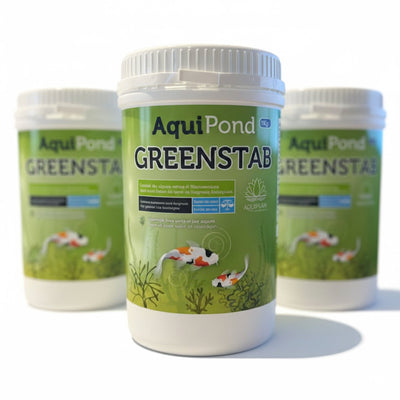 Aquipond Greenstab - Balanced pond water, limits algae
À partir de €34,95
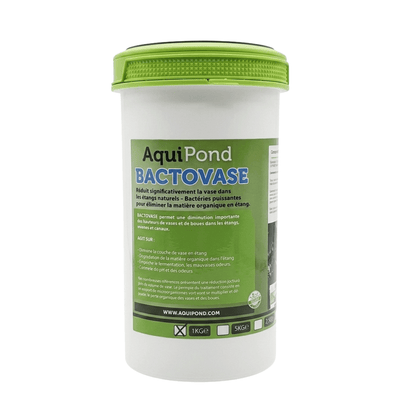 Aquipond Bactovase 1 kg – Bacteria for pond sludge reduction (5 to 10 m²)
€39,95
View product
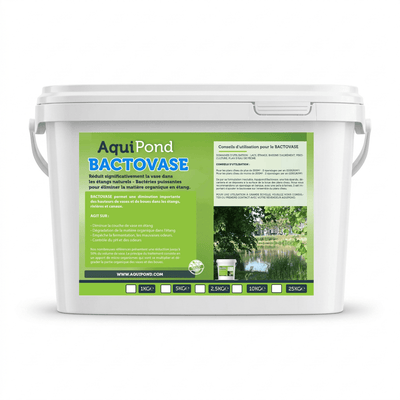 Aquipond Bactovase 2.5 kg – Bacteria to reduce pond sludge (12.5 to 25 m²)
€89,95
View product
 Aquipond Bactovase 5 kg – Bacteria to reduce pond sludge (25 to 50 m²)
€151,00
View product


Leave a comment