


Filamentous green algae in a pond: how to identify it, understand its life cycle, and know when to act
They are called angel hair, beard, cotton wool, or string algae. They cling to waterfall stones, wrap around stems, and rise in yellowish mats on sunny afternoons. For many pond owners, "filamentous green algae" is one and the same enemy. In reality, several very different algae hide behind this name, and knowing which one you have helps you understand why it is there and when it is worth taking action. A brief detour into biology before reaching for the net.
— The short answer
Filamentous algae are green algae made up of cells aligned in long threads. The most common in ponds are spirogyra, slimy and floating in spring, and cladophores, coarse, branched and attached to stones in summer. They thrive in clear, sunny water rich in nutrients. A moderate presence is normal and even useful. Action is needed when they smother plants, disturb fish or cover the surface: start with mechanical removal, then reduce nutrients.

What exactly is a filamentous alga?
A filamentous alga is a photosynthetic organism whose cells remain attached end to end after dividing, forming sometimes very long threads. Unlike the phytoplankton in green water, it is visible to the naked eye and can be touched. Most of the ones found in ponds belong to the green algae in the botanical sense. They draw their nutrients directly from the water across their entire surface, without roots: this is why they react so quickly to excess phosphates or nitrates.
Recognizing them by touch and sight
You don't need a microscope for a first impression. Take a handful of filaments, spread them out in a white dish with a little water, and touch them.
| Appearance and texture | Likely group | Typical period |
|---|---|---|
| Bright green, very slippery, unbranched, floating masses | Spirogyra (Spirogyra) | Spring, when the water is still cool |
| Coarse, branched, in tufts attached to stones and waterfalls | Cladophores (Cladophora) | Summer, flowing or agitated water |
| Dense, dark green felt on damp banks and shallow areas | Vaucheria | Spring and autumn |
| Net-like mesh, like fishnet stockings | Water net (Hydrodictyon) | Hot summer |
These guidelines remain indicative: without microscopic observation, we refer to a “probable group.” But they are sufficient for practical purposes, because the behavior of each group guides the response.
The seasonal cycle in the pond
As soon as the water warms up and the days lengthen, filaments often start growing before the aquatic plants, which are still dormant. They benefit from clear water, few competitors, and nutrients released during winter by the decomposition of leaves and sludge. This is the classic “filament outbreak” of April and May.
As the season progresses, higher plants regain the upper hand in a well-planted pond: they consume nutrients and shade the water. In a sparsely planted or heavily loaded pond, the filaments continue to grow, and mats rise to the surface in warm weather. These floating mats are not a new invasion: they are filaments lifted by the oxygen bubbles they produce themselves in the light. At the end of summer, some die and sink, feeding the sludge of the following year.
Why they establish themselves in your pond
Three conditions almost always combine. Plenty of light: a pond facing due south, with little floating foliage. Clear water: paradoxically, a highly effective UV-C system against green water leaves more light for the filaments. And available nutrients: generous feeding, sludge, nutrient-rich top-up water, and runoff. Many filamentous algae also tolerate hard water and a high pH very well, which are common in limestone regions.
That is why a pond can go from green water to filamentous algae after a UV system is installed: one problem has been solved, not the common cause of both.
When should you intervene?
A small amount of filaments is not a problem. They shelter insect larvae, provide support for microorganisms, and offer refuge for fry. Take action when they smother oxygenating plants, clog the pump or prefilter, cover a large part of the surface, or when their massive decomposition at the end of the season threatens oxygen levels.
Fine-mesh Fish net M 180 cm – Superfish
Fine-mesh net with a long handle for collecting and removing filaments without stepping into the pond. Live price and add to cart:
The intervention sequence that works
Start with mechanical removal: by hand, with a net, or by winding the strands around a rough stick. Let them drain for a day at the water's edge so the small creatures can return to the pond. Then vacuum the bottom, where the dead filaments accumulate.
Filamentous algae nozzle for Pondovac – Oase
Special nozzle for vacuuming up filamentous algae with a Pondovac vacuum without clogging the hose. Live price and add to cart:
If the infestation is severe, targeted treatment for filamentous algae can speed up the return to normal, provided you follow the dosage based on the pond's actual volume, aerate well, and remove detached algae so they do not decompose on site. Then, and this is the step many people skip, address the causes: fewer nutrients, more plants, and a little shade over the surface.
AquaActiv AlGo Direct 5 L – Oase
Targeted treatment for filamentous algae, to be dosed according to the pond's volume. Live price and add to cart:

Not sure what type of filaments they are? Send us a close-up photo and a view of the pond, or bring a sample in a jar to Aquiflor in Nodebais: we will help you identify it and choose the right solution.
Frequently asked questions
— Are filamentous algae dangerous for fish?
Not directly. The risk comes from a massive infestation that suddenly dies and consumes oxygen as it decomposes, or from fish becoming entangled in dense masses.
— Why have I had filaments since the water became clear?
Clear water allows more light to reach the bottom. If nutrients remain available, filaments take over from suspended algae.
— How can spirogyra and cladophora be distinguished?
Spirogyra is very slippery, unbranched, and often floats in masses. Cladophora is rough to the touch, branched, and attached to stones.
— Should all filamentous algae be removed?
No. A moderate presence is beneficial to small aquatic life. Action is needed when they smother plants, interfere with the pump, or take over the surface.
In summary
- “Filamentous algae” refers to several algae: spirogyra, cladophora, Vaucheria, and water net.
- Touch and appearance are enough for a first identification.
- Light, clear water, and nutrients are the three conditions for their success.
- A moderate presence is normal; action is needed when they become invasive.
- Mechanical removal, suction, then correcting the causes.
Sources and references
- Wetzel R. G., Limnology: Lake and River Ecosystems, 3rd edition, Academic Press, 2001
- Scheffer M., Ecology of Shallow Lakes, Chapman & Hall, 1998
- Oase (AquaActiv AlGo Direct, Pondovac) and Superfish manufacturer technical data sheets
- Foudebassin consulting experience, Nodebais (Belgium)
Last updated: September 29, 2026.
Products recommended by our experts
See the full selection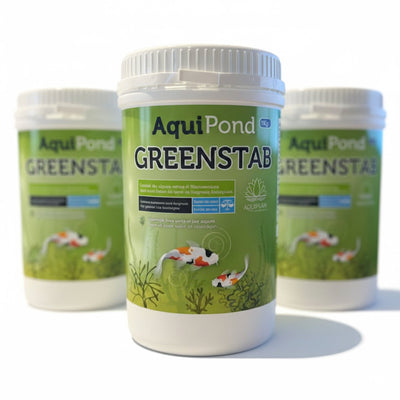 Aquipond Greenstab - Balanced pond water, limits algae
À partir de €34,95
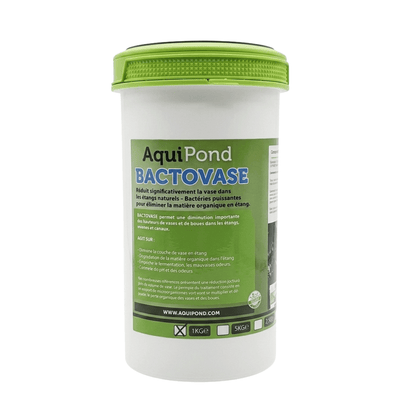 Aquipond Bactovase 1 kg – Bacteria for pond sludge reduction (5 to 10 m²)
€39,95
View product
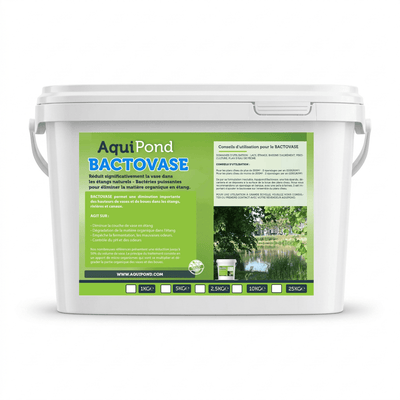 Aquipond Bactovase 2.5 kg – Bacteria to reduce pond sludge (12.5 to 25 m²)
€89,95
View product
 Aquipond Bactovase 5 kg – Bacteria to reduce pond sludge (25 to 50 m²)
€151,00
View product


Leave a comment