


The Foudebassin.com team
Published
8 min read
Dytiscus: the beetle that hunts fish in your pond (and why you can't stop it from coming)
It is about three centimetres long, dark green almost black, edged in yellow, swims like a torpedo and also attacks small fish (Wildlife Trusts). The great diving beetle (Dytiscus marginalis) is one of the most impressive insects you can find in a garden pond. And its larva is even more formidable.
The essentials
- The great diving beetle is a large aquatic beetle measuring about 3 cm; its larva, armed with hook-like mandibles, is a formidable hunter.
- Adults and larvae eat insects, tadpoles and small fish: fry are the most exposed.
- It arrives by flying, often at night: you cannot stop it from coming into an open pond.
- Fry are protected by hiding places, a covered tank and, if necessary, removal with a net and gloves.
≈ 3 cmadult size
At nightit flies and colonises ponds
Out of the waterthe larva pupates in the bank
22 to 39 mmadults of the genus Dytiscus
Recognising the diving beetle and its larva
- The adult: a large, smooth, shiny oval beetle, dark green almost black with a yellow border. Its flattened hind legs, fringed with hairs, serve as oars. It regularly comes to the surface, rear first, to fill the air under its elytra: it replenishes this reserve by taking the tip of its abdomen out of the water (Wildlife Trusts).
- The larva: elongated, with a flat head armed with two large hook-like mandibles. English speakers call diving beetle larvae "water tigers" (University of Wisconsin-Milwaukee).
The genus Dytiscus includes closely related species that measure 22 to 39 mm as adults (DELTA key to British aquatic beetles). The table below summarises what distinguishes the adult from its larva.
| Criterion | Adult | Larva |
|---|---|---|
| Shape | Oval, smooth, shiny | Elongated, flat head |
| Weapon | Jaws that chew the prey | Hollow hook-like mandibles |
| Out of the water | Returns to the water after pupation | Leaves the water to pupate |
| Movement | Swims and flies | Swims, does not fly |
Do not confuse it with a dragonfly larva, which is stockier and has a fold-out lip: our article on the wildlife that settles in the pond features these other hunters.
Two rare diving beetles are protected
The great diving beetle is not a protected species, but two rare aquatic beetles from the same family are: the great diving beetle (Dytiscus latissimus) and the two-lined diving beetle (Graphoderus bilineatus). In France, the decree of 23 April 2007 on protected insects prohibits, among other things, capturing, destroying or transporting them (text of the decree, DREAL Bourgogne-Franche-Comté). In Wallonia, they are listed in Annex IIa of the Nature Conservation Act, which lists strictly protected species (Wallex). If you see an unusually large diving beetle or larva, do not capture it: photograph it and ask for advice.
From egg to adult
The female lays eggs underwater, often in slits she makes in plant stems, and the eggs hatch in a few weeks (Animal Diversity Web, University of Michigan). The larva grows by hunting, then leaves the water to pupate in the damp soil of the bank (DELTA key). The adult that emerges returns to the water and can then fly to other ponds.
In practical terms, a natural bank with damp soil and plants allows the diving beetle to complete its life cycle on site. A smooth liner right up to the edge makes this much less likely.
What the diving beetle really eats
The adult hunts small invertebrates, tadpoles and even small fish (Wildlife Trusts), and also feeds on dead animals (UWM). The larva is a formidable hunter: it seizes its prey with its hollow mandibles, injects digestive juices into it, then sucks out the contents, which are digested outside its body (DELTA key). It attacks tadpoles, insect larvae, snails, leeches and small fish (UWM).
In our experience, in a pond with adult koi or goldfish, the diving beetle rarely causes problems. In a breeding pond, a medaka tank or a pond with many fry, however, it can take some of them.
Why you cannot stop it from coming
Adult diving beetles fly well, especially at night, and are attracted by lights (UWM). Like many aquatic insects, they spot water by the polarised light reflected from its surface, and aquatic beetles thus land by mistake on red or black cars, whose bodywork reflects similar light (Kriska et al., 2006). An open pond can therefore receive diving beetles from elsewhere at any time, and removing one does not prevent others from arriving.
Protecting your fry
- Dense plants: bulrush, native watermilfoil and bank plant roots offer hiding places where young fish can escape hunters.
- A breeding tank covered with a mosquito net if you are raising medakas or goldfish.
- Adult fish in the main pond: they are larger than the small fish it hunts; only fry grow up separately.
- Removal with a net of large larvae from a fry tank, with gloves: they bite.
No insecticide should be used in a pond: it would kill all useful insects and be toxic to fish.
What to do if a diving beetle attacks your fry?
You see fry disappearing and you spot a diving beetle or a large larva? Here is the procedure, in order:
- Identify the animal: an oval adult edged in yellow, or an elongated larva with hook-like mandibles (see the table above). If it is mainly tadpoles you want to protect, also see how to isolate tadpoles.
- Look where your fry are: in a large planted pond, they have hiding places; in a small bare tank, they are exposed.
- Capture the large larvae from the fry tank by passing the net through the plants, with protected hands.
- Release them into your main pond, the one with the adult fish, rather than killing them: do not move them to another body of water.
- Isolate the smallest fry while they grow up, as for spring medaka breeding.
In a pond with adult fish, there is no need to hunt down every diving beetle: focus your efforts on the tank or corner where the fry are growing. For their food during this period, see how to feed baby koi.
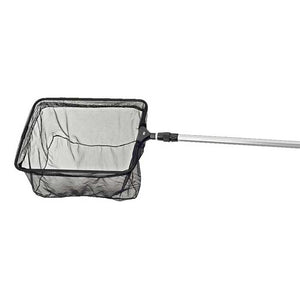
 Fine Fish net M 180 cm – SuperfishFine mesh and long handle to remove larvae from plants without dipping your hand in.View product
 Submerged bulrush (Ceratophyllum demersum)Submerged plant with dense foliage, which forms hiding places for young fish.View product
The diving beetle in the pond food chain
Impressive as it may be, the diving beetle is a sign of a living pond. As a predator of insects, larvae and tadpoles, it is part of the food chain of a natural pond.
An unknown insect in your pond?
Send us a photo: we will help you identify it and decide whether to take action.
Frequently asked questions
Does the diving beetle bite humans?
The larva, armed with large jaws, can bite if you grab it, and the adult can pinch. It is painful; in case of a significant reaction or allergy, consult a doctor.
Can it kill a koi?
Its prey are invertebrates, tadpoles and small fish: a healthy adult koi far exceeds this size. Very young koi, however, are possible prey, like all small fish.
How does it spend the winter?
Some adults and larvae remain active under the ice; other adults spend the winter sheltered, for example under stones.
How to distinguish a diving beetle larva from a dragonfly larva?
The diving beetle larva is elongated, with a flat head and two clearly visible hook-like mandibles. The dragonfly larva is stockier and hides under its head a lip that it unfolds to catch its prey.
What to do if a diving beetle attacks my fry?
Identify the animal, then, in a fry tank, remove the large larvae with a net and gloves and release them into your main pond, the one with the adult fish. Isolate the smallest fry while they grow up.
And you?
Have you ever seen a diving beetle attack a fish in your pond? Share your photo or story in the comments.
Also read: Baby koi in the pond: will they survive?, The wildlife that settles in the pond and Raising fish in a garden pond.
Produits et rayons conseillés

Products recommended by our experts
See the full selection Aquipond ImmunoFish – 1 Liter – Koï Mucus for 20 m³
€39,95
View product
 Aquipond ImmunoFish – 2.5 Liters – Koï Mucus for 50 m³
€59,95
View product
 Aquipond ImmunoFish – 5 Liters – Koï Mucus for 100 m³
€89,95
View product
 Malamix 17 – organic supplement for koi and pond fish – 1 L
€28,71


Leave a comment