


The Foudebassin.com team
Published
9 min read
Notonecta: the insect that swims on its back in your pond… and which English speakers nickname the “water bee”
Lean over your pond one summer day: you may see a small insect about 1.5 cm long suspended just below the surface, belly up, paddling with two long legs like oars. It's a backswimmer. It looks harmless. Those who have ever caught one by hand know that this is not entirely the case.
The essentials
- The backswimmer is a 1.4 to 1.6 cm aquatic bug that swims on its back, just below the surface.
- Its bite is painful but rare, almost always occurring when it is handled. In case of a severe reaction or allergy, consult a doctor.
- It hunts insects, mosquito larvae, tadpoles, fry, and small fish.
- In a fry tank, a medaka pond, or a mini-pond without fish, remove backswimmers with a net. In an adult goldfish or koi pond, our experience shows that they can be left alone.
1.4 to 1.6 cm adult size
On its back with its silver belly facing the sky
1 generation per year
5 larval stages
What is a backswimmer?
The backswimmer (Notonecta glauca) is an aquatic bug, a relative of the bugs in our gardens. It lives in the calm waters of Europe: ponds, lakes, ponds, and even rainwater collection tanks. Three details give it away:
- it swims on its back, hence its English name "backswimmer" (University of Florida);
- it carries a silver air bubble under its belly, which shines underwater;
- it often stays still, the tip of its abdomen stuck to the surface to renew its air.
Recognizing it without confusing it with others
In the pond, the backswimmer is mainly confused with the water boatman, another aquatic bug of similar shape. The Wildlife Trusts give the simplest criterion: the water boatman swims upright and spends less time near the surface. The adult backswimmer is light brown, with large reddish eyes; it measures about 1.4 cm according to the Wildlife Trusts, and up to 16 mm according to the University of Florida. Its belly appears silver because a thin layer of air remains trapped in the hairs covering it. Another important difference: the water boatman is not predatory and does not bite (Missouri Department of Conservation). For the other inhabitants of the pond, see our guide to the wildlife that settles in the pond.
| Criterion | Backswimmer | Water boatman |
|---|---|---|
| Swimming direction | On its back, belly facing the sky | Upright |
| Position | Often suspended below the surface | Less often on the surface |
| Diet | Predatory: insects, tadpoles, fry | Non-predatory |
| Bite | Painful if handled | Does not bite |
Yes, it bites (and it hurts)
The backswimmer has a rostrum, a kind of pointed beak with which it injects digestive saliva into its prey. If caught, it can use it to defend itself. The bite is sharp and painful. These bites remain rare and almost always occur when handling the insect (University of Florida). In case of a severe reaction or allergy, consult a doctor: see below what to do in case of a bite. In English, it is also nicknamed "water bee" or "water wasp" (Missouri Department of Conservation).
The right reflex: never pick it up with your bare hands. If you need to empty a tank or clean the pond in summer, wear gloves.
What to do in case of a bite?
A backswimmer bite is treated like an ordinary insect bite. The official advice from Santé.fr and the NHS is as follows:
- clean the area with soap and water;
- apply cold wrapped in a cloth, for fifteen to twenty minutes at most;
- do not scratch, to avoid infection.
When to consult?
Call your doctor or go to the emergency room in case of generalized itching, red patches on the skin, swelling of the face or tongue, malaise, or breathing difficulties (Santé.fr). For a child under one year old, always ask for a doctor's advice (NHS).
It flies from one pond to another
This explains why it appears in a new pond: adults fly, including at night (Missouri Department of Conservation), and are attracted by the polarized light reflected by a water surface (Mathejczyk et al., 2023).
Its year in the pond
The backswimmer only has one generation per year. The eggs are attached to aquatic plants; the larvae that hatch from them look like small wingless adults and go through five stages throughout the summer (University of Florida). Adults can then fly away. They can be seen all year round (Wildlife Trusts). In winter, when the water drops to around 5 °C, adults remain completely submerged instead of coming up to breathe at the surface. The larvae grow in summer (University of Florida), while your fish fry are still small.
Should it be removed?
In the vast majority of ponds, no. The backswimmer is part of the balance: it eats mosquito larvae and serves itself as prey for many animals, including fish and amphibians (Missouri Department of Conservation). In our experience, adult goldfish and koi readily swallow them. The problem only arises:
- in a breeding tank or a fry pond;
- in a mini-pond without fish, where it has no predator;
- in a medaka pond, small fish that remain prey.
In these cases, remove the backswimmers with a net and cover the tank with a fine mosquito net during the breeding period (method detailed below). No product is necessary: an insecticide would also affect a large part of the pond's wildlife.
A formidable hunter: protecting fry and tadpoles
The backswimmer detects vibrations at the surface, then pounces on its prey and bites it with its rostrum (Wildlife Trusts). It mainly attacks other insects, but also mosquito larvae, fish eggs, fry, and tadpoles (University of Florida), and even small fish (Missouri Department of Conservation). In a pond where your goldfish or medaka breed, it can cause damage among the very young, and adult small fish like the medaka remain possible prey. If your goldfish breed, then watch the fry and, if necessary, raise them in a protected tank.
In a tank or mini-pond where you are raising medaka fry or other pond fry, the method consists of three steps, in the order of the diagram:
- put on waterproof gloves, then remove the backswimmers with a fine-mesh net passed just below the surface, where they often stay still;
- release them in a pond where fish live, rather than killing them;
- cover the tank with a fine mosquito net as long as the fry are small, to prevent new arrivals by air.
There is no need to try to empty a goldfish or koi pond of all its backswimmers: reserve your efforts for fry tanks without adult fish and medaka ponds, small fish that remain prey.
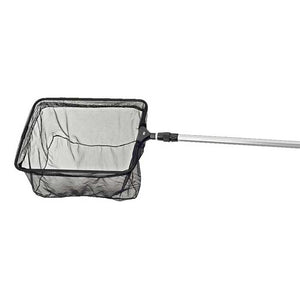
 Fine Fish net M 180 cm – SuperfishFine mesh and long handle to pick up insects on the surface without approaching with your hand.See the product
 Long waterproof pond gloves S/MProtect hands and forearms when you empty the net or clean a tank in summer.See the product
Any doubt about an insect in your pond?
Send us a photo: we will help you identify it and decide whether to act.
Frequently asked questions
Is the backswimmer dangerous to children?
Its bite is painful but rare, and almost always occurs when catching the insect. Teach them to observe without touching. In case of a severe reaction or allergy, consult a doctor.
Do my fish eat backswimmers?
Fish are among their predators. In our experience, adult goldfish, koi, and roach readily swallow them, and a pond populated with them has significantly fewer than a tank without fish.
Why are there so many in my rainwater barrel?
Adult backswimmers get there by flying, attracted by the reflections of the water (Mathejczyk et al., 2023). They then find mosquito larvae there and no fish to eat them.
What to do if bitten by a backswimmer?
Clean the area with soap and water, apply cold wrapped in a cloth, and do not scratch. Consult a doctor or go to the emergency room in case of swelling of the face or tongue, widespread red patches, malaise, or breathing difficulties.
How to distinguish a backswimmer from a water boatman?
Look at the swimming direction: the backswimmer swims on its back, silver belly facing the sky, while the water boatman swims upright and spends less time on the surface. The water boatman is not predatory and does not bite.
Do backswimmers spend the winter in the pond?
Yes. They can be seen all year round. When the water is cold, adults remain submerged instead of coming up to breathe at the surface.
And you?
Have you ever been bitten by a backswimmer? Tell us in the comments.
Also read: The wildlife that settles in the pond, Eliminating mosquitoes from the pond, and How to isolate tadpoles in my pond.
Produits et rayons conseillés

Products recommended by our experts
See the full selection Aquipond BactoClay - Montmorillonite clay 2 kg for koi ponds
€39,95
View product
 Minerall in One Aquipond - Increases GH & KH simultaneously - 2.5KG to treat 30M³
€49,00
View product
 Sera Aqua-Test Set - The essential analysis kit for ponds and aquariums
€34,61
 Aquipond KH+ 1kg - Increases Carbonate Hardness (KH)
€19,95
Read also
All our tips Wasps and bees drinking from the pond: should we worry or rejoice?
Updated November 24, 20266 min read
 No more slugs in the garden? How a pond attracts toads and frogs, their natural predators
Updated November 24, 20267 min read
 Does a pond attract rats? The real causes and how to prevent them
Updated November 24, 20267 min read
Leave a comment