


The Foudebassin.com team
Published
6 min read
The freshwater hydra: the tiny “nearly immortal” animal that may live in your pond
Contracted, it measures only a few millimeters, and about one to five centimeters when stretched (Missouri Department of Conservation), resembling a small thread topped with tentacles, and living attached to plants or stones in many ponds without anyone noticing. Yet, the freshwater hydra (Hydra) is one of the creatures that intrigues biologists the most.
The essentials
- The hydra is a tiny cnidarian, a relative of jellyfish, attached to submerged plants.
- In the laboratory, its risk of dying does not increase with age: about 0.6% per year.
- It captures small prey with its stinging tentacles, including very young fry.
- In a pond with adult fish, it remains discreet; it is in the fry tanks that it must be monitored.
- A magnifying glass and a jar are enough to observe it.
1 to 5 cm stretched, depending on the species
~1,800 hydras monitored in the laboratory
~10 years of monitoring
0.6% annual risk of dying, constant
A relative of jellyfish
The hydra belongs to the same group as jellyfish, anemones, and corals: cnidarians. It consists of a tubular body attached by a foot, and a crown of several long tentacles armed with stinging cells. Depending on the species, it is gray, brown, green, orange, or almost transparent (Missouri Department of Conservation). Green hydras owe their color to microscopic algae that live in their cells and provide them with part of their food.
"Almost immortal"
The hydra fascinates for two reasons:
- Regeneration: cut, it regenerates the removed parts (Missouri Department of Conservation). It actually takes its name from the Lernaean Hydra, the mythological monster whose heads grew back.
- The absence of apparent aging: its stem cells continuously replace damaged or lost tissues. The Max Planck Institute for Demographic Research monitored about 1,800 hydras for nearly ten years, each in its dish at 18°C, without predators: their risk of dying remained constant, around 0.6% per year, and they did not stop budding (MPIDR; Schaible et al., PNAS, 2015). In nature, they of course die from predation, disease, or poor conditions.
A little hunter
Still, tentacles deployed, it waits for a prey to touch them: daphnia, cyclops, small larvae. The stinging cells paralyze the prey, which the tentacles bring to the mouth. It reproduces mainly by budding: small hydras grow on its body and detach. Some species also reproduce sexually, especially when conditions deteriorate or before winter, by producing eggs with a resistant shell (Missouri Department of Conservation).
Danger for fry?
For adult fish, the sources consulted report no danger: the hydra only attacks very small prey (Missouri Department of Conservation). For fry only a few days old, such as those of medakas or goldfish in a breeding tank, a large population of hydras can capture them. It is mainly a problem for aquarists and breeders: in fish farming, large populations of hydras can seriously threaten newly hatched fry, according to the Missouri Department of Conservation. In a pond, many fish eat hydras when they see them, and aquatic insects also feed on them (same source).
| Situation | Pond with adult fish | Fry tank without adult fish |
|---|---|---|
| Predators of hydras | Fish, aquatic insects | Few or none |
| Easy prey | Small invertebrates | Fry only a few days old, daphnia |
| What we do | Nothing in particular | Monitor and limit |
What to do if hydras invade a fry tank?
Here is the gentle method we recommend, without products:
- transfer the fry to a clean container, with water from the same tank;
- remove the colonized plants and decorations, and rinse them with tap water, away from the pond;
- wipe the walls of the tank, where hydras readily attach themselves;
- reduce the food distributed and the daphnia inputs, so as not to restart their multiplication;
- monitor the tank for a few weeks before putting the fry back in.
In a pond, never use a treatment intended for aquariums. For the monitoring of young fish, see our guides on the first medaka spawns and the survival of baby koi in the pond.
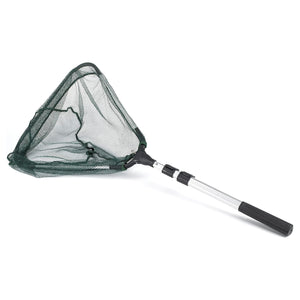
 Fine mesh net 140 cm – OaseTo remove a few strands of submerged plants to observe, or gently remove fry.See the product
 Submerged hornwort (Ceratophyllum demersum)Rootless submerged plant, refuge for small fauna and ideal support for observation in a jar.See the product
Observing them
Place a few submerged plants from your pond in a jar of pond water, in the light, and wait a few hours without moving the jar. The hydras then deploy their tentacles on the walls or leaves. With a magnifying glass, the spectacle is striking.
Do the observation in spring or summer, in a jar placed near a window but out of direct sunlight, and put the plants and water back in the pond the same evening. In our experience, this is the right compromise to see the hydras without heating the water in the jar.
A doubt about a small animal in your pond?
Send us a photo: we will help you identify it and decide if action is needed.
Frequently Asked Questions
Do hydras sting humans?
The sources consulted do not report a sting on humans: their stinging cells are used to capture small prey. Simply wash your hands after handling plants and pond water.
Why are there suddenly so many in my tank?
A large population of daphnia or an excess of food probably gives them enough to multiply: with abundant prey, hydras bud and form new individuals.
Is the hydra really immortal?
No. In the laboratory, sheltered from predators, its risk of dying does not increase with age. In nature, it dies from predation, disease, or poor conditions.
How does it reproduce?
Mainly by budding: a small hydra grows on its side then detaches. Some species also produce eggs, especially before winter.
Do hydras threaten fry in a pond?
Rarely in a pond with adult fish. The risk mainly concerns breeding tanks, where fry only a few days old are numerous and predators of hydras are absent.
And you?
Did you know that an "almost immortal" animal could live in your pond? Share this article, it always makes an impression.
Also read: The fauna that settles in the pond, Raising daphnia and Fish farming in a garden pond.
Produits et rayons conseillés

Products recommended by our experts
See the full selection Aquipond BactoClay - Montmorillonite clay 2 kg for koi ponds
€39,95
View product
 Minerall in One Aquipond - Increases GH & KH simultaneously - 2.5KG to treat 30M³
€49,00
View product
 Sera Aqua-Test Set - The essential analysis kit for ponds and aquariums
€34,61
 Aquipond KH+ 1kg - Increases Carbonate Hardness (KH)
€19,95


Leave a comment