


The Foudebassin.com team
Published
7 min read
Common wallcreeper larva: the architect insect that builds itself a house with grains of sand and twigs
Look closely at the bottom of your pond, near the plants: you may see small tubes a few centimetres long, made from bits of leaves, twigs or grains of sand, moving slowly along. These are not debris carried by the current. Hidden inside is a caddisfly larva, one of the most ingenious insects in our freshwater.
The essentials
- Caddisflies (Trichoptera) spend their larval lives underwater; many make themselves a case from silk and materials found on site.
- Each family has its own style: leaves, twigs, sand and even snail shells.
- The adult looks like a small moth with furry wings, active at dusk or at night.
- Caddisflies are expected in almost all good-quality ponds.
- In the pond, leave them in peace: keep some plants, a few leaves and an undisturbed area of the bottom.
~13,000 species worldwide
~200 species in Great Britain
Nearly half found in ponds
2 to 3 cm Duprat's golden caddis cases
A custom-made home
Caddisflies, or Trichoptera, spend their larval lives in water. Many species build themselves a case: they secrete sticky silk and gather materials they find around them in it. Predatory species, on the other hand, generally live without a case, free or sheltered in silk nets (North Carolina State University). Each family, and even each genus, has its own style:
- cases made of leaf pieces arranged in a spiral;
- tubes made of twigs laid end to end;
- cases made of grains of sand or fine gravel;
- and even cases made of small snail shells.
The larva lives in its case, with its head and legs sticking out, and drags it along as it moves. It protects it from predators and camouflages it. It enlarges it as it grows.
Gold and pearls
A French artist, Hubert Duprat, made these larvae famous by using only gold sequins and precious stones as materials: they built genuine jewellery, exhibited in museums. He started in 1979 with gold sequins, then added turquoise, opal, lapis lazuli, pearls and small 18-carat gold rods; his cases measure 2 to 3 cm and were notably exhibited at the Picasso Museum in Antibes in 1998, according to the article he co-authored with Christian Besson in the journal Leonardo. Proof that they really do use everything they find.
What it eats
Depending on the species, the larva feeds on dead leaves, algae, plant debris or small animals. Most help break down organic matter at the bottom of the pond. They also serve as food for fish and other aquatic animals (North Carolina State University).
Which caddisflies in a pond?
There are around 13,000 species of caddisflies worldwide and 200 in Great Britain (Royal Entomological Society). Nearly half of British species have already been found in ponds, and the Freshwater Habitats Trust considers them one of the groups expected to be seen in almost all good-quality ponds. In still waters, it notably mentions limnophilous species (genus Limnephilus), a species whose case is made of flat leaves (Glyphotaelius pellucidus) and the large caddisfly Phryganea bipunctata, whose larvae are predatory while still keeping a case made of plant material in Phryganeidae, according to Duprat and Besson.
| Criterion | Case-bearing larva | Non-case-bearing larva |
|---|---|---|
| Shelter | Silk and material tube, carried | Free, or fixed silk net |
| Diet | Mostly debris, leaves, algae | Mostly predatory |
| Where to see it | On the bottom, among the plants | Often in flowing water, where the nets catch food |
According to North Carolina State University and the Royal Entomological Society.
The adult, a furry moth
After pupating in its closed case, the insect rises to the surface and takes flight. The adult looks like a small brown moth with wings covered in hair (hence the name Trichoptera, "furry wings"), folded in a roof shape. It flies mainly at dusk or at night, often attracted by lights, and feeds little or not at all (North Carolina State University).
An indicator of good health
Like mayflies, many caddisflies are sensitive to pollution and serve as indicators of water quality (Missouri Department of Conservation). Their presence in your pond is a compliment.
To learn more about life at the bottom, read what happens at the bottom of a pond and our guide to the self-sustaining natural pond.
Observing them with your children
- Fill a clear container or white basin with water from the pond.
- Pass a fine-mesh net over the bottom, near the plants, without scraping the liner.
- Carefully empty the net into the container and wait a few minutes: the "twigs" will eventually stick their heads out.
- Observe them with a magnifying glass, without removing the larvae from their cases.
- Put everything back in the pond, in the same place, within the hour.
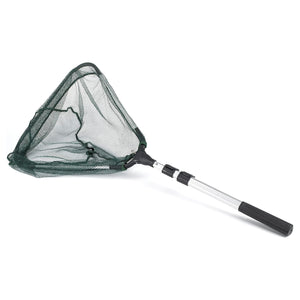
 Fine-mesh net 140 cm – OaseFine mesh for picking up the small bottom dwellers without damaging them, for the time of an observation.View the product
 Hornwort (Ceratophyllum demersum)Rootless submerged plant, which offers shelter and plant debris to the small bottom larvae.View the product
During autumn cleaning, leave a corner of the bottom undisturbed, with a few leaves. In our experience, this is where the case-bearing larvae take refuge when the sludge is removed from the rest of the pond.
Common mistakes
- Removing the "moving twigs" thinking you are cleaning. Before throwing away a piece of debris, look to see if it doesn't have a head and legs.
- Dredging the entire bottom at once. For the gentle method, follow our article on removing sludge without harming wildlife.
- Treating the water for insects. An insecticide would also affect these larvae, which are sensitive to pollution.
Want a more lively pond?
We help you choose submerged plants that offer shelter and food to the small wildlife.
Frequently asked questions
Do caddisfly larvae damage the plants?
Some herbivorous species nibble on plants, according to North Carolina State University. The sources consulted do not report them as harmful to pond plants.
Do they bite?
No. Caddisflies do not have stingers, and the sources consulted report no danger to humans.
Do fish eat caddisfly larvae?
Yes. They are part of the food for fish and other aquatic animals, according to North Carolina State University.
How long does the adult live?
Generally a few weeks, according to the Missouri Department of Conservation. It does not feed, or only on liquids, and devotes itself to reproduction.
Why do I never see any in my pond?
The larvae are well camouflaged and the adults fly mainly at dusk or at night. A pond without submerged plants or natural debris at the bottom also offers them little material and food.
And you?
Have you ever seen a "walking twig" at the bottom of your pond? Try it with your children and tell us.
Also read: The wildlife that settles in the pond, What happens at the bottom of a pond? and Attracting biodiversity with a natural pond.
Produits et rayons conseillés

Products recommended by our experts
See the full selection Best price
Colombo Test Lab Professional - Complete Test & Analysis Case (Best Seller!)
€44,94
 Sera Aqua-Test Set - The essential analysis kit for ponds and aquariums
€34,61
 Sera Koi Aqua-Test Box - Complete analysis case with many tests
€79,11
 AquaActiv Quicksticks 6 in 1 - Water analysis by strips (50pcs) - Oase
€19,95
View product
Read also
All our tips Wasps and bees drinking from the pond: should we worry or rejoice?
Updated November 24, 20266 min read
 No more slugs in the garden? How a pond attracts toads and frogs, their natural predators
Updated November 24, 20267 min read
 Does a pond attract rats? The real causes and how to prevent them
Updated November 24, 20267 min read
Leave a comment