


Corentin Lits
Published Updated
7 min read
What water should be used to fill a garden pond?
Good water quality is the foundation of a healthy pond. Water plays a very important role in the pond. Its quality must be checked several times a year to enjoy a clear pond with healthy fish and plants.
Tap waterthe simplest solution, taken before the water softener
Water conditionerto neutralize chlorine in tap water
KHthe value to monitor with fresh or rainwater
Patiencelet the filtration start before adding fish
What water for the first filling?
What water should you use when filling your pond for the first time? We recommend using water from a spring or tap water. In nature, a pond is often fed by spring water.
Fish and plants need hard water rich in minerals. We strongly advise against filling your pond with rainwater that is too low in minerals and often acidic.
If you fill your pond with tap water, you should take the water before your water softener.
Why avoid softened water? A water softener removes calcium and magnesium from the water, generally by exchanging them for sodium. The resulting water has very low hardness and reduced buffering capacity: the pH then becomes more unstable, which stresses the fish and plants. Take the water from an outdoor tap located before the device.
You have no choice and you filled your pond with rainwater? It is important to check the GH and KH of your pond. We recommend performing a water analysis and asking the advice of our specialists via info@foudebassin.com
With rainwater, the first reflex is to measure the KH, which indicates the water's ability to stabilize its pH. The data sheet for our Aquipond KH+ indicates that KH should ideally be between 6 and 12° and that a small measure per m³ increases it by 1 to 2 units: correct in small steps and check between additions. For the analysis, our guide how to perform a water analysis of my pond details the method.
JBL Pro Aquatest KHCarbonate hardness drop test, for ponds and aquariums.View productAquipond KH+ 1 kgIncreases carbonate hardness and stabilizes the pH of water that is too soft.View product
Tap water, well water, or rainwater: comparison
Each water source has its advantages and pitfalls. The goal is not to obtain "perfect" water from day one, but water that is sufficiently mineralized, free of toxic products, which the filtration can then stabilize.
- Tap water: it generally contains chlorine or chloramines, added to make it drinkable. These disinfectants irritate the gills and slow down the establishment of beneficial bacteria. A water conditioner neutralizes them.
- Spring or well water: its composition depends on the ground. It may contain nitrates, iron, or be low in oxygen at the outlet. An analysis before filling avoids unpleasant surprises.
- Rainwater: useful for moderate top-ups, it is too soft for a full filling. It can also carry metals from gutters.
- Softened water: to be avoided for a pond, as explained above.
Prepare the water before introducing the fish
Freshly poured water is "empty" biologically: the bacteria that break down fish waste are not yet established in the filter. Here is the order we recommend for a new pond.
- Fill the pond, preferably with tap water taken before the softener.
- Condition the water to neutralize chlorine, chloramines, and heavy metals, following the dosage indicated on the bottle.
- Turn on the pump and filter continuously: it is in the filter that the bacteria will establish themselves.
- Inoculate the filter with pond bacteria to speed up the start-up.
- Test the water (pH, KH, nitrites) before introducing the first fish, then add them gradually.
How long exactly to wait? We answer this in our article how long before putting fish in a new pond. For a masonry pond, a concrete rinsing step is also necessary: see making a concrete pond.
The JBL BiotoPond, for example, neutralizes chlorine, chloramines, and heavy metals in tap water. Its data sheet indicates a dosage of 30 to 50 g per 1,000 liters of pond water, to be diluted in a watering can with pond water and then spread over the entire surface.
JBL BiotoPond 500 mlWater conditioner: neutralizes chlorine, chloramines, and heavy metals.View productAquipond NitriBoost 1 LLiquid nitrifying bacteria to inoculate the filter at start-up.View product
The values to monitor in the pond water
A few simple measurements are enough to know if the water is suitable. Do them after filling, then several times a season, and always after a large addition of water.
| Measurement | Why monitor it |
|---|---|
| KH (carbonate hardness) | It stabilizes the pH. Rainwater or softened water has a very low KH, hence sudden pH variations. |
| GH (total hardness) | It reflects the minerals available (calcium, magnesium) for fish and plants. |
| pH | Generally, a slightly alkaline and stable pH is suitable for pond fish. Stability matters more than a precise value. |
| Nitrites (NO2) | Toxic to fish, they must remain as close to zero as possible. A spike indicates that the filter has not yet started. |
To adjust the hardness, find our products for water hardness. Well-mixed and oxygenated water also helps biological filtration: see how to oxygenate pond water.
Top up the level during the season
In summer, evaporation lowers the level. Minerals, however, do not evaporate: they concentrate slightly in the remaining water. Regular top-ups in small quantities are therefore preferable to a large filling all at once.
- For a moderate top-up, collected rainwater can be suitable and compensates for the concentration of minerals.
- After heavy rains or repeated top-ups with rainwater, check the KH: the Aquipond KH+ data sheet reminds us that rainwater lowers it.
- For a large top-up with tap water, add a water conditioner as during the first filling.
- Pour the water gently, without putting the bottom sludge back into suspension.
Frequently asked questions about pond water
Can you fill a pond with tap water?
Yes, it is generally the simplest solution. Take the water before the softener and use a water conditioner to neutralize chlorine and chloramines before introducing the fish.
Can you fill a pond only with rainwater?
We advise against it: rainwater is very low in minerals and often acidic. If it is already done, measure the KH and GH and correct them gradually with suitable products.
How long to wait before adding fish?
The time it takes for the filtration to start and for nitrites to remain close to zero. Inoculating the filter with bacteria helps shorten this phase; test the water before each introduction.
Should you change the water of a garden pond?
A well-filtered pond does not need to be emptied. Regular top-ups and, if necessary, a partial renewal are sufficient in most cases.
Products recommended by our experts
See the full selection JBL BiotoPond 500ml - Water conditioner for adapting pond water
€21,84
View product
 Aquipond KH+ 1kg - Increases Carbonate Hardness (KH)
€19,95
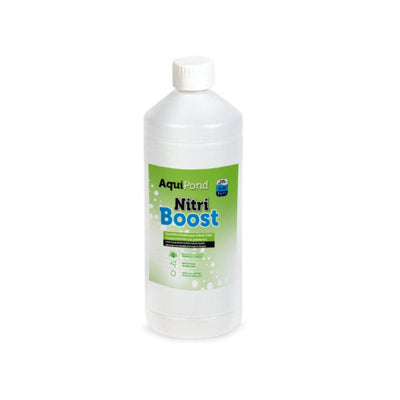 Aquipond NitriBoost - Liquid Nitrifying Bacteria for 10M³ - 1L
€39,95
View product
 JBL Pro Aquatest Combiset Pond - Complete analysis case for pond
€59,95
View product
Read also
All our tips Pond bulrushes: soft rush, striped bulrush and drooping bulrush, the guide
Updated November 26, 20263 min read
 Utricularia: the carnivorous aquatic plant that hunts mosquito larvae
Updated November 26, 20263 min read
 Thalia dealbata: the large exotic bank plant that survives the winter outdoors
Updated November 26, 20263 min read
Comments
Leave a comment