


How to limit algae in a pond: natural and effective methods
A pond overrun by algae can quickly become a problem for its balance and appearance. Green water, bad smells, falling oxygen levels… these nuisances are often caused by an excessive growth of floating or filamentous algae. If left uncontrolled, they can disturb the ecosystem, harm the fish and limit the development of aquatic plants.
Keeping a pond clean and healthy depends on rigorous algae management. A good balance rests on several levers: nutrient control, oxygenation, competing plants and, where necessary, the use of suitable solutions. Among the options available, natural treatments are preferable for a lasting effect that respects biodiversity.
In this article, we look at the causes of algae growth, the best natural solutions to limit it, and the effective products available in our collection of anti-algae solutions to bring back clear, balanced water.

In brief: Algae thrive in a pond when the water receives too many nutrients (phosphates, nitrates), too much light and heat. They recede when the environment is rebalanced: beneficial bacteria, competing aquatic plants, barley straw, better aeration, a UV-C lamp and manual removal with a net. Start by tackling the cause.
2 typesof algae: floating and filamentous
3 factorsnutrients, light and heat
6.5 to 8.5pH range recommended in this guide
1 prioritytackle the cause, not just the algae
Updated on 1 November 2026 — The Foudebassin experts
Why do algae take over ponds?
Algae are a natural part of a pond's ecosystem, but when they grow in excess, they become invasive and upset the balance of the aquatic environment. To keep their growth under better control, it is essential to understand the factors that encourage them to appear.
The causes of algae growth
Algae develop mainly under the influence of three factors:
- An excess of nutrients: too many phosphates and nitrates in the water encourage rapid algae growth. These nutrients often come from decomposing leaves, fish waste, fertilizer washed in by rain or insufficient filtration.
- Strong exposure to light: the more sun a pond gets, the faster algae multiply. Light stimulates photosynthesis and speeds up their growth, especially in summer.
- High temperatures: heat boosts algae growth, particularly in shallow or poorly oxygenated water.
Managing these factors effectively is therefore essential to limit an algae invasion.
The types of algae you may find in the pond
There are mainly two types of invasive algae in a pond:
- Floating algae: they give the water a green tint, making the pond cloudy and preventing light from penetrating properly. They are often a sign of excess nutrients and can be tackled with a UV clarifier.
- Filamentous algae: they form long fibres attached to walls, rocks or plants. They are harder to remove and call for mechanical action combined with specific bacteria to limit their growth.
Each type of algae requires a suitable approach to be controlled effectively.
Still unsure about the diagnosis? Our guide algae in a pond: identifying the problem covers the most common cases, and our article on filamentous algae goes further on this particular type.
How to assess the water quality of your pond
Before acting against algae, it is essential to analyze the water quality in order to identify the imbalances behind their growth. To do so, it is advisable to test several parameters:
- Water hardness (KH and GH): water that is too soft encourages pH instability and algae growth.
- Nitrate and phosphate levels: a level that is too high indicates a nutrient overload.
- Water pH: a pH that is too high can boost algae growth.
For an accurate diagnosis, water test kits let you measure these parameters and adapt the solutions accordingly.
Green or invasive algae: how to tell them apart?
Four situations look alike from a distance and are handled differently: green water, filamentous algae, cyanobacteria and duckweed, which is a plant. Identify what you are seeing before you act.
| What you see | What is it? | First step |
|---|---|---|
| Green, opaque water, no visible strands | Microscopic algae in suspension | Rebalance the water (nutrients, shade, bacteria); a UV-C lamp works on the water that passes through the unit. Green water guide |
| Strands or mats clinging to walls and plants | Filamentous algae | Manual removal with a net, then reduce nutrients. Filamentous algae guide |
| Blue-green film or scum, strong smell | Possible cyanobacteria | Keep swimmers and animals away, do not treat on your own. Cyanobacteria guide |
| Carpet of small round leaves across the whole surface | Duckweed, which is a plant | Remove with a landing net, then cut nutrients. Duckweed plan |
Not sure what you are looking at? Do not treat at random. Take a photo of the pond and the water, then use our free water analysis: we will help you identify the problem.
Natural solutions to limit algae
Reducing algae in a pond starts above all with natural, lasting solutions that respect the pond's biological balance. Rather than resorting to chemical treatments that can disturb the aquatic ecosystem, several natural methods can effectively reduce and prevent algae growth.
Using beneficial bacteria
Beneficial bacteria play an essential role in reducing algae by promoting the breakdown of organic matter and by limiting excess nutrients in the water. They turn waste into elements that aquatic plants can absorb, thereby reducing the phosphates and nitrates responsible for algae growth.
Recommended products:
- Aquipond Greenstab : a solution based on natural bacteria that helps balance the water and limits the appearance of algae.
- Pond bacteria from our collection : ideal for boosting biological filtration and improving water quality over the long term.
Aquipond GreenstabLimits algae growth by depriving them of the nutrients they need, all year round.See Greenstab →Aquipond Bacto Maintenance 500 gMaintenance bacteria to support biological filtration during the season.See the bacteria →
Competing aquatic plants
Algae thrive on the nutrients in the water. To limit their growth, it is effective to introduce aquatic plants that compete with them and absorb these nutrients before the algae can benefit from them.
Recommended floating and oxygenating plants:
- Marsh pennywort (Hydrocotyle vulgaris) : quickly consumes nitrates and helps stabilize the ecosystem.
- Water lilies: besides their decorative effect, the broad leaves of water lilies provide shade and limit the penetration of UV rays.
- Ceratophyllum (Hornwort) : an oxygenating plant that is effective against green water.
Adding these plants improves the pond's biological balance while slowing algae growth.
For more help choosing plants, see our list of filtering aquatic plants.
Barley straw mulch
Barley straw mulch is a natural solution that is often overlooked, yet particularly effective at reducing algae growth. As it slowly breaks down in the water, barley straw releases substances that slow the development of algae without affecting fish or other aquatic organisms.
Recommended product:
- Aquipond Eco AlgControl : a natural barley straw treatment that limits algae growth and promotes clear water.
By combining beneficial bacteria, aquatic plants and barley straw, it is possible to keep algae in check over the long term while respecting the pond's environment. These natural methods give you healthier water without resorting to harsh solutions.
Long-term treatments against algae
Keeping algae in check over the long term calls for effective solutions that prevent their growth while maintaining the pond's ecological balance. Three main approaches work in the long run: UV treatment, specific solutions against filamentous algae and improved oxygenation of the pond.
Using the UV lamp
UV-C lamps are an effective way to deal with the floating algae responsible for green water. They work by emitting ultraviolet rays that damage the cells of suspended algae, limiting their multiplication.
Advantages of UV-C lamps:
- Fast, effective reduction of suspended algae
- Improved water clarity
- Continuous prevention of algal blooms
For optimal treatment, it is essential to match the power of the UV lamp to the volume of the pond. Regular maintenance of the system ensures its effectiveness over the long term.
Recommended products:
- UV-C lamps available in the collection of anti-algae solutions, suited to different pond sizes.
A UV-C lamp loses effectiveness over time even if it still lights up: replace the bulb as recommended by the manufacturer, usually before the season. See how to choose the right UV for your pond and how to tell whether your UV still works.
Treatments for filamentous algae
Unlike floating algae, filamentous algae cling to surfaces and form dense masses that can quickly overrun a pond. Specific treatments exist to reduce them effectively.
Suitable solutions:
- Algisin by Colombo : acts quickly on filamentous algae; follow the instructions for use (dosage, checking water hardness beforehand) to protect aquatic fauna and flora.
- Aquipond Eco AlgControl : natural solution that slows the development of filamentous algae by limiting their access to essential nutrients.
Algisin 1000 ml – ColomboTargeted treatment of filamentous algae, water tester included. Follow the dosage on the leaflet.See Algisin →Algae Brush telescopic brushBrush from 51 to 151 cm to loosen filaments from walls and stones.See the brush →
These treatments should be used alongside a good ecological balance to prevent a new outbreak.
Aeration and oxygenation of the water
A good oxygen level in the water is essential to limit algae growth. A well-oxygenated pond encourages the development of beneficial bacteria that break down the organic matter behind algal growth.
Advantages of oxygenation:
- Reduction of the nutrients that encourage algae
- Improved water quality
- Better balance for fish and aquatic plants
Installing an aerator improves water circulation and prevents the stagnant areas where algae thrive.
Recommended products:
- Aerators and oxygenation systems available in our shop, suited to the needs of different types of ponds.
To size your installation, see our guide how to oxygenate pond water.
Manual techniques to reduce algae
Manual methods are an essential first step in controlling algae in a pond. They act immediately and can be combined with longer-term solutions for a healthy, balanced pond.
Removing algae by hand
Filamentous algae cling to rocks, aquatic plants and the walls of the pond. Their rapid growth can smother the aquatic environment and harm the oxygenation of the water. Manual removal is a simple, accessible method for reducing their presence.
Effective techniques:
- Using a rake or a stick: wind the algae around the rake and pull them out of the water. This method is particularly effective for long filaments that cling to surfaces.
- Using a coarse-mesh net: lets you catch floating masses without removing the small beneficial organisms in the water.
- Regular intervention: removing algae as soon as they appear limits their spread and reduces their impact on the pond's balance.
Fine-mesh nets to remove dead algae
Dead algae that are not removed quickly decompose and release nutrients into the water, encouraging new outbreaks. Using a fine-mesh net is a simple way to keep a pond clean.
Advantages of fine-mesh nets:
- Effective removal of decomposing algae
- Reduction of the organic matter that encourages algae growth
- Prevention of sediment build-up at the bottom of the pond
Regular maintenance, combined with other methods against algae, ensures clearer water and a more balanced ecosystem.

Which method for which result?
This table summarizes the levers described in this article. None of them solves everything on its own: combine them, starting with those that act on the cause.
| Method | What it does, and how quickly | Precautions |
|---|---|---|
| Beneficial bacteria and competing plants | Reduce the nutrients algae feed on. Gradual effect, from season to season | Follow the stated doses |
| Barley straw | Slows the development of new algae without removing those already there. 1 to 2 weeks above 20 °C, 6 to 8 weeks below 10 °C before it takes effect, then about 4 to 6 months of effect (Purdue) | Decomposition consumes oxygen: net and aerated water. Results vary depending on the algae |
| UV-C lamp | Limits the algae suspended in the water that passes through the unit. Visible over the days on green water | No effect on attached filaments; replace the bulb as per the instructions |
| Manual removal (net, rake) | Removes filaments and dead algae. Immediate | Remove the algae before they decompose |
| Aeration | Prevents the build-up of decomposing matter and supports the bacteria. Continuous | Size according to the volume of the pond |
| Pond dye (Aquipond Blue Lake) | Dye that filters light and limits the photosynthesis of algae, for ponds and large bodies of water. According to the product sheet: 1 sachet of 100 g per 1,000 m² against algae, expected effect over 4 to 6 weeks depending on sunshine and water renewal. Start in spring | A complement to an overall strategy (aeration, bacteria, reduced inputs), never a stand-alone solution. Compatibility with fish and swimming: according to the manufacturer, at the recommended doses. Body of water connected to a watercourse or subject to authorization: check local regulations before adding anything. 10,000 m² size: 10 sachets |
| Targeted commercial product | Deals with a given situation, as a last resort. Timing varies depending on the product | Read the leaflet, check that it is permitted in your country, watch the oxygen |
Barley straw laid in spring works before summer; laid in the middle of a bloom, it will arrive too late. For week-by-week tasks, follow the maintenance calendar above.
When and how to act?
Managing algae in a pond requires a thoughtful approach to avoid an ecological imbalance. Knowing when and how to act makes interventions more effective and limits the impact on aquatic fauna and flora.
Frequency and timing of interventions
Algae removal should be carried out at strategic moments to be as effective as possible and limit their growth.
Best times to act:
- Spring and early summer: algae generally grow as temperatures and sunshine increase. Acting early helps prevent an invasion.
- After heavy rain: the nutrients carried in by runoff can encourage algae growth. A water check and an adjustment of parameters may be necessary.
- When growth is visible: as soon as the water turns cloudy or filaments appear in large quantities, it is advisable to act quickly to avoid a decline in the pond.
Frequency of interventions:
- Regular monitoring: a weekly check of the water quality and the condition of the pond helps you anticipate problems.
- Monthly manual upkeep: removing algae and organic debris prevents nutrient-rich matter from building up.
- Moderate use of products: treatments, whether natural or chemical, should be spaced out to avoid disturbing the biological balance.
Precautions when using chemical treatments
Although some chemical solutions can give quick results, their use requires precautions to protect aquatic life and water quality.
Good practice:
- Read the instructions carefully: follow the recommended doses to avoid any risk of toxicity.
- Prefer applying in calm weather: avoid windy or rainy periods that could spread the product unevenly.
- Monitor the oxygenation of the water: some treatments can reduce the oxygen concentration, endangering fish and other aquatic organisms.
- Avoid treatments in the height of the heat: high temperatures increase stress on fish and can worsen the side effects of chemical products.
Where possible, it is advisable to opt for natural, preventive solutions before considering harsher treatments. Balanced, reasoned management ensures the long-term health of your pond's ecosystem.
After a treatment: decomposing algae consume oxygen. Remove them with a net as soon as possible, run an aerator or a waterfall, and watch the behavior of the fish. If they come to the surface to gasp for air, increase aeration without delay.
What to do if the algae persist?
Despite natural solutions and preventive treatments, algae sometimes keep growing. In that case, a thorough analysis of the water quality and, where appropriate, the use of more specific treatments become necessary.

Test the water
Before considering other solutions, it is essential to understand why the algae persist. A chemical imbalance may be behind the problem.
Parameters to check:
- Water pH: a pH that is too high encourages algae growth. The ideal lies between 6.5 and 8.5.
- Water hardness (KH and GH): water that is too soft or too hard can unbalance the ecosystem and influence algae growth.
- Nitrate and phosphate levels: these nutrients, which come from organic waste and external inputs (leaves, fish food), are the main sources of algae growth.
Related solutions:
- If nitrates and phosphates are too high, reduce the amount of food and increase biological filtration.
- If the pH is unstable, use correctors to restore the balance.
- In case of insufficient hardness, add suitable minerals to reinforce the stability of the water.
- Using a water test kit lets you measure these parameters and adapt the treatments accordingly.

For a complete diagnosis, follow our method for carrying out a water analysis of your pond.
Chemical products as a last resort
If algae persist despite optimizing the water parameters and natural methods, it may be necessary to consider a chemical anti-algae treatment. However, these products must be used with care so as not to upset the pond's balance or harm fish and aquatic plants.
Recommendations for safe use:
- Choose a suitable product: some products are designed to target only filamentous or floating algae.
- Respect the dosage: overuse can unbalance the ecosystem and affect fauna and flora.
- Monitor the oxygenation of the pond: when a chemical treatment acts on a large quantity of algae, their decomposition can reduce the available oxygen, endangering the fish. It is advisable to add an aerator if necessary.
- Do not mix several treatments: combining several chemical products can cause unwanted reactions and increased toxicity.
Example of an effective treatment:
The Algisin by Colombo treatment, available in our shop, is a solution specially formulated to deal with filamentous algae; follow the instructions for use to protect fish and aquatic plants.
As a last resort, if no solution works, it may be useful to consult a specialist for a more precise diagnosis and tailored support.
Conclusion
Mastering algae in a pond rests on an overall approach combining prevention, natural methods and targeted treatments. By encouraging a stable biological balance, it is possible to limit algae growth and keep the water clear and healthy over the long term.
Summary of natural methods
To control algae effectively while respecting the pond's ecosystem, several ecological solutions can be put in place:
- Use of beneficial bacteria to reduce the nutrients responsible for algae growth.
- Introduction of competing aquatic plants to absorb excess phosphates and nitrates.
- Addition of barley straw to limit algae growth naturally.
- Improved aeration and oxygenation to prevent the build-up of decomposing organic matter.
- Installation of a UV lamp to limit floating algae before they become invasive.
- Manual techniques such as using a net or a rake to remove visible algae.

Adopt a preventive approach
Rather than intervening only when algae take over, regular monitoring and preventive actions help limit the risks. Testing the water quality, maintaining good filtration and avoiding overfeeding the fish are simple actions that help preserve the balance of the pond.
The importance of a well-balanced pond
A healthy pond is a harmonious ecosystem in which every element – plants, fish, micro-organisms – plays an essential role. Rather than looking for radical solutions, it is better to opt for integrated management that respects biodiversity and promotes a natural balance.
By applying these good practices and using suitable products when necessary, you can enjoy a clear, healthy pond all year round.
Frequently asked questions
How can you limit algae in a pond naturally?
By acting on their resources: fewer nutrients (bacteria, competing plants, measured feeding), less direct light (water lilies, floating plants) and well-oxygenated water. Barley straw and manual removal complement these measures.
Why does my pond turn green in spring?
With rising temperatures and more sunshine, floating algae develop before plants and bacteria are fully active. A suitable UV-C lamp and well-established filtration limit this phenomenon.
Is barley straw effective against algae?
It slows the development of algae by slowly decomposing in the water. Its action is gradual: it is used as prevention or as a complement, not as an immediate solution.
Is a UV lamp enough against filamentous algae?
No. The UV-C lamp works on algae suspended in the water that passes through the unit. Filaments attached to the walls call for manual removal, a rebalancing of the water and, if needed, a targeted treatment.
Are anti-algae treatments dangerous for fish?
Used according to the instructions, products suited to ponds limit the risks, but no treatment is harmless. Respect the dosage, check the water hardness before treating and monitor oxygenation, because the decomposition of algae consumes oxygen.
What is the difference between filamentous algae and green water?
Filamentous algae form strands or mats attached to the walls and plants: you remove them with a net. Green water comes from microscopic algae in suspension: you act on the nutrients and the shade and, if needed, use a UV-C lamp.
How can you recognize invasive algae in a pond?
It quickly covers a large surface in strands or mats, or turns the water green. A blue-green film or scum may be a cyanobacterium: keep swimmers and animals away and do not treat on your own. Duckweed, on the other hand, is a plant.
How long does barley straw take to work?
According to Purdue University, it takes 1 to 2 weeks above 20 °C and 6 to 8 weeks below 10 °C for the straw to produce enough of the active substance, and then the effect lasts about 4 to 6 months. Results vary depending on the algae.
My pond is green with a blue-green film: what should I do?
Keep your distance, ban swimming and keep dogs and other animals out, then seek advice. The Government of Quebec states that dogs are particularly vulnerable if they swallow water from an affected area. Do not start any treatment before you have identified the problem.
Is your situation different?
Algae, green water, suspicious film: tell us what you see and we will point you to the right method.
Free water analysis · Write to us
Experts since 1998 · Free delivery from €149 (excluding bulky items)
Also read: Natural pond: the guide to healthy water all year round · Filamentous algae in a pond · Cyanobacteria in a natural pond: the complete guide
Further reading
- Filamentous algae: limiting them for good
- Green water: how to clean a pond
- Phosphates: why they feed algae and how to bring them down
- Protective net: slowing the advance of algae
- Start of the season: limiting algae growth
- Algae-eating fish for an outdoor pond
- Algae-eating snails for a pond
- Green moss on a pond: what to do?
- Green algae: sizing UV-C, filter and plants correctly
Sources
- Purdue University, « Barley Straw for Algae Control » (C. A. Lembi, 2002) — mechanism, timing by temperature, doses, limits
- Government of Quebec, « Preventing health problems associated with blue-green algae blooms » (June 2023) — precautions near a blue-green algae bloom, animals
Les produits conseillés par nos experts
Voir toute la sélection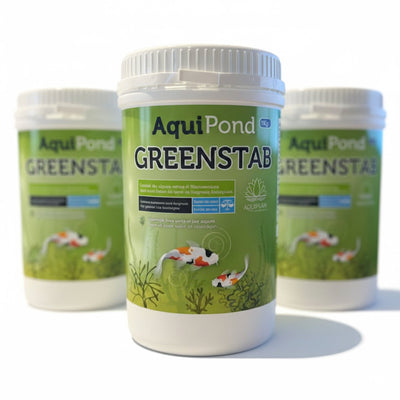 Aquipond Greenstab - Balanced pond water, limits algae
À partir de €38,45
 Aquipond Eco AlgControl 1kg barley straw straw (Max 5M³) / 100% natural barley to treat algae
€25,09
 Aquipond Bacto Maintenance 500G – 0.5 Kg - Maintenance Bacteria - Treats 5m³ throughout the season
€32,79
 Aquipond BactoClay - Montmorillonite clay 2 kg for koi ponds
€43,95
Voir le produit


Leave a comment