

How to treat algae in a pond sustainably? The best solutions for treating algae
Green water, filamentous algae, slippery surfaces, biofilm, organic deposits, or sludge on the bottom of the pond: these problems are often related. However, they cannot all be treated in the same way, and a solution that is effective in one pond is not necessarily effective in another.
Removing visible algae can quickly improve the pond’s appearance, but this is not always enough. If the water remains unstable, the bottom is loaded with organic matter, or filtration is not effective enough, the algae will gradually return.
For longer-lasting results, it is best to follow a complete method: test the water, rebalance the minerals if necessary, remove organic deposits, and then support the pond’s beneficial bacteria.
— The 4-step anti-algae method
- Test the water parameters.
- Stabilize GH, KH, and pH when necessary.
- Reduce algae, biofilm, and organic waste.
- Maintain the filtration system and pond with suitable bacteria.
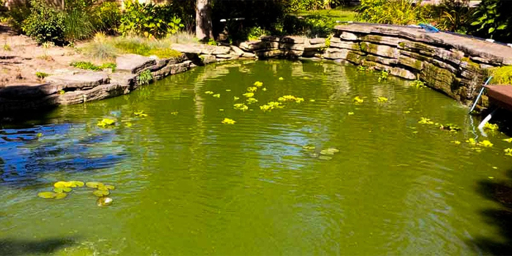
Why do algae appear in a pond?
Algae grow when several conditions come together: strong light, available nutrients, water loaded with organic matter, and sometimes insufficient filtration. They are therefore not always the main problem: they are often the visible sign of a pond accumulating waste or whose biological balance is becoming more fragile.
The most common causes are fallen leaves, pollen, fish waste, uneaten food, decomposing plants, an overcrowded pond, undersized filtration, or poorly circulated areas. Over time, this organic matter accumulates on the bottom, in the filter media, or on the surfaces.
This organic load gradually fuels a negative cycle: deposits turn into sludge, surfaces become more slippery, biofilm develops, and available nutrients encourage algae growth. The warmer the pond, the faster this process can become.
— Green water, filamentous algae, biofilm, or sludge: identifying the problem
- Green water is generally caused by suspended single-celled algae. Check sun exposure, nutrient levels, filtration capacity, and whether a UV unit is working properly.
- Filamentous algae cling to stones, plants, walls, and waterfalls. They are often encouraged by light, phosphates, nitrates, and the accumulation of organic waste.
- Biofilm forms a sometimes brown, green, or translucent layer on walls, liners, stones, and areas with little water movement.
- Sludge refers to the accumulation of leaves, excrement, leftover food, and plant debris that decompose at the bottom of the pond.
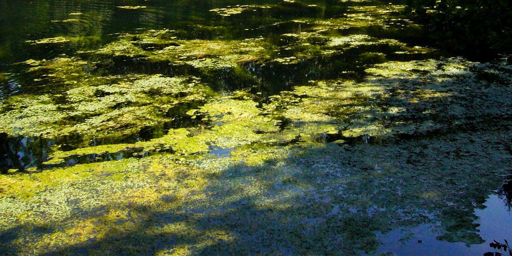
For further information
Read our guide filamentous algae in a pond: how to eliminate them.
READ THE ARTICLEKey point: clear water does not always guarantee a balanced pond. The condition of the bottom, walls, and filter, the smell of the water, and the behavior of the fish are also important indicators.
Step 1: analyze the water before any treatment
When faced with algae, the first instinct is often to look for an algae treatment. However, water analysis prevents treating a symptom without addressing its cause. It shows whether the water lacks minerals, whether the pH is unstable, or whether nutrients are too readily available.
Water analysis is particularly useful in spring, when restarting filtration, after heavy rainfall, after a major water change, after intensive filter cleaning, or as soon as algae become recurrent. Regular monitoring helps anticipate imbalances.
— Which parameters should be checked first?
pH indicates whether the water is acidic, neutral, or alkaline. Beyond a single reading, it is above all its stability that matters: significant fluctuations can weaken fish and disrupt biological filtration.
KH, or carbonate hardness, acts as a natural buffer. It helps limit pH fluctuations, particularly between day and night. GH, or total hardness, provides information in particular about the presence of calcium and magnesium.
Nitrites (NO2) and ammonia/ammonium (NH3/NH4) should be checked as a priority if the fish show signs of weakness or if filtration has been disrupted. Nitrates (NO3) and phosphates (PO4) should be monitored when algae return regularly.
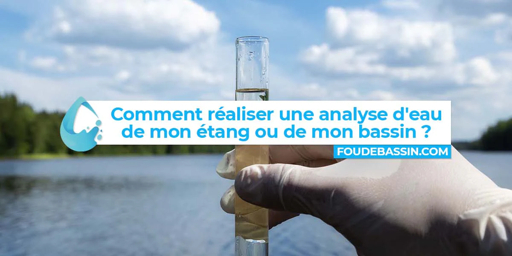
— Analyzing pond water
Test strips provide a quick check, while drop tests and analysis cases are better suited to a detailed diagnosis of pH, GH, KH, nitrites, nitrates, or phosphates.
VIEW WATER TESTS AND ANALYSIS KITS
An appropriate treatment always begins with an appropriate analysis.

Seasonal advice
Prepare for the warmer season with how to analyze pond water in spring.
READ THE ARTICLEStep 2: stabilize GH, KH, and pH through mineralization
Once the analysis has been completed, corrections should only be made when justified. Mineralization does not directly eliminate algae, but it helps create more stable water for fish, plants, bacteria, and biological filtration.
Pond water can gradually become depleted of minerals after repeated rainfall, the addition of fresh water, significant water changes, or simply over the course of the season.
— Understanding the role of GH, KH, and pH
A GH that is too low may indicate mineral-poor water. A KH that is too low increases the risk of pH fluctuations, particularly due to sunlight, algae, plants, and bacterial activity.
If the pH is unstable, avoid changing it abruptly. First check the KH, then the GH if necessary. Corrections should be gradual, with a new test after each addition.
You may also like
To correct carbonate hardness, see how to increase the KH of a pond or pool.
READ THE ARTICLEOptiminera
A comprehensive remineralization approach to favor when the goal is to improve the stability of pH, GH, and KH.
VIEW OPTIMINERAAquipond Minerall in One
A suitable solution when both GH and KH need to be increased, as part of a complete remineralization process.
VIEW MINERALL IN ONEWhen only the KH needs to be raised, a targeted solution such as Aquipond KH+ may be more appropriate than a general mineral supplement.
The right mineralizer depends on the test results: do not correct a parameter at random.
Step 3: reduce algae, biofilm, and organic deposits
Even with properly mineralized water, accumulated waste continues to feed algae. Leaves, excess food, excrement, and plant debris should also be removed as regularly as possible.
It is also important to control the filtration flow rate, check poorly circulated areas, and clean the filter media without removing all the beneficial bacteria. Cleaning solutions therefore do not replace routine maintenance.
— In what situations should you act on deposits?
- Filamentous algae take hold on stones, plants, or walls.
- The surfaces become visibly slippery and biofilm develops.
- The bottom of the pond contains a lot of plant debris and organic waste.
- The filtration system becomes clogged faster than usual.
- A lava-rock filter, a constructed wetland, a planted filter, or a poorly circulated area appears clogged.
— Two solutions depending on the cleaning required
Aquatic Science Biobooster+ is a solution to consider for helping reduce filamentous algae, organic waste, and light silt. Its action may cause certain materials to rise to the surface; this waste must then be removed with a net or via a skimmer.
Aquipond Boost & Clean offers a complementary approach, particularly suited to ponds with organic deposits, slippery walls, biofilm, or clogged filtration areas. Its active oxygen formula helps loosen certain deposits, encourages them to rise to the surface, and supports oxygenation in the most heavily loaded areas.
You may also like
To check your equipment, see how to tell whether your UV is still working.
READ THE ARTICLEAquatic Science Biobooster+
To act on filamentous algae, light silt, and organic waste, while supporting the pond’s biological activity.
VIEW BIOBOOSTER+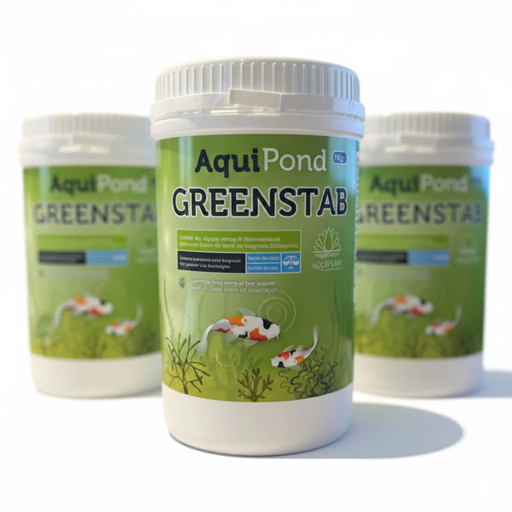
Aquipond Boost & Clean
To help loosen deposits, limit biofilm, and clean dirty areas of the pond, walls, or filtration system.
VIEW BOOST & CLEAN— Removing surfaced waste: an essential step
A treatment can help loosen and bring to the surface algae, light silt particles, biofilm fragments, or other organic waste. But for this action to be truly long-lasting, these elements must leave the pond.
Use a fine-mesh net to collect small floating debris, algae, plant residues, and particles brought to the surface. In ponds heavily exposed to leaves, pollen, or dust, a skimmer can complement this work.
Maintenance advice
Find the essential steps for maintaining a pond throughout the seasons.
READ THE ARTICLE— Remove waste with a suitable pond net
A fine-mesh net is recommended for collecting algae, biofilm fragments, fine leaves, and small floating debris. Wider meshes are better suited to collecting large debris or handling fish.
The treatment loosens some of the waste; a fine-mesh net allows you to remove it thoroughly.
Step 4: continue with maintenance bacteria
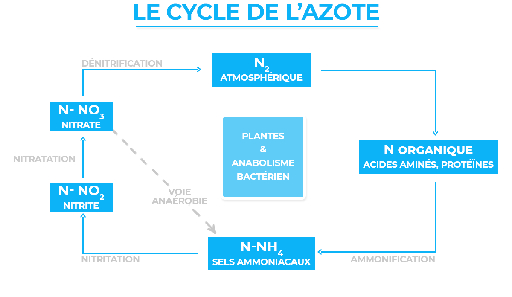
After cleaning and physically removing the waste, bacteria play an essential role in maintaining a more lasting balance. They do not replace filtration, aeration, or manual removal of deposits, but they help gradually process the remaining organic matter.
Beneficial bacteria contribute to the operation of biological filtration and support the natural decomposition of waste remaining in the pond. They therefore help limit the accumulation of nutrients available to algae.
— Why add bacteria after an algae treatment?
Cleaning removes some of the pollution, but organic matter always remains at the bottom, in the filter, and in less accessible areas of the pond. The bacteria can then take over and support its gradual decomposition.
They are particularly useful after winter, when restarting the filtration system, after cleaning the pond or filter, after adding fish, and during warm periods.
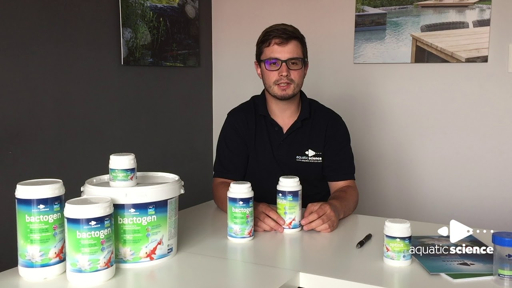
Aquatic Science Bactogen
A mixture of bacteria, enzymes, minerals, and trace elements intended for maintaining the pond and its biological filtration.
VIEW BACTOGEN BACTERIA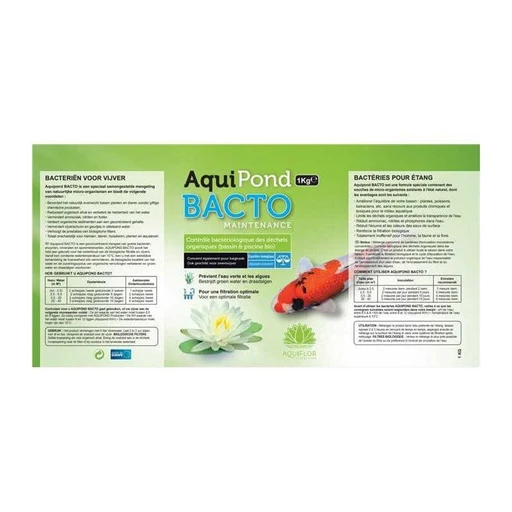
Aquipond Bacto Maintenance
A consistent maintenance solution after a cleaning phase, particularly after using Boost & Clean, to support bacterial activity throughout the season.
VIEW BACTO MAINTENANCEBest practices for limiting algae recurrence
- Regularly remove leaves, pollen, and floating debris.
- Feed fish carefully, without leaving uneaten food.
- Check the pump flow rate, water circulation, and filter condition.
- Increase aeration during hot periods or in heavily stocked ponds.
- Clean the filter media moderately to preserve beneficial bacteria.
- Regularly check the pH, GH, KH, nitrites, nitrates, and phosphates.
- Install suitable aquatic plants without allowing them to cover the entire surface and make it inaccessible.
- Plan regular bacterial maintenance when the temperature and activity level of the pond increase.
Which solution should you choose for the observed problem?
| Observed problem | Priority checks | Primary action | Solutions to consider |
|---|---|---|---|
| Green water | Filtration, UV, NO3, PO4, exposure | Reduce nutrients and optimize filtration | Water testing, appropriate UV, filter maintenance |
| String algae | NO3, PO4, waste, circulation | Reduce waste and remove algae | Biobooster+ or Aquipond Boost & Clean, fine-mesh net, bacteria |
| Slippery walls / biofilm | Organic deposits, circulation, filtration | Clean deposits and support oxygenation | Aquipond Boost & Clean, followed by Bacto Maintenance or Bactogen |
| Light sludge | Leaves, excrement, plant debris | Remove waste and support its decomposition | Biobooster+, bacteria, and mechanical maintenance |
| Unstable pH | KH, GH, rainwater, water changes | Rebalance hardness levels gradually | Optiminera, Minerall in One, or KH+ depending on the results |
| Filtration clogs quickly | Organic load, flow rate, filter media | Clean without destroying the filter’s biological balance | Boost & Clean or Biobooster+, followed by bacteria |
Treat algae without masking the imbalance
Algae are rarely an isolated problem. They often indicate water that is too rich in nutrients, accumulated waste, inadequate circulation, insufficient biological maintenance, or inadequate mineralization.
The most consistent approach is therefore to test the water, stabilize its hardness, reduce waste, remove it physically, and support filtration with suitable bacteria.
By combining these steps, the pond becomes easier to maintain, the walls stay cleaner, the bottom accumulates less buildup, and the risk of algae returning gradually decreases.
Leave a comment